
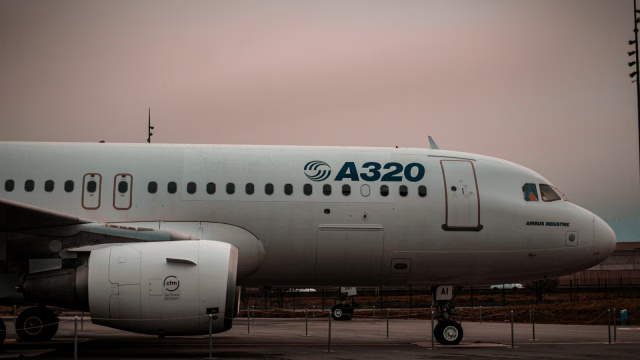
The world woke up to aviation chaos after Airbus took the extraordinary step of issuing a global recall for nearly 6,000 A320-family aircraft—the backbone of commercial aviation. The airline ordered an urgent software update on over 300 A320-family aircraft in India after a flight-control glitch linked to solar radiation.
A recall in aviation means every affected aircraft must stop flying immediately until a safety problem is repaired. And in this case, the order landed overnight like a shockwave.
From New York to New Delhi, from São Paulo to Singapore, airlines scrambled to rewrite flight schedules, ground jets, and warn millions of passengers of impending disruption.
The crisis began after a JetBlue-operated flight suffered a terrifying mid-air scare. A sudden, unexplained “uncommanded altitude drop” that forced pilots into an emergency descent.
Early investigations traced the incident to a software vulnerability, a flaw capable of corrupting the aircraft’s flight-control data under certain conditions. With evidence that this glitch could affect thousands of A320s worldwide, regulators and Airbus had no choice.
Within hours, more than half of the world’s A320 fleet, the single most widely used short-haul aircraft was ordered to remain on the ground until fixed. Just like that, the world’s most reliable workhorse was grounded in one of the largest aviation stoppages in history.
A Sudden Scare in Mid-Air Sparks a Global Emergency
What investigators discovered was even more alarming, a burst of intense solar radiation had interfered with the aircraft’s onboard computers, scrambling essential flight-control data.
For a fly-by-wire aircraft like the A320—where software mediates every movement from pitch to roll—the implications were terrifying. One corrupted line of code could mean unexpected loss of control with little time for pilots to react. This single incident was enough to trigger a worldwide grounding.
IndiGo and the Air India group are the major Indian operators of A320 family aircraft — A320, A319, and A321 — which form the bulk of India’s narrow-body aircraft fleet.
Why Safety Experts Are Alarmed
The recall landed at the worst possible time, just after a major global travel weekend. Airlines in India, Europe, the US, the Middle East, and Latin America cancelled or rerouted thousands of flights. Passengers faced hours-long queues, last-minute cancellations, and vanished travel plans.
The software patch itself is simple, most aircraft can be updated within a few hours. But the real problem is deeper since one-third of A320s need hardware modifications and these repairs could take days or even weeks.
As per data shared by the DGCA, a total of 338 Airbus A320 family aircraft of Indian airlines — IndiGo, Air India, and Air India Express — were identified as planes that required rectification action prescribed by Airbus late Friday.
The required action, which typically takes around two hours, has been completed on 189 of those aircraft as of 10 am Saturday.
According to the DGCA, the required rectification action should be completed on the remaining aircraft by around 5:30 am Sunday. Officials said that there was no need for passengers to panic as the impact on flight operations is not significant.
Former Fighter Pilot Sounds the Alarm
Amid the unfolding aviation crisis, MJ Augustine Vinod, a retired Group Captain, fighter pilot, airline captain and noted columnist took to X soon after news of the A320 grounding broke.
A man who has flown MiG-21s, Mirage-2000s and the Airbus A320, Vinod has long written about vulnerabilities in modern digital cockpits.
He posted a pointed reminder on X, “24 April 2022 — I warned this could happen. Intense solar radiation can mess with flight computers. What is happening to the Airbus A320 family… At that time I did flag it to all and sundry.”
He also referenced an article he wrote two years ago, detailing how high-altitude radiation events—rare but powerful—can cause bit-flips, sensor anomalies or transient glitches in highly computer-dependent aircraft systems.
Airbus vs Boeing
Boeing’s history with India is marked by some of the earliest and most high-profile aviation tragedies involving its aircraft. In the 1970s and 1980s, multiple fatal crashes involving Boeing jets occurred in Indian airspace—caused variously by weather, operational factors, and navigational issues.
These incidents did not stem from Boeing design flaws, but they did force the manufacturer and global regulators to rethink cockpit instrumentation clarity, crew training standards, terrain-awareness systems, and approach procedures in challenging geographies.
Decades later, Boeing faced a far more direct crisis as the the 737 MAX grounding. Software mismanagement, flawed assumptions and inadequate pilot training led to two catastrophic crashes—an event that shook global trust and grounded fleets worldwide for nearly two years.
Where Boeing stumbled over excessive reliance on a single automated system, Airbus now confronts the other edge of modern aviation—hyper-digitalisation.
This philosophy has made Airbus jets extraordinarily safe and fuel-efficient. But the A320 recall reveals the inherent risk: when software lies at the heart of every control surface, one corrupted data stream—whether triggered by radiation or a logic flaw—can compromise the whole aircraft.
Unlike Boeing’s MAX crisis, Airbus’s problem is not faulty design but the fragile nature of interconnected, code-heavy systems. As aircraft become flying supercomputers, their susceptibility to rare but powerful disruptions grows.
This is the burden Airbus now carries, which is to reassure airlines, passengers and regulators that digital supremacy does not mean digital vulnerability.
The recall has also reignited the long-running debate between the world’s two biggest aircraft makers—Airbus and Boeing—whose designs reflect fundamentally different philosophies.
Airbus has always believed in automation-first aviation, relying heavily on computer-controlled, fly-by-wire systems that prevent pilots from exceeding the aircraft’s limits.
Boeing, traditionally, has championed pilot-centric control, giving human judgment priority and using automated systems more sparingly. But the A320 software flaw and the earlier Boeing 737 MAX crisis show that both paths carry risk when critical systems misbehave.
Boeing’s past and Airbus’s present tells us that modern aviation runs on software as much as on metal.
Whether it is Boeing’s failure in overseeing automated stabilisation systems or Airbus’s sudden exposure to computer corruption under extreme radiation events, the lesson is identical:
And in an era where millions of travellers depend daily on the A320—the world’s most widely used short-haul aircraft—this recall has become more than a technical issue. It is a reminder that even the most trusted machines can falter when nature and technology collide.
A Wake-Up Call for Global Aviation
The A320 recall exposes a difficult truth that even the safest aircraft in the world can be undone by a vulnerability nobody anticipated.
If something as routine—and natural—as solar radiation can scramble critical systems, regulators and manufacturers face urgent questions:
- How rigorously is aviation software tested against extreme events?
- Are backups robust enough to withstand cosmic interference?
- Do pilots receive adequate training for software-driven anomalies?
For passengers, the crisis delivers a jarring reminder, that flying today depends on invisible systems—millions of lines of code that must perform perfectly, every time.
With thousands of jets grounded, airlines are racing to restore operations. Airbus teams are working around the clock to deploy fixes. Regulators are rewriting emergency guidelines. And millions of travellers are watching tickets, itineraries, and holiday plans unravel by the hour.
The A320 has long been the backbone of global aviation. But this crisis shows just how fragile that backbone can be when software, hardware, and nature collide.