



















The planned delivery of three AH-64E Apache Guardian attack helicopters to the Indian Army has taken an unexpected turn. The Antonov Airlines An-124 cargo aircraft transporting the helicopters to India returned to the United States with the rotorcraft still onboard, after a long stopover in the United Kingdom.
A Boeing spokesperson told The War Zone (TWZ) that the company was investigating “logistical issues” that interrupted the transportation process.
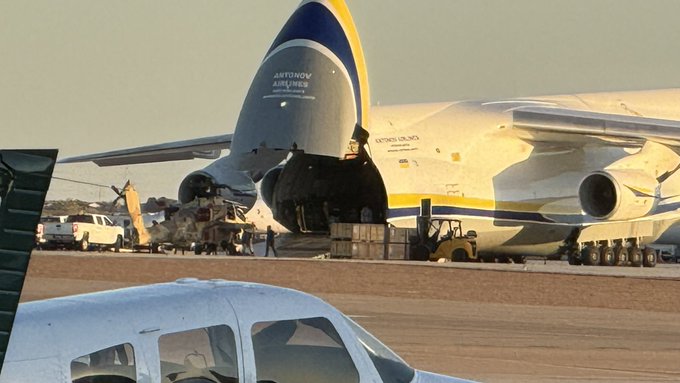
The unusual movements of the transport aircraft were first noted by plane spotter ‘KiwaSpotter’, who tracked the heavy-lift An-124, serial number UR-82008. The aircraft arrived at Mesa Gateway Airport in Arizona on October 30 after a flight from its home base in Leipzig, Germany.
The Apaches had been moved from Boeing’s nearby Mesa facility before being loaded onto the An-124. The transport aircraft then departed the United States on November 1 and flew to East Midlands Airport in England. Photos showed the helicopters already painted in their desert camouflage scheme for the Indian Army. At least one aircraft, serial number IA-7105, was identifiable.
The An-124 and its Apache cargo remained parked at the British airport for eight days before departing once again. However, instead of continuing toward India, the aircraft returned across the Atlantic to Mesa Gateway Airport, where it landed on November 8.
After returning to the United States, the Apaches were unloaded from the Antonov aircraft. Images showed the helicopters being towed on the ground with their rotor blades removed.
The Indian Army had already received its first batch of three AH-64E helicopters in July this year. This delivery was part of a total order for six aircraft, valued at $796 million. The agreement was signed in February 2020 during U.S. President Donald Trump’s visit to New Delhi.
The first three helicopters were flown to India aboard an Antonov Airlines An-124 transport aircraft and arrived at Air Force Station Hindon. At that time, India’s Minister of Defense, Rajnath Singh, said the new helicopters would strengthen the Army Aviation Corps’ operational capabilities, especially in difficult terrain conditions.
These first AH-64Es are currently being used for crew training at the Indian Army Aviation Training School in Nashik, Maharashtra. Once training is complete, the helicopters are expected to be deployed to the Nagtalao Army Aviation Base near Jodhpur, in northwestern India.
Had the latest batch of three Apaches arrived as scheduled, they would have completed the Indian Army’s order.
TWZ in its article said it has contacted Boeing for more information about the delay and the company issued the following statement:
“We are currently addressing logistical issues caused by external factors to complete the delivery process for the remaining aircraft. We remain closely engaged with the U.S. government and Indian Army and continue working to execute our contract as expeditiously as possible to meet India’s needs and fleet requirements.”
It remains unclear what exactly caused the transport problem. Boeing did not specify whether the issue was related to the Apaches themselves, the An-124 transport aircraft, or another factor involved in the transfer. The “logistical issues” could involve technical concerns, paperwork delays, or other administrative obstacles such as customs procedures. Some observers have also speculated that political or diplomatic factors might have interfered, although no formal explanation has been given.
India’s order for AH-64E helicopters covers two separate military branches. Previously, the Indian Air Force had purchased 22 Apaches, which have all been successfully delivered and are in service. The Indian Army’s smaller six-aircraft order marked its first direct acquisition of the type.
The current delay comes at a time when New Delhi has been expanding its defense purchases from the United States. Other major U.S.-made aircraft now in Indian service include the C-130J Hercules transport aircraft, the CH-47F Chinook heavy-lift helicopter, and the P-8I Neptune maritime patrol aircraft, which is the local variant of the P-8A Poseidon.
However, relations between the United States and India have faced new challenges. Following the Pahalgam terrorist attack in India earlier this year and subsequent military clashes with Pakistan, tensions grew between New Delhi and Washington. The Trump administration imposed a 50 percent tariff on Indian goods, on what they called as U.S. dissatisfaction with India’s ongoing purchases of Russian oil. These developments have led to public debate within India about the long-term reliability of the United States as a defense partner.
Though there were diplomatic strains, U.S.-made military hardware are helpful to modernize Indian Air force. The Apache Guardian is considered one of the most advanced attack helicopters in the world, equipped with modern sensors, weapon systems, and networking capabilities. For the Indian Army, the AH-64E represents a significant increase in combat power, particularly in the border regions where the Army faces potential threats from both Pakistan and China.
The delay in the latest shipment of Apaches has therefore drawn attention, given the Army’s need to strengthen its attack helicopter fleet as soon as possible.
Boeing has stated that it is working closely with both governments to resolve the transportation problems and complete the deliveries quickly. The company said it remains committed to meeting India’s defense requirements and expects to finalize the delivery of the remaining Apaches in the near future.