
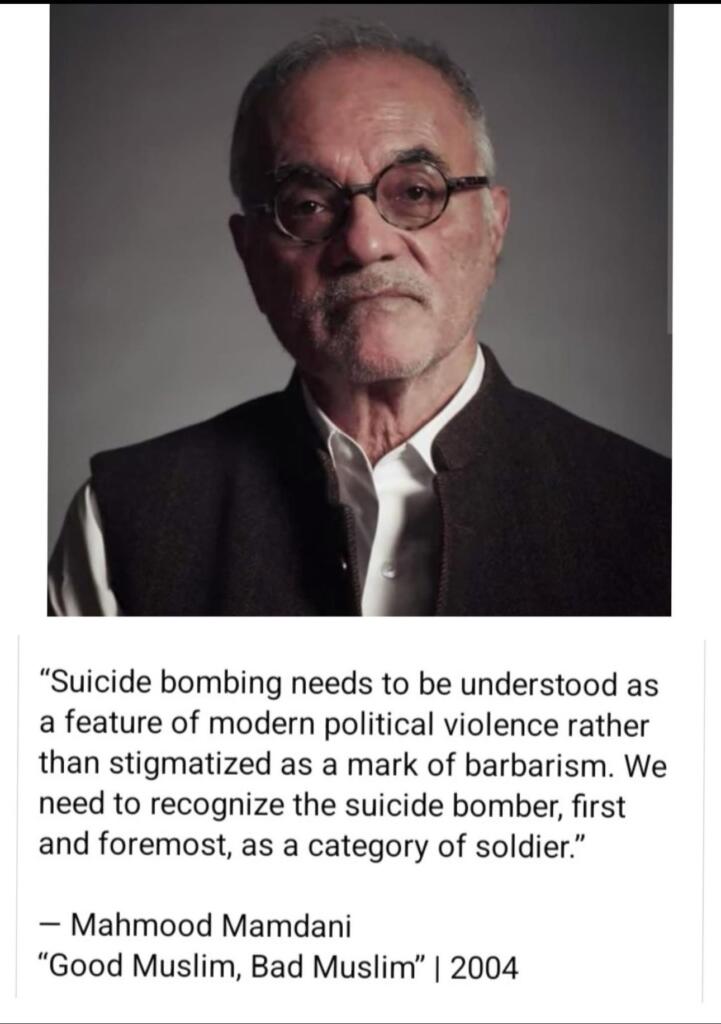
In contemporary political thought, few debates provoke as much discomfort as the academic treatment of terrorism—especially when scholars attempt to “contextualize” or “reinterpret” acts such as suicide bombing. A prominent example is the argument advanced by Kenyan-American academic Mahmood Mamdani, father of New York Assemblyman Zohran Mamdani. In his 2004 book Good Muslim, Bad Muslim, he wrote:
“Suicide bombing needs to be understood as a feature of modern political violence rather than stigmatized as a mark of barbarism. We need to recognize the suicide bomber, first and foremost, as a category of soldier.”
This line has been widely criticized for its willingness to reframe what is, in common moral understanding, suicide bombing – a deliberate act of mass murder as a normalized military tactic.
Though Mamdani does not condone violence and does not support terrorism, the intellectual move he makes—common among certain Marxist and post-colonial theorists—raises a deeper question: When does critical analysis of violence slip into a rhetorical whitewashing of terror?
This article argues that the Marxist-inflected intellectual tradition Mamdani draws from risks blurring that line, and in doing so, may unintentionally echo the justificatory logic used by violent actors—even though their actions differ completely.
The Problem With “Reframing” Suicide Bombers as Soldiers
Mamdani’s argument rests on a long-standing Marxist and post-colonial impulse: to locate violence in the broader structure of oppression and to understand insurgent acts as responses to colonial or imperial domination. The intention, in theory, is to explain—not excuse.
But the choice of framing matters. Calling an act of suicide bombing “a category of soldier” performs a subtle moral shift. Soldiers are understood as legitimate combatants operating under rules of war. Suicide bombers, by contrast, deliberately target civilians as an ideology of destruction.
To place both under the same conceptual umbrella risks softening the moral clarity society has painstakingly built around the protection of non-combatants.
This is where the critique of Marxist intellectualism enters. Marxist and neo-Marxist frameworks often emphasize structural violence—poverty, occupation, state force—over the agency of the perpetrator. In doing so, they run the risk of transforming the terrorist into a symptom, rather than a moral actor. At their worst, such frameworks can give the impression that the bomber’s choices are rational, justified, or inevitable.
This is not merely academic hair-splitting. The way elites talk about violence shapes public understanding of what is acceptable.
How Marxist Intellectualism Can Slide Into Whitewashing
The issue is not that Mahmood Mamdani supports terror—he does not. But the pattern his work participates in has consequences.
Marxist intellectuals who approach terrorism through the prism of anti-imperialist struggle often:
-
Shift moral blame away from the perpetrator and toward geopolitical conditions.
Structural analysis becomes a shield against moral evaluation. -
Normalize insurgent violence as a predictable response to oppression, flattening distinctions between self-defense and atrocity.
-
Reframe perpetrators as political actors with grievances, rather than individuals making ethically catastrophic decisions.
This is the form of whitewashing critics point to—not explicit support for terrorism, but a thinning of the moral boundary that society must preserve.
When suicide bombing is normalized as “a feature of modern political violence,” it ceases to be a horror and becomes merely another tactic in a repertoire. Such framing may not intend to legitimize terror, but it unmistakably dilutes the categorical condemnation that terrorism requires.
A Troubling Convergence of Standpoints: The Intellectual and the Violent Actor
It would be false and irresponsible to equate Mahmood Mamdani—a scholar and public intellectual—with a violent extremist like Umar, the accused in the Delhi blasts. Their actions, roles, and moral positions are worlds apart.
But there is a convergence in standpoint worth examining—not in deed, but in the logic each places at the center of violence.
-
The violent extremist claims his acts are part of a justified struggle.
-
The radical intellectual argues that such acts must be understood within larger systems of oppression.
One enacts violence; the other analyzes it.
Yet both position suicide bombing within a political rationality.
This is the dangerous overlap.
Not because the intellectual endorses the violence—he does not—but because the analytical framing can unintentionally mirror, sanitize, or even dignify the narrative that terrorists use to justify killing.
And this is where the threat to humanity lies:
When violent actors and intellectuals begin speaking in similar structural terms about the same acts, society risks losing its unambiguous condemnation of terror.
Why Moral Clarity Matters
A world in which suicide bombing becomes just another “feature” of political violence is a world that has surrendered its ethical anchor.
Academic analysis is necessary. Context matters. But when explanation begins to erode condemnation, a line has been crossed. Intellectuals have a responsibility not only to analyze but also to protect the moral boundaries that keep human life sacred.
Marxist frameworks, when applied to terrorism, often fail this test. Mahmood Mamdani’s statement is a revealing example of how high theory can slide, unintentionally, into a rhetorical normalization of brutality.
To preserve our shared humanity, suicide bombing must remain what it is:
a deliberate and indefensible attack on innocent life, never to be reframed, softened, or conceptualized into moral legitimacy.