
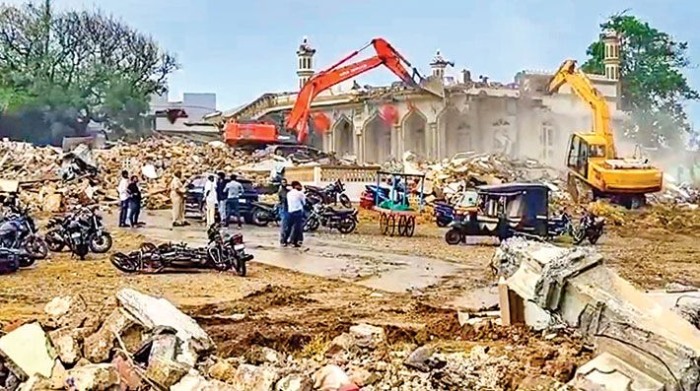
The events in Prabhas Patan, Gir Somnath, this November were more than just a local law-and-order incident — they once again brought into focus the troubling question of Faith’s uneasy relationship with lawful authority and civic order. What began as a routine demolition drive by Gujarat’s administration to reclaim government land spiraled into chaos, when a mob, led by members of a local Muslim group, violently resisted the removal of an illegal structure — a dargah built without authorization.
The confrontation, involving stone pelting, injured police personnel, and led to an FIR against a mob of around a hundred individuals, including several identified culprits. It was not the first such clash — nor is it likely to be the last. The recurring pattern of religious defiance, in which Islamic groups rally violently under the pretext of “protecting faith,” exposes a deep-rooted conflict between religious absolutism and the modern rule of law.
The Incident: Law Meets Resistance
On November 10, the administration of Gir Somnath district intensified its ongoing demolition drive targeting encroachments and illegal constructions near the sacred Somnath Temple — one of Hinduism’s holiest shrines. Among the structures slated for removal were 11 properties: shops, houses, and places of worship built on government land near Shankha Circle.
While the operation began smoothly, Violent Defiance of Law flared came in officials moved to demolish the unauthorized Hazrat Rangeela Shah Dargah. As the police arrived to enforce the demolition, a group of Muslim women in burqas, accompanied by children, stormed the site. They were joined by men from the locality, who quickly turned the protest violent.
Despite repeated appeals from officials to disperse peacefully, the crowd began pelting stones at the police. Inspector M.V. Patel and Head Constable Kuldeep Singh Parmar were among those injured in the attack. Forced to restore order or destabilise Islam’s Violent Defiance of Law , the police resorted to a mild lathi charge and fired three tear gas shells. The mob eventually scattered, leaving behind a trail of injuries, chaos, and renewed fear in an area sacred to millions of Hindus.
Lawful Action, Lawless Response
The Gujarat Police acted swiftly after the violence. An FIR was filed at the Prabhas Patan Police Station under multiple sections of the Bharatiya Nyaya Sanhita (BNS) — the reformed Indian penal law — including provisions relating to assaulting public servants, unlawful assembly, and obstruction of government duty.
Seventeen individuals have been identified and charged. Their names — including Rafiq Gadhia, Shabana Haroon Motia, Razia Hussain Kalwat, and others — feature prominently in the complaint lodged by Deputy Mamlatdar Ranjit Singh Kher. In addition, a case has been registered under Section 135 of the Gujarat Police Act, underscoring the administration’s intent to set a precedent that defiance of the law, no matter the religious pretext, will not be tolerated.
Video evidence of Violent Defiance of Law from the scene confirmed that around 80 to 100 people participated in the assault, with several women and children strategically placed in the front ranks to impede police action. This familiar tactic — using religious identity and family members as shields — mirrors methods observed in earlier communal flashpoints, from Delhi to Prayagraj.
Faith or Excuse for Anarchy?
The Somnath incident reignites a critical question: when religion becomes a cover for lawlessness, Violent Defiance of Law remains supreme, how can a secular democracy ensure order? The administration’s demolition drive was not aimed at any particular faith — it targeted illegal encroachments across communities. Yet, the resistance came solely from a section of the Muslim populace, for whom the unauthorized dargah became a symbol of defiance.
This reaction is not isolated. Across India, whenever the state attempts to enforce land laws or remove unauthorised religious structures, violent pushback often emanates from radical Muslim pockets driven by Islam’s Violent Defiance of Law. Be it in Uttar Pradesh, Delhi’s Shaheen Bagh, or Bengal’s Howrah, the pattern remains consistent — the invocation of religious victimhood, followed by organized resistance, often degenerating into stone pelting and arson.
The ideological undercurrent behind such incidents cannot be ignored. When religious identity is weaponized against constitutional authority. The recurring violent defense of unlawful acts under the garb of “faith” reveals a deeper socio-religious conditioning: a belief that divine law overrides civil law.
The Somnath Irony
That this incident unfolded in Somnath — the site of the historic temple repeatedly destroyed by Islam’s Violent Defiance of Law through Islamic invaders and symbolically rebuilt as an assertion of India’s civilizational resilience — adds a layer of tragic irony. The town that witnessed centuries of plunder under the banner of jihad once again saw a violent eruption linked to the same ethos of religious supremacy over law.
Modern India’s administrative machinery, however, responded with firmness and restraint. The police neither retaliated with excess force nor allowed the mob to dictate terms.
The Larger Lesson
The Gir Somnath violence underscores an uncomfortable truth: whenever the state seeks to enforce uniform law, sections of Islamist society perceive it as persecution. This manufactured victimhood narrative, amplified by online propaganda, erodes trust and emboldens radicalism.
The solution cannot lie in appeasement. It lies in uncompromising enforcement of the law — and in dismantling the culture of immunity that has for decades allowed religious groups to defy civic regulations. India’s secularism does not mean submission to intimidation in the name of faith. It means equal accountability under one legal system.