
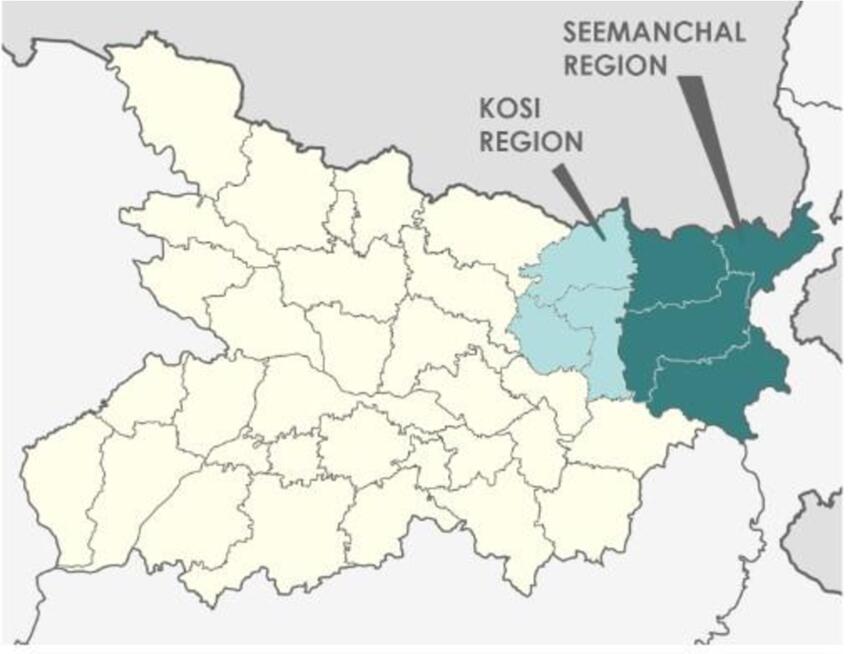
India’s founding fathers envisioned a republic where democracy would transcend divisions of caste, creed, and religion. The vote of one citizen was meant to be as powerful as the vote of another, regardless of faith. Yet, as the famous phrase goes, “Demography is destiny.” When changes of demography alter the balance of communities in specific regions, they inevitably reshape political power, social relations, and even national cohesion. What is unfolding in Seemanchal, Bihar, offers a sobering warning of how demographic imbalance can quietly erode the very foundation of Indian democracy.
Let’s take a Closer Look
Demography of Kishanganj, with a Muslim population of around 60%, has not elected a Hindu MLA since 1967. In Kochadhaman, where Muslims make up 72%, there has never been a Hindu MLA in the history of the constituency. Bahadurganj, with 68% Muslims, hasn’t had one for three decades; Amour, with roughly 70%, for forty years. These are not isolated figures — they reflect a pattern where entire communities lose political representation, voice, and visibility once they become minorities in their own homeland.
This raises uncomfortable but essential questions. Why do India’s self-proclaimed champions of secularism stay silent on the disenfranchisement of Hindu minorities in such districts? Why are minority rights invoked only when they concern one side of the division of demography? Democracy cannot survive if it turns into a numbers game where the majority in each pocket decides who deserves representation and who can be ignored. Yet that is exactly what is happening in these regions.
The principle of secularism must protect every community, not selectively empower some while silencing others. When political representation becomes permanently lopsided, democracy loses its moral balance. The Seemanchal example shows how demography, when left unchecked or manipulated through migration, religious conversion, or differential fertility rates, can reshape constituencies in ways that make genuine political competition impossible. Over time, this breeds alienation and resentment — fertile ground for social unrest.
The tragedy is that India’s political class often looks away. Parties dependent on vote banks see demographic shifts as electoral opportunities, not national challenges. Bureaucrats avoid the topic of demography for fear of being branded communal. Intellectuals dismiss the issue as “fear-mongering.” In this silence, however, lies the seed of future conflict. When one community’s growing numbers translate into permanent political dominance in a region, others begin to feel unwelcome in their own homes. What starts as quiet marginalization can end as mass migration or even violence — as seen in parts of Kashmir, Assam, and Bengal in different eras.
To call attention to these demographic patterns is not to attack any religion. It is to defend the secular, plural fabric of India. A truly inclusive democracy demands that no group — Hindu, Muslim, Christian, or otherwise — feels voiceless. The danger lies in pretending that numbers don’t matter. Numbers determine who wins elections, who controls local administrations, whose schools receive funding, and whose neighborhoods get neglected. Demography directly shapes access to opportunity.
If we ignore such demographic realities, India risks walking into a future of fractured sovereignties — pockets where the national political consensus no longer applies. Already, regions like Seemanchal are economically backward, with some of the poorest literacy rates in India. When political representation also becomes mono-communal, these districts become isolated from the mainstream of development. The majority in those regions may thrive politically, but the region as a whole suffers economically because diversity — the true engine of innovation and competition — disappears.
Moreover, demographic imbalance has a multiplier effect. When communities lose confidence that the democratic system can protect their interests, they withdraw from civic life. They stop voting, investing, or even sending their children to public schools dominated by another community. Such disengagement hollows out democracy from within, leaving only the shell of elections without the spirit of equality.
The real challenge, then, is to restore balance — not by suppressing one group, but by ensuring fairness to all. Political parties should promote cross-community candidates who can represent everyone. The Election Commission can periodically review constituency boundaries to prevent demographic monopolies from turning permanent. Governments must invest equally in the social and economic upliftment of all communities, ensuring that one group’s growth does not come at the cost of another’s exclusion.
If India fails to address this silent drift, the consequences could be suicidal for the entire nation. A democracy divided along religious lines cannot survive indefinitely; it either fragments politically or collapses morally. Seemanchal is not just a local story — it is a warning signal for the republic. Demography, once ignored, has the power to turn destiny. And in a democracy, that destiny can determine whether we remain united citizens — or fractured communities watching the promise of India fade away.