
Introduction
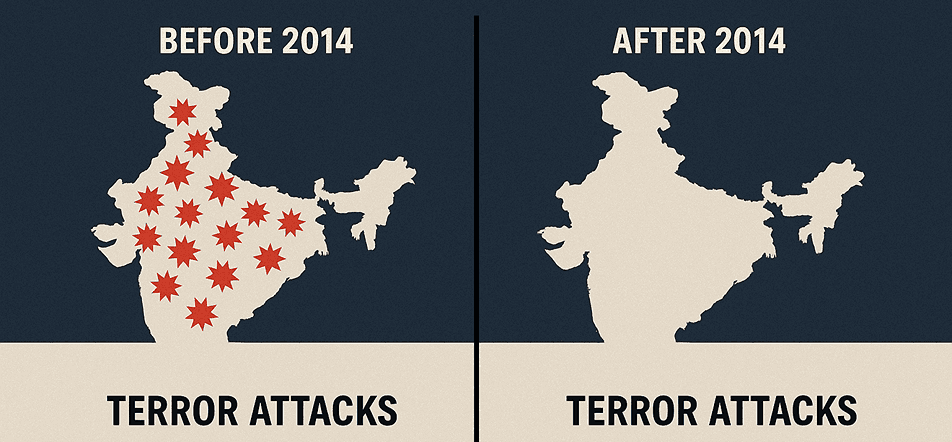
There’s a strange pattern in Indian politics: when terror attacks were frequent under Congress, the outrage was muffled; now that they’ve drastically reduced under the BJP, the same old critics are shouting louder than ever. It’s almost as if stability itself has become a problem — at least for those who thrive on blaming the government. But proven facts do confirm that post-2014 India’s Security Record overwhelms previous decades to a large extent.
The contrast between the Congress years, when India lived through one terror headline after another, and the BJP era, where major attacks have sharply declined, is too obvious to ignore. Yet, the so-called “liberal” and leftist sections of the commentariat continue to accuse the government of “failing on security” or “politicizing nationalism.” Ironically, they are more uncomfortable with the absence of attacks than they ever were with the tragedy of their frequency.
The Congress Years: A Decade of Blood and Helplessness
Let’s not rewrite history but check the period. From the 1993 Mumbai serial blasts to the 2008 26/11 attacks, India’s Security Record under Congress governments was marked by repeated, devastating terrorist strikes. Every few months, bombs ripped through markets, trains, and hotels. The nation grieved, the government condemned, and the cycle repeated.
Yes, intelligence failures and gaps in coordination were part of the problem. But the deeper issue was the mindset — a policy of endless “restraint.” After the 26/11 Mumbai attacks, when terrorists from across the border held the financial capital hostage for three days, India didn’t retaliate militarily. It sent dossiers. That wasn’t peacekeeping; it was paralysis disguised as diplomacy.
This era of “tolerance” toward terror did little to deter India’s enemies. If anything, it emboldened them. Cross-border terror networks saw India as a soft target — a country that would absorb the blows and move on.
The BJP Approach: From Dossiers to Deterrence
Enter 2014. The BJP’s rise to power came with a promise: enough is enough. Terror would not be met with empty statements but with consequences. And within just a few years, the difference on India’s Security Record was visible.
The 2016 Uri attack was a test. The response — surgical strikes inside Pakistani territory — changed the rules of engagement. When Pulwama happened in 2019, India didn’t just retaliate; it struck deep into Balakot. The message was unmistakable: this is a new India, one that hits back.
Critics can debate the long-term strategy, but they cannot deny the results. Large-scale terror attacks on civilian targets outside conflict zones have dramatically declined. Intelligence networks have improved, coordination between agencies is tighter, and the fear that once defined urban India has lessened.
For the first time in decades, India’s enemies are uncertain about the cost of their actions — and that’s precisely what deterrence is supposed to achieve.
The Left’s Selective Outrage
So why does the left still blame the government? The answer lies not in facts but in politics.
The left ecosystem — from intellectual circles to sections of the media — has a peculiar discomfort with a strong state narrative. When the BJP talks of proven India’s Security Record and national security, it’s branded as “hyper-nationalism.” When it strikes back, it’s accused of “warmongering.” And when terror incidents fall, the same critics suddenly pivot to a different script: “What about internal harmony?”
This shifting goalpost isn’t analysis; it’s political opportunism.
The same voices that once demanded “decisive action” against Pakistan now dismiss military responses as “theatrics.” Their real problem isn’t the government’s failure — it’s its success. A strong, confident India undercuts the moral superiority of their old narratives.
And so, the government is blamed not for attacks, but for preventing them “too aggressively.”
Hypocrisy of Blame Without Accountability
Under Congress, terrorism was a tragedy. Under BJP, it’s a “talking point.” That’s the hypocrisy of our political culture.
When 26/11 happened and India’s Security Record was indeed at stake, there was no demand for resignations. No intellectual wrote essays blaming “policy paralysis.” But when India retaliated after Uri, the same commentators questioned satellite images, casualty figures, and the authenticity of the strikes — not the actions of terrorists.
Somehow, skepticism is always reserved for our own forces, never for our enemies. This mindset doesn’t stem from ideology; it comes from a decades-old habit of undermining anything that reflects national strength when it’s politically inconvenient.
Security and the Politics of Denial
The left’s criticism also reveals its confusion about what security means. For them, the real “threats” are debates on nationalism or the rise of assertive patriotism — not the men with guns across the border.
They conflate domestic political disagreements with terrorism, diluting the seriousness of national security. While it’s fair to discuss social harmony or civil rights, using those issues to downplay ascending India’s Security Record in counterterrorism is intellectually dishonest.
It’s not that the BJP government is perfect. No government is. But refusing to acknowledge a reduction in terror attacks because it doesn’t fit your political comfort zone is willful blindness.
Conclusion: Time to Call Out the Double Standards
Facts matter. Under Congress, India faced frequent, large-scale terror attacks with little deterrence. Under BJP, despite a few tragic incidents, the scale and frequency have fallen sharply. The difference isn’t accidental — it’s the result of a tougher, more proactive doctrine.
Yet, the left and sections of the opposition remain locked in a cycle of denial. They can’t admit that a government they oppose has delivered stability and made India’s Security Record almost enviable. So, they twist the narrative, equating assertiveness with aggression and calling strength “polarization.”
But the Indian public sees through this. They remember what it was like to live in fear of the next explosion — and they know that, for all its flaws, today’s India stands stronger, safer, and more decisive.
At some point, credit must be given where it’s due. The real question is not why the BJP is praised for improving security — it’s why so many refuse to celebrate India’s safety unless it helps their politics.