
A cleaner, more sustainable future does not start in big factories or state-of-the-art recycling plants; it starts at the waste bin. As the global community engages with how to use and dispose of materials, the circular economy has become a model for progress. Where the old take-make-waste linear model sees resources wasted, the circular economy strives to keep materials in use for as long as possible through reuse, repair, and recycling. At the core of this lies one simple action: source segregation of waste.
Recycling becomes expensive and hard to do when waste is all mixed together. By sorting waste properly, material reaches respective material recycling or recovery centres in optimal condition. That is where colour code dustbins come into the picture – low cost, but effective. And with a uniform system for all kinds of waste, segregation is intuitive, efficient, and scalable across homes, offices, institutions, and public spaces.
This post discusses the role of colour coding in waste-collecting dustbins and how it improves the circular economy.
What is a Colour Code Dustbin?
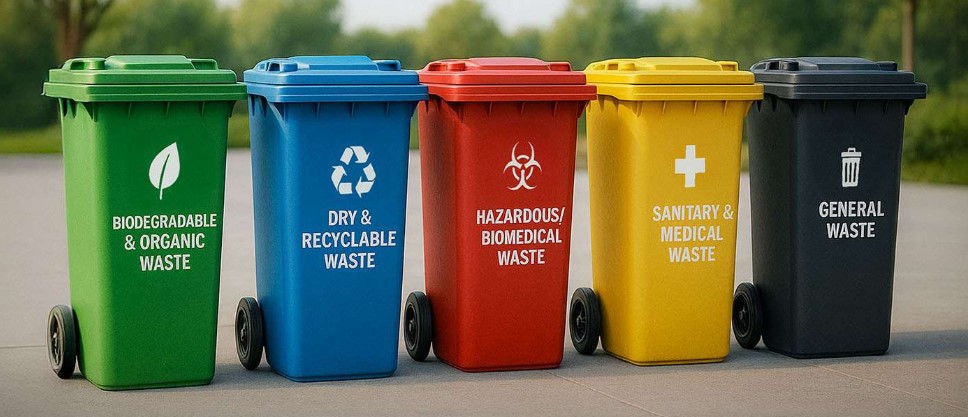
A colour code dustbin follows the visually guided waste sorting system, in which storage bins are assigned colours according to the types of waste. In India, there are different colour codes of dustbins which are frequently adopted:
1. Green
This colour involves organic or compostable waste, including food scraps and garden waste.
2. Blue
It includes dry recyclable materials such as paper, plastic, metal, and cardboard.
3. Red
Red indicates the dumping of hazardous items like sanitary products, batteries, paints, and chemicals.
4. Yellow
Yellow is for biomedical or infectious materials being used in hospitals.
They serve as universal visual signals, easy to comprehend even without the use of language or being able to read. There is indeed a colour code dustbin system at the house and business level to keep waste management practices consistent and with little crossover or contamination.
These standardised systems are increasingly being seen in public waste bins, school compounds, airports, banks, and shopping malls, including industry and gated housing societies.
The Role of Colour Coding in the Circular Economy
Through the use of coloured dustbins, several benefits may be derived:
1. Improved Material Segregation
Source segregation ensures recyclables are clean and ready to go as soon as they are processed.
2. Lower Contamination
Recyclables are often contaminated with mixed garbage, requiring more sorting and increasing the need for landfills. Thus, proper separation results in a significant reduction in contamination.
3. Enhanced Recovery of Recoverable Materials
High-value materials, such as plastics, metals, glass, and paper, can be broken down and turned into new goods, rather than relying on virgin resources.
4. Promotes Composting and Soil Health
Green bins hold scraps of organic waste that are hauled away and composted for productive use to enrich the soil of farms and gardens.
5. Environmental Education
A simple act of choosing the right bin fosters sustainability at the individual and community levels.
All of these outcomes lead to a stronger circular economy by extending product and material lifecycles.
From Waste to Resource: A Journey Initiated by Colour Coding
The smart cycle of waste turned into a resource is sustainable:
Grbage → Collecting → Separating → Recycling → Processing → Reusing
Colour coding is used to achieve faster and resource-efficient processing at each level. Plastics, for instance, that are tossed into the blue bin remain cleaner, therefore requiring less removal of contaminants and processing to turn into recycled granules for use in making something else, be it packaging or textiles. In fact, companies like Banyan Nation are already doing that; they are upcycling plastic waste into quality recycled plastics.
There is also widespread source segregation done by the municipalities and authorised recyclers for better efficiency. And the more we move the right waste to the right facility, the more efficient and sustainable the system becomes.
Challenges in Colour-Coded Waste Segregation
Although there is no denying that great strides have been made, several issues continue to affect large-scale adoption:
1. Awareness Gap
Most people do not know what a colour code dustbin means or why it is important.
2. Mismanagement of Dumping
Negligence or improper surveillance results in a mix of waste.
3. Collection Issues
Segregated waste can get mixed during transit.
4. Infrastructure Limitations
Not all areas have recycling or composting facilities that can handle sorted waste.
If we are to realise the true power of colour code dustbins, these barriers need to be tackled together.
Practical Strategies to Improve Adoption
There are a few more things that can speed up your results:
1. Education and Outreach
Efforts should be made to create an awareness about the segregation of waste at schools, corporations, and other public places, for it to become a common habit.
2. Clear Labels and Easy Bin Design
Icons, multilingual text, and bin placement strategies nudge people to make the right decision.
3. Collectors’ Involvement
Importantly, it is the waste workers who are key. They can keep segregation in place at the collection where they have been appropriately trained and incentivised.
4. Reward Systems
Incentives such as a rebate, recognition, or point systems can motivate households and businesses to get on board with the right thing.
5. Collaborations and EPR Compliance
Extended Producer Responsibility (EPR) allows brands to act on collection and recycling, moving toward a closed-loop waste regime.
Thus, following the above strategies increases adoption and maintains the consistency of the colour code dustbin model everywhere.
The Role Businesses and Brands Can Play in the Circular Economy
A circular economy works when companies rethink their processes to minimise waste and maximise recycled input materials. Companies can contribute by:
- Implementing take-back or drop-off recycling programs.
2. Higher use of recycled content in products.
3. Creating consumer awareness campaigns.
4. Supporting recycling supply chains through EPR schemes.
Branding of the circular economy allows businesses to demonstrate that they care about being sustainable and also benefit economically from resource recovery.
Conclusion
Colour code dustbins and segregation demonstrate that huge environmental changes can be done through small steps. A colour code dustbin system ensures the waste sorting is intuitive, contributing to resource recovery. Companies such as Banyan Nation have shown that there is, in fact, a vigorous, looped economy at work where things are being recycled, reused, and eventually gain value rather than becoming waste. It is in the bin that we clean up the planet. So, let us select the correct dustbin, use the correct bin every time, and assist in empowering a circular economy from our spaces.