


















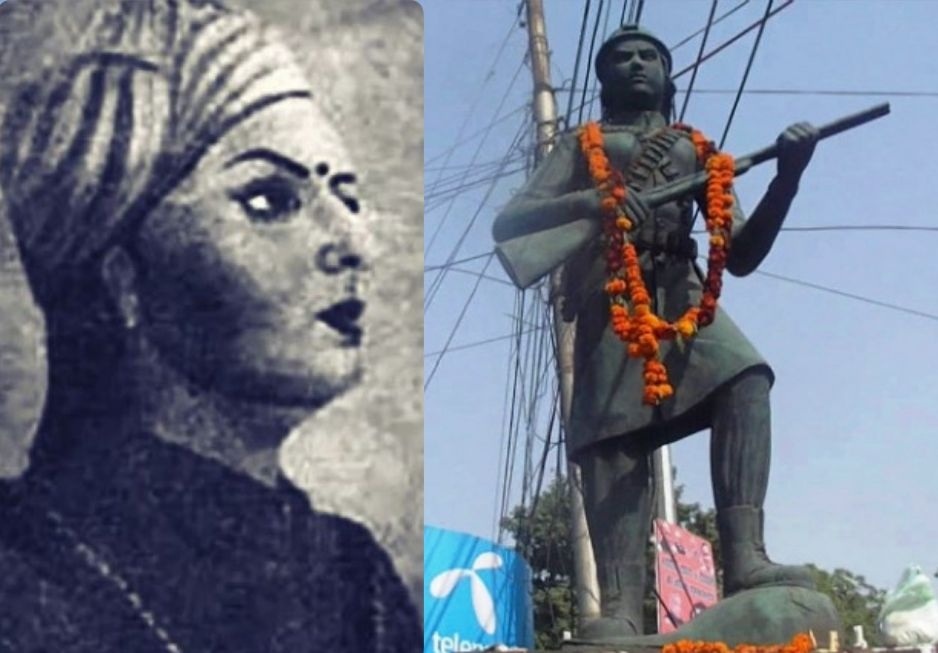
India commemorates the brave sacrifice of Veerangana Uda Devi Pasi on November 16 each year, a name that resounds with courage, resistance, and the assertion of Dalit and women’s identity.
More than a warrior, she was a blazing symbol of defiance in the Revolt of 1857—an indomitable fighter who stood tall against the British at Lucknow’s Sikandar Bagh, where she laid down her life for freedom.
The history of India’s freedom movement is etched with the sacrifices of countless heroes. The First War of Independence—1857—records legendary figures such as Bahadur Shah Zafar, Nana Sahib, Rani Lakshmibai of Jhansi, Tatya Tope, Begum Hazrat Mahal, and Mangal Pandey.
Among these towering personalities stands the remarkable Uda Devi Pasi, whose bravery and leadership continue to live in collective memory.
Uda Devi was not just a fighter; she was a symbol of Dalit pride and womanhood, a beacon of resistance who challenged colonial might on 16 November 1857 during the historic battle at Sikandar Bagh in Lucknow.
The nation salutes and pays tribute to her as a true “freedom fighter and veerangana.”
A Woman Who Chose Courage Over Circumstance
The heart of the revolt lay in northern India, and in Lucknow—the capital of Awadh—where Begum Hazrat Mahal raised the banner of rebellion after Nawab Wajid Ali Shah was sent to Calcutta. Uda Devi became the head of Begum Hazrat Mahal’s women’s battalion, playing a crucial role in this uprising.
Born on 30 June in Ujriyanv village near Lucknow, Uda Devi belonged to the Pasi community, the second-largest Scheduled Caste group in Uttar Pradesh. Records alternately cite 1829 or 1830 as her birth year.
An only child, she married Makka Pasi, a soldier in Nawab Wajid Ali Shah’s army. Makka Pasi was martyred on 10 June 1857 while fighting the British near Chinhat, close to Lucknow.
His death strengthened Uda Devi’s resolve and she vowed to avenge him—and fate brought her to Sikandar Bagh, where she fulfilled that pledge.
Historian Rajkumar, in his book Aadhunik Pasi Samaj Ka Itihas, recounts her remarkable role.
The Battle of Sikandar Bagh: A Fierce Stand
The battle of Sikandar Bagh remains one of the fiercest episodes of the 1857 uprising. When the British forces advanced to reclaim Lucknow, Uda Devi and her women’s regiment took charge of defending the fortification.
Professor Badri Narayan, in his research on subaltern communities of North India, writes about her extraordinary contribution in his work Dalit Veeranganayein Evam Mukti Ki Chaah.
Even British officers and journalists noted her bravery. In her article “1857 ki Veeranganayein, Jinhें Bhula Diya Gaya,” Rana Safvi cites Sergeant Forbes Mitchell’s book Reminiscences of the Great Mutiny, describing how Uda Devi perched atop a large pipal tree and shot down several British soldiers before attaining martyrdom.
A Legacy Revived: Symbol of Dalit Assertion and Social Justice
Colonial historiography long ignored heroes like Uda Devi. Though absent in mainstream texts, she lived on in folk songs, oral narratives, and community memory. Today she stands tall as an icon of Bahujan identity and Dalit assertion.
Her bravery is still sung across Uttar Pradesh in local ballads—“कोई उनको हब्शी कहता, कोई कहता नीच अछूत, अबला कोई उन्हें बतलाए, कोई कहे उन्हें मजबूत.
लखनऊ की धरती लाल हुई, जब पासिन ने बंदूक उठाई. अंग्रेज सिपाही कांप उठे, जब उदादेवी ने गोली चलाई.”
The ballad dedicated to Uda Devi captures not just her bravery, but also the deep social and political meanings attached to her life. Each line reflects the layered reality she lived through—as a Dalit woman, a rebel, and a freedom fighter.
Uda Devi defied every social label placed upon her. She rose above caste, color, and gender discrimination to claim a place in history through her own strength. By lifting a rifle and stepping onto the battlefield, Uda Devi shattered social barriers that tried to restrict Dalit women to the margins of society.
This folk ballad is more than a tribute—it is a powerful document of remembrance as it preserves her Dalit identity with pride. It challenges both colonial narratives and casteist histories, celebrates her defiance of social expectations and anchors her legacy in community consciousness.
In contemporary Indian politics, her name has been restored as a symbol of social justice, equality, and resistance. Both the Pasi community and the larger Dalit movement honour her as “Veerangana Uda Devi.”
Uttar Pradesh observes 30 June as her birth anniversary and 16 November as “Uda Devi Shaheed Diwas.” These commemorations are more than remembrance; they are a revival of a community’s historic identity.
Uda Devi Pasi’s story is not just the tale of an individual’s courage—it is the reclaiming of a legacy that colonial narratives once tried to erase.