














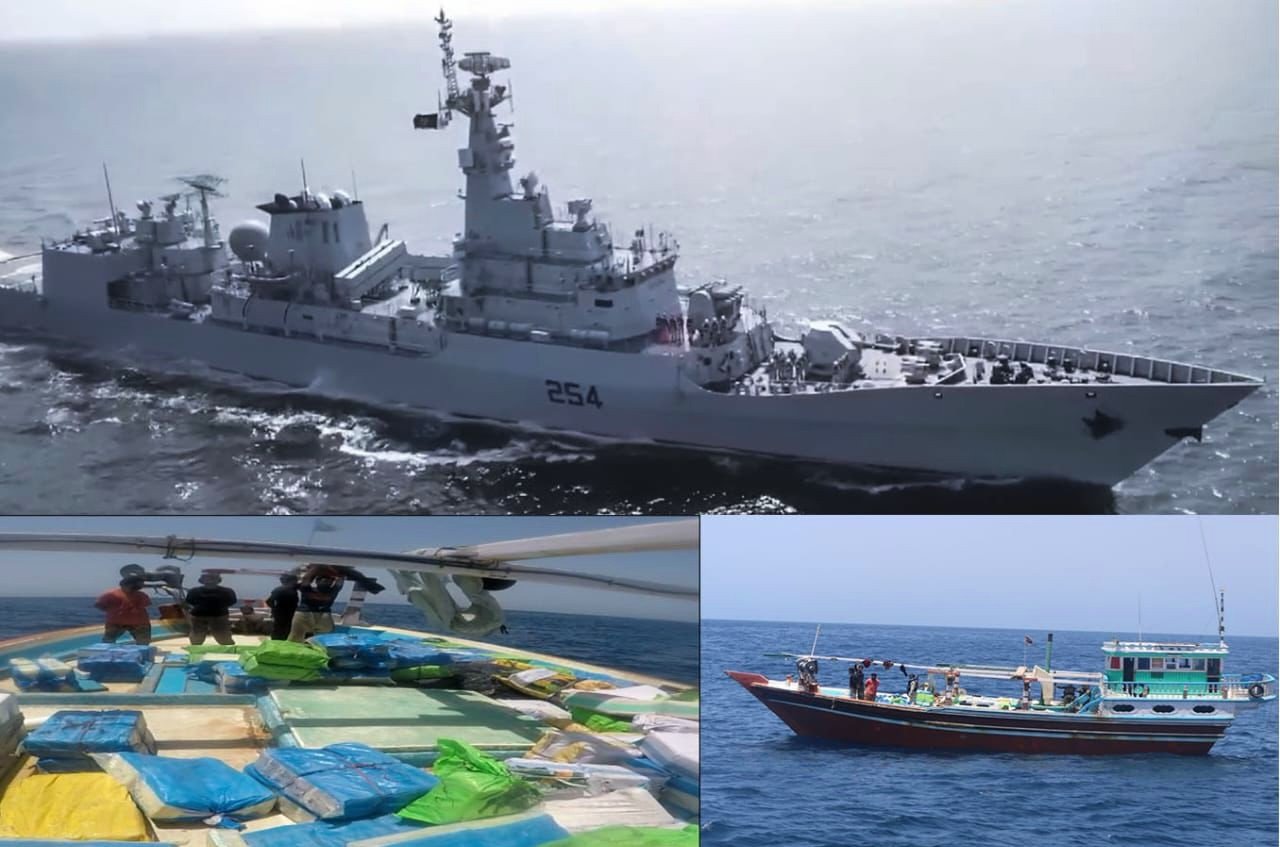
The blunt truth is that Pakistan’s drug war is heavy on theatre and light on results. The photos displaying neat stacks of crystal meth, heroin and hashish spread across a ship’s deck and masked commandos coupled with stern officials at a press conference are always ready. The message conveyed is that Pakistan is taking action. But when the cameras leave, the legal cases wobble, the financiers vanish and the core networks carry on. This is not an accident. It is a design. Pakistan has built a “safe exit” corridor, where a system where high-visibility interdictions project compliance to the world while leaving the real machinery of the trade largely untouched.
Start at sea. Maritime taskforces and the Pakistan Navy are good at catching stateless dhows in the Arabian Sea and the Gulf of Oman. The seizures are real and often large. They also come in clusters at sensitive political moments. Big shows of force have a habit of appearing around key international reviews, crisis loans or moments of diplomatic pressure. Correlation is not proof but the pattern is useful. It allows Islamabad to signal cooperation to the Financial Action Task Force, the IMF and powerful allies without taking on the deeper risks that come with targeting the people who finance, supply and protect the trade.
Move ashore and the spectacle fades. The chain of custody such as the basic paperwork that proves what was seized, how it was sealed, where it was stored and how it was tested is the spine of any narcotics case. Break that chain and the case collapses. Pakistan’s courts have made this point repeatedly. The standard is strict, as it should be given the penalties. Yet case after case fails on these simple steps–seals not accounted for, samples not tracked, labs not compliant and witnesses unprepared.
This is where the “safe exit” logic becomes visible. At sea, seizures deliver instant headlines and foreign applause. In court, poor evidence handling and thin investigation create the exit ramp. The crew is punished when the record is strong and the case is thrown out when it is not. The result is a system that is very good at removing photo-worthy piles of drugs and very poor at dismantling the organisations that paid for the chemicals, arranged the logistics, greased the permits and insured the risk.
There is also a wider political economy to consider. Pakistan needs investment, debt relief and diplomatic cover. Gwadar, the free zone and the wider China-Pakistan Economic Corridor are promoted as strategic crown jewels. In such a setting, enforcement tends to favour the visible and limit the disruptive. That does not mean zone operators or foreign investors are complicit. It means the state is cautious about actions that might spook capital or upset powerful friends. Maritime interdictions harm nobody with clout. Financial investigations that identify beneficial owners, seize accounts and test political patronage do.
It is tempting to say the answer is simply “do more raids.” That misses the point. Pakistan does plenty of raids. The problem is what happens before and after. Before the raid, there is often no top-down investigation that follows the money, maps company structures, or traces links between brokers, labs and logistics. After the raid, there is often weak paperwork, patchy forensics and a case file that looks strong on quantity but fragile on procedure. The state spends its energy on the most public step, which is the seizure and not on the quiet graft of building a prosecution that can survive a courtroom.
If the aim is results rather than headlines, it might help to tilt enforcement towards power instead of performance. A good place to start could be evidence handling. Treating seals, exhibit logs, transport and laboratory protocols as consistent nationwide standards would likely reduce avoidable errors. A simple monthly audit, showing how many files meet best practice, how many fall short, and why, could nudge practice in the right direction. In the end, the procedure tends to decide convictions.
It may also be useful to link major maritime seizures to financial inquiries as a default. Freezing accounts, pulling phone and shipping records, and tracing who paid for fuel, crew, satellite phones and insurance could help move cases up the chain. If a much-publicised haul does not lead to a broader case within six to twelve months, it might be worth asking whether the effort is drifting towards theatre rather than impact.
Public reporting could shift from tonnage to outcomes. Instead of only listing kilograms and “street value”, authorities might publish figures for indictments and convictions, and note how many mid-tier brokers or financiers are charged, broken down by province and court. That kind of visibility often shapes behaviour. In the same spirit, incentives could be adjusted so that units are recognised not just for large seizures, but for clean chains of custody and successful prosecutions. Quiet case-builders such as investigators, analysts and forensic accountants might deserve as much credit as boarding teams.
Interdictions do matter and they may matter most when they begin a chain that ends with accountable people, seized assets and reduced capacity rather than another picture for the evening news.
(Shashwat Gupta Ray is a multiple award-winning defence and strategic affairs journalist with over 20 years of experience in print and digital media. Previously Deputy Editor at Herald Group of Publications and Resident Editor at Gomantak Times, he has extensively covered major events, including the 26/11 Mumbai terror attacks and Maoist insurgencies. He is also the creator of the award-winning YouTube channel Uncovering India, which focuses on impactful social and developmental documentaries.)