
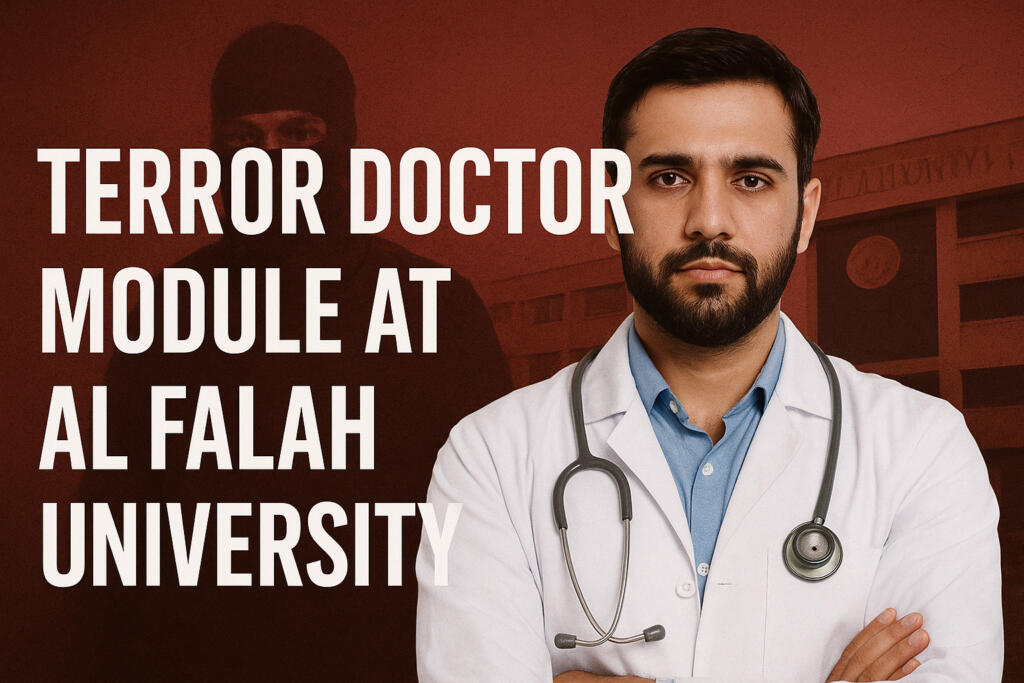
In a shocking revelation that has sent ripples through India’s academic and security establishments, investigators have unearthed a chilling radical network operating out of Al Falah University and Medical College in Faridabad, Haryana. What makes this case particularly alarming is not just the link to the recent Delhi car blast, but the fact that the alleged masterminds and operatives were not uneducated extremists — they were doctors. Men and women trained to heal, now accused of plotting destruction.
The investigation into the Delhi car blast has exposed what officials are calling a “terror doctor module”, a sophisticated radical network of radicalized medical professionals who allegedly used their academic positions and social respectability to mask extremist operations. This disturbing development has forced law enforcement to widen their probe into how deep-rooted radicalization has become — even within institutions meant to symbolize education, healing, and service.
The Spark: Delhi Car Blast and the DNA Link
The breakthrough came when investigators traced the Hyundai i20 car used in the Delhi blast to a man identified as Dr. Umar Nabi, also known by his alias Umar Mohammad. Dr. Nabi served as an Assistant Professor at Al Falah Medical College, where he was known among students as a quiet but ambitious faculty member. His death in the blast initially left questions unanswered — until forensic science provided the truth. A DNA test confirmed that the charred remains found in the vehicle belonged to Dr. Umar, matching samples taken from his mother.
This discovery of such vicious radical network shocked not only the institution but also the broader academic community. A medical professional, trained in anatomy and life sciences, had become the driver of a car bomb — a grim symbol of ideology overpowering intellect.
A Network of Radical Minds
Following Umar Nabi’s identification, the investigation expanded rapidly. Security agencies unearthed links between Umar and three other doctors from the same university — Dr. Muzammil Shakeel (also known as Muzammil Ganaie), Dr. Shaheen Shahid (also referred to as Shaheen Saeed), and Dr. Sajjad Ahmad. All four have now been arrested under terrorism-related charges.
The investigation revealed that three of them — Umar, Muzammil, and Shaheen — hail from Pulwama, a district in Jammu and Kashmir known for repeated recruitment of youth into radical network of terrorists. The fourth, Dr. Sajjad, is from Anantnag, another area that has seen significant extremist activity in the past decade.
Intelligence agencies believe the group was inspired and guided by foreign-based handlers, possibly linked to outfits operating in Pakistan-occupied Kashmir. What’s troubling, officials note, is how seamlessly these individuals managed to blend into India’s educational system, gaining advanced degrees and respected positions, while allegedly harbouring extremist ideologies.
The Academic Cover: Radicalization Behind the Lab Coats
The Al Falah University module has prompted urgent questions about radicalization in Indian campuses. Investigators suspect that the group may have used the university’s resources and network for covert meetings, encrypted communication, and recruitment. According to early intelligence, at least one of the accused had made multiple trips to Kashmir under the pretext of visiting family but was believed to be meeting with local operatives of banned terror groups.
The use of medical professionals in terror operations is not without precedent globally. From bomb-makers with engineering backgrounds to doctors involved in radical outfits abroad, extremist organizations have long sought to exploit educated recruits for their technical expertise and social invisibility. However, this is one of the first known cases in India where a radical network of doctors from a single institution is suspected of forming a dedicated terror module.
Al Falah University Under the Lens
Following the arrests, Al Falah University and its medical college have come under intense scrutiny. Investigative teams have reportedly collected records of student admissions, staff backgrounds, and communications to trace potential accomplices or sympathizers. The management has maintained that the university was unaware of any such activities and is fully cooperating with authorities. However, sources indicate that the National Investigation Agency (NIA) and other central agencies are now monitoring campuses with similar demographic profiles for signs of extremist infiltration.
The scandal has sparked a national debate on how radical ideologies are creeping into professional institutions. Questions are being raised about background checks during faculty recruitment, social media monitoring of students and teachers, and the broader need to counter radical network of ideological indoctrination through campus awareness programs.
From Healing Hands to Destructive Minds
Perhaps the most tragic irony of this case lies in the contrast between the professions of the accused and the path they chose. Doctors are trained to save lives, to uphold the sanctity of the Hippocratic Oath — “First, do no harm.” Yet, these individuals, according to investigators, turned their medical intelligence and organizational skills toward aiding terror. Their transformation from healers to harbingers of violence underscores how radical ideology can subvert even the most educated minds if left unchecked.
Implications for National Security
This “Doctor Terror Module” has significant implications for India’s internal security. It signals a new phase of extremist recruitment — one that targets professionals, not just marginalized youth. The case demonstrates how radical network of learned terrorists are evolving, seeking educated operatives capable of carrying out sophisticated, high-impact attacks without arousing suspicion.
The government is now expected to intensify vigilance within private universities and professional colleges, especially those with foreign students or cross-border affiliations. The Home Ministry has reportedly called for a review of background verification protocols for both staff and students in sensitive disciplines like medicine, engineering, and information technology.
Conclusion
The unmasking of the Al Falah University terror doctor module is a wake-up call for India. It reveals how extremism or a regimented radical network can penetrate even the most respected institutions, using intellect as camouflage for ideology. The case demands not only a strong legal response but also a deeper introspection into how radical ideas are spreading among India’s educated youth.
As investigators continue to trace the full extent of this network, one lesson stands clear — terror no longer wears a predictable face. Sometimes, it hides behind a stethoscope.