
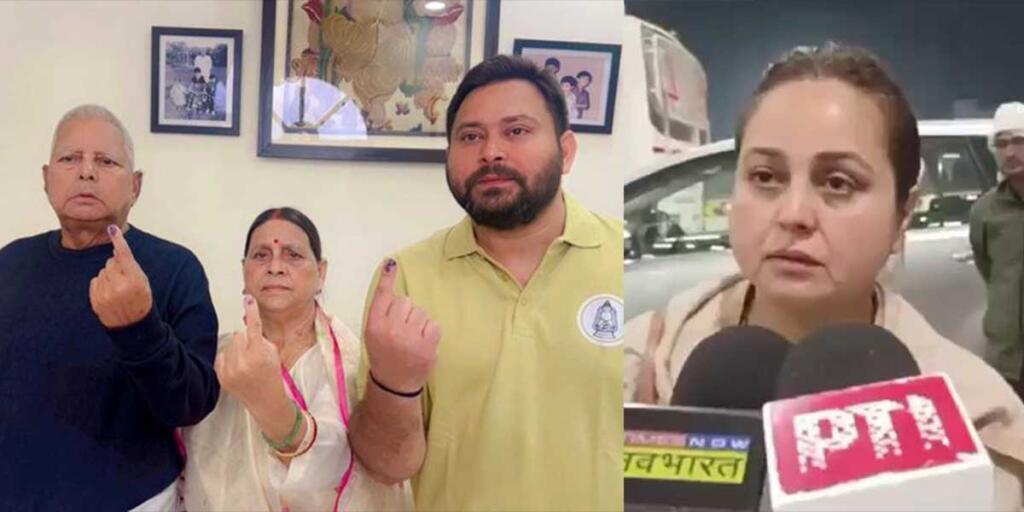
The dramatic collapse of the Rashtriya Janata Dal (RJD) in the Bihar election has not only reshaped the state’s political landscape but also triggered an unprecedented crisis within the Lalu Yadav household. What began as a routine review meeting after the party’s defeat quickly spiralled into a full-blown family eruption, revealing years of tension, rivalry, and unspoken grievances simmering beneath the surface. The meltdown marked by confrontations, accusations, and emotional departures has exposed how fragile dynastic structures can become when faced with electoral setbacks and internal power struggles. For a family that once commanded Bihar’s political stage, the current turmoil marks a painful reckoning with its own legacy.
The flashpoint occurred during a performance review meeting held a day after the results were declared. The National Democratic Alliance (NDA) had swept the election, leaving the RJD with one of its worst tallies in recent years. At this meeting, Tejashwi Yadav and his sister Rohini Acharya clashed sharply over internal party issues.
According to those present, Rohini suggested that the leadership urgently address protests by party workers against RJD MP Sanjay Yadav. Her brother Tejashwi reacted angrily, accusing her of sabotaging the party’s image. He reportedly told her, “We lost the election because of you. We are cursed by you.”
The confrontation escalated to the point where Tejashwi allegedly threw a slipper at his sister and used abusive language, shocking those in the room. For Rohini, who had returned from Singapore at Tejashwi’s own request to help with the campaign, this was the breaking point. Within 24 hours, she announced her decision to quit politics and sever ties with the family.
The conflict did not erupt overnight. Behind the scenes, multiple frictions had been building for years ranging from disagreements over candidate choices to insecurities among senior leaders about Rohini’s rising popularity. Those long-buried tensions finally exploded in the post-election meeting.
Rohini’s fallout with the family goes far deeper than a single argument. Problems had been brewing since at least 2023, when Tejashwi encouraged her to contest the Lok Sabha election from Saran. She agreed only after Lalu Yadav gave his approval but expressed a preference for Pataliputra. This angered her sister Misa Bharti, who viewed Pataliputra as her stronghold.
Despite initially resisting, Rohini eventually contested from Saran and lost to the BJP’s Rajiv Pratap Rudy. Her defeat was frequently used to undermine her, with party leaders reminding her of the loss while others allegedly tried to sabotage her campaign.
Sanjay Yadav, a close aide of Tejashwi, reportedly played a major role in fuelling divisions, often telling Rohini to leave politics and return to Singapore. He is also accused of warning Tejashwi that Rohini could become a political threat to him in the future. Rohini’s attempts to highlight internal mismanagement or bring cohesion to the campaign were repeatedly brushed aside, deepening her frustration.
The rift between the siblings widened when Rohini was allowed to campaign only in Raghopur, despite her wish to cover the entire Saran district to present a united family front. Instead of bridging the divide, this decision only highlighted the growing mistrust within the family.
Adding to the turmoil, two MLAs who had openly mocked her Lok Sabha loss were rewarded with tickets for the assembly election a move that Rohini’s supporters saw as part of a larger effort to undermine her stature within the party.
The recent explosion within the Yadav household did not occur in isolation. It follows a series of dramatic events that reveal widening fissures within the family.
In May, Lalu Prasad expelled his elder son, Tej Pratap Yadav, from both the party and the family for six years. Tej Pratap retaliated by forming his own political outfit and contesting the assembly election, where he suffered defeat.
Two years earlier, another explosive incident shook the family when Tej Pratap’s estranged wife, Aishwarya Rai, was thrown out of the Circular Road residence after a confrontation. Aishwarya, the granddaughter of former Chief Minister Daroga Prasad Rai, had long been entangled in disputes with the family that ultimately pushed her out.
With long-standing tensions already alive, Rohini’s exit created a domino effect. Three of her sisters Rajlakshmi, Ragini, and Chanda also left the family home with their families, signalling a deepening crisis. Today, only Misa Bharti and Tejashwi remain with their parents in Patna.
Rohini, who once donated a kidney to Lalu Prasad, described her final days in the household as emotionally devastating. She publicly stated, “I have no family. I was asked to leave by Sanjay Yadav and Ramiz.” She also alleged she was assaulted with slippers and subjected to verbal abuse a charge none of the accused have responded to publicly.
Tej Pratap and their uncle, former MP Sadhu Yadav, have openly declared support for her, further intensifying the divide within the clan.
The tensions within the Yadav family mirror the RJD’s own political decline. The party’s fall from 75 seats in the 2020 assembly election to just 25 seats in 2025 marks its worst performance since 2010. The Mahagathbandhan, once touted as a formidable alliance, has been reduced to a mere 35 seats.
Meanwhile, the NDA has emerged stronger than ever with 202 seats, reflecting a decisive shift in voter sentiment.
For decades, the Yadav family operated as an unchallenged force in Bihar politics. But over time, the weight of dynastic control where leadership positions are inherited rather than earned began to create friction, ambition, and resentment.
Internal sabotage, competing power centres, and family members vying for Lalu’s legacy have all contributed to weakening the party from within. The very model that once secured continuity for the RJD now appears to be tearing it apart.
Lalu Prasad Yadav now confronts the most personal crisis of his career: the disintegration of the political dynasty he spent decades building. As family members leave, accuse, and fight one another, the emotional and political toll is unmistakable. What was once a tightly knit unit that commanded loyalty across Bihar is today fractured by suspicion, rivalry, and a desperate struggle for relevance.
This moment stands as a dramatic reminder of the inherent risks of dynastic politics. While it promises continuity, it also nurtures internal competition, entitlement, and instability. For the Yadav family, the battle is no longer only against political opponents it is within their own walls.
Whether the dynasty rises again or collapses under the weight of its contradictions will determine not just the future of the RJD, but also the legacy of one of Bihar’s most influential political families.