
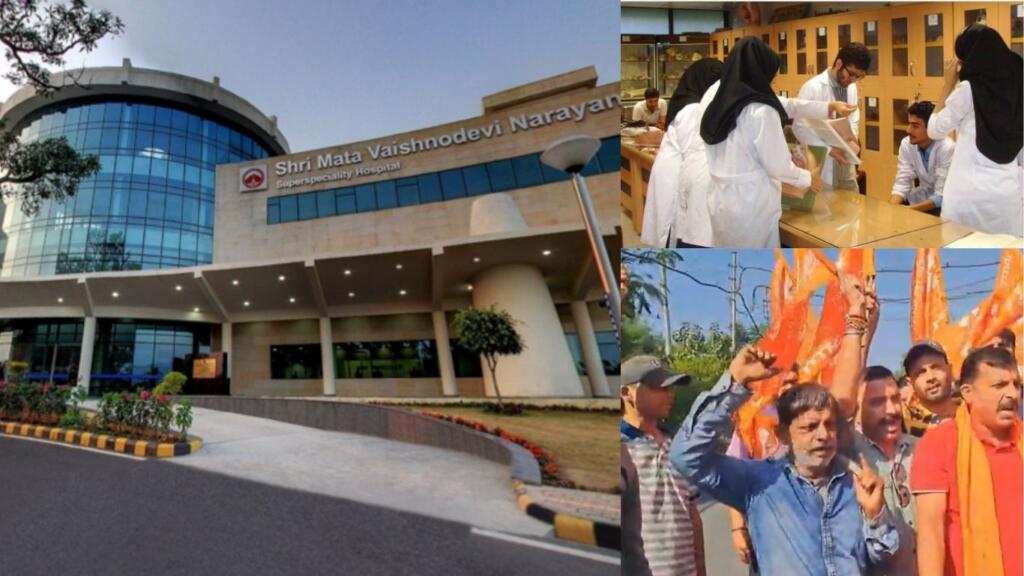
The release of the maiden MBBS admission list for the newly established Sri Mata Vaishno Devi Institute of Medical Excellence (SMVDIME) in Katra has triggered an intense public debate across Jammu and Kashmir. At the heart of the controversy lies a striking statistic out of 50 seats allocated in the first MBBS batch, 42 have reportedly gone to students from the Muslim community, while only seven belong to Hindu students. The data, published by the J&K Board of Professional Entrance Examinations (JK BOPEE), has prompted widespread discussion about the selection process, the role of the Board, and the demographic composition at an institution funded entirely by the Shri Mata Vaishno Devi Shrine Board (SMVDSB) a statutory Hindu religious body.
While the admissions were officially conducted under the merit-based NEET-UG 2025 framework, the distribution has raised fundamental questions about fairness, institutional identity, and religious sensitivity in faith-funded educational institutions functioning under public systems.
The SMVD Shrine Board, established in 1986 to manage one of India’s most revered Hindu pilgrimage sites, had envisioned SMVDIME as a modern medical education hub to serve the people of Jammu and Kashmir. The project, built at a cost of ₹500 crore, was financed exclusively through donations from Hindu pilgrims. It was meant to be both a humanitarian and spiritual extension of the shrine’s service ethos.
The Board already operates the Shri Mata Vaishno Devi College of Nursing and the SMVD Super Speciality Hospital, both regarded for their contributions to healthcare and skill development in the region. However, the demographic imbalance in the new MBBS batch appears to have taken the Board by surprise.
Sources within the SMVDSB admitted that while BOPEE handled admissions, the implications of such an overwhelming religious skew were “unanticipated.” Officials fear that it may create friction on the campus, given the institution’s vegetarian-only policy, Hindu cultural environment, and spiritual code of conduct all deeply rooted in the ethos of the Vaishno Devi shrine.
Questions Over BOPEE’s Role and Admission Process
The controversy deepened when observers noticed that SMVDIME was not listed among the affiliated MBBS/BDS colleges in BOPEE’s 2025 Information Brochure. This omission has led to doubts about the procedural clarity behind extending the admission process to a shrine-managed medical institution.
An official aware of the development described it as “procedurally ambiguous,” suggesting that the college should have received a formal affiliation notification before BOPEE began allotting seats.
However, BOPEE officials have defended the process, asserting that once the National Medical Commission (NMC) grants recognition, centralized NEET counselling automatically applies. They maintain that the selection was purely merit-based and that religion plays no role in NEET counselling or seat allocation.
Yet, critics argue that the complete absence of coordination between BOPEE and SMVDSB has led to a situation where a shrine-funded institution may have inadvertently become the centre of a sensitive demographic imbalance one that could have been mitigated with prior consultation or guidelines.
Affidavit Clause on Institutional Values Sparks New Debate
Adding to the controversy is an Annexure-I Affidavit that all SMVDIME students are required to sign. The affidavit, attested by a First-Class Magistrate, mandates adherence to the institution’s values and includes a clause stating:
“I will ensure that non-vegetarian food in any form is not consumed, cooked, or served in the University/College/Hospital premises of SMVDIME.”
While such a code aligns with the spiritual discipline of the Vaishno Devi Shrine, it has raised practical and cultural concerns in the context of the newly admitted batch’s composition.
Bajrang Dal leader Rakesh Kumar Bajrangi warned that the demographic imbalance could “trigger future friction” if students begin demanding spaces for religious practices or non-vegetarian meals. He urged the Shrine Board to “protect the institution’s spiritual identity.”
Jammu, Jammu and Kashmir: Jammu Rashtriya Bajrang Dal President Rakesh Bajrangi said that the new Shri Mata Vaishno Devi Shrine Board medical college allotted 42 seats to Muslims, 7 to Hindus, and 1 to Sikhs, calling it discriminatory. He urged Lt Governor Manoj Sinha to act… pic.twitter.com/t0AVzlbTbQ
— IANS (@ians_india) November 5, 2025
Balancing Faith, Law, and Institutional Autonomy
The situation presents a complex challenge in a country where minority-managed institutions often enjoy legal autonomy to preserve their religious character. Many such institutions admit predominantly students of their own faith under constitutional protection. In this context, several observers have questioned whether Hindu religious institutions funded by devotees should not have similar leeway to maintain certain cultural values, provided they do not discriminate on admission grounds.
Incase if SMVDSB cannot influence who gets admitted, it can frame internal regulations on conduct that reflect its spiritual values, much like other institutions with religious origins from Christian missionary schools to Sikh charitable trusts.
The SMVDIME episode has emerged as a test case for India’s ongoing struggle to balance faith-based institutional identity.
As of now, neither the Shrine Board nor BOPEE has issued detailed public clarifications. The Board maintains silence, while BOPEE reiterates that the process was transparent and within NEET norms.
However, the larger questions remain unresolved:
-
Can a shrine-funded institution retain its spiritual environment?
-
Should the state introduce faith-sensitivity clauses for institutions built on religious endowments?
As the first MBBS batch at SMVDIME prepares to begin its journey, the institute finds itself not just as a medical school but as a symbolic battleground between devotion and diversity.