
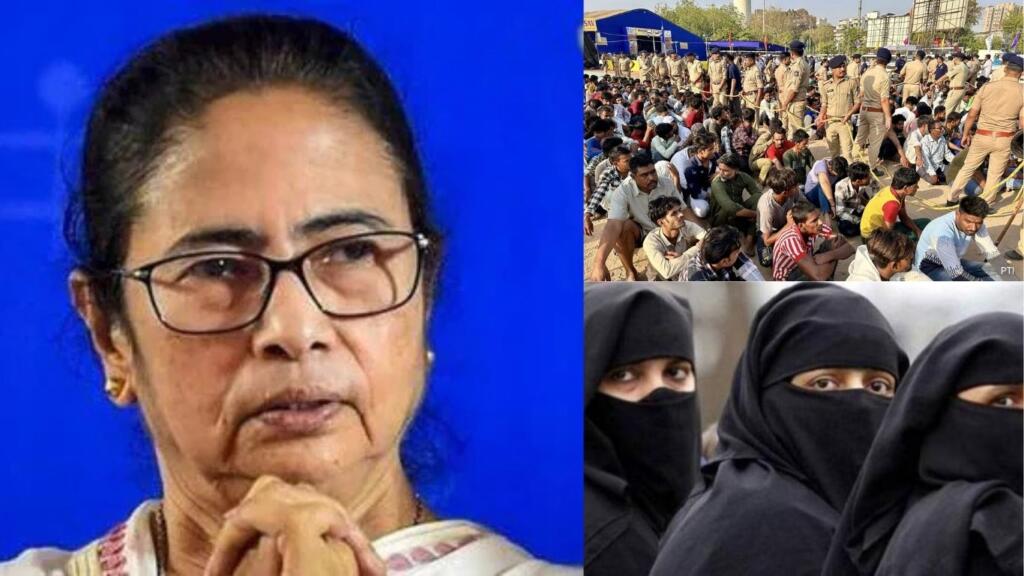
The massive exodus of illegal Bangladeshi migrants from West Bengal’s border districts has exposed the Trinamool Congress government’s deep panic over the Election Commission’s Special Intensive Revision (SIR) of electoral rolls. As the BSF cracks down on infiltrators trying to flee India, questions are mounting about the Mamata Banerjee administration’s desperate attempts to protect fake voters and resist electoral transparency.
Illegal Migrants Flee as Voter Verification Begins
The announcement of the nationwide SIR by the Election Commission has sent shockwaves across several districts of West Bengal, particularly North 24 Parganas, where the infiltration problem has persisted for years. In just two days, the Border Security Force (BSF) arrested at least 48 Bangladeshi infiltrators attempting to cross back into Bangladesh. The arrests were made in the Basirhat sector, which shares a porous border with the neighbouring country.
Officials revealed that the infiltrators, fearing detention or deportation, decided to escape after the SIR process began. The verification exercise involves Booth Level Officers (BLOs) visiting every household to verify voter details, a move that has triggered anxiety among undocumented residents who have long enjoyed political protection.
A senior BSF officer confirmed that most of those detained had been working in Kolkata and surrounding areas as labourers, domestic workers, and small-scale traders. “They were scared that the voter verification teams would expose their illegal status, so they tried to sneak out under the cover of darkness,” the officer said.
In the last three days alone, nearly 90 Bangladeshi nationals have been caught in North 24 Parganas while trying to cross the international border without documents. On Saturday night, another 45 infiltrators including 11 children and 15 women were detained in Hakimpur by BSF patrol teams.
Basirhat Superintendent of Police Hossain Mehedi Rahaman confirmed that those arrested had been working in areas like Rajarhat and Kolkata and were attempting to return to Bangladesh through illegal routes. All have been remanded to 14-day judicial custody.
The BSF has now intensified patrols along the 2,216 km-long India-Bangladesh border. Security agencies are working closely with local police to ensure that no illegal crossings take place during the ongoing voter verification. The sudden rise in attempted escapes has not only revealed the extent of illegal settlements but also the fear among infiltrators that their names will be struck off the electoral rolls once verification is completed
Adding to the controversy, the Mamata Banerjee-led West Bengal government transferred over 500 senior officials on October 24 just hours before the Election Commission announced the nationwide SIR. The massive reshuffle, one of the biggest in recent years, has raised suspicions of a politically motivated attempt to manipulate the voter verification process.
Official data shows that 61 IAS and 145 WBCS (Executive) officers were transferred early in the day, followed by six IAS and 315 WBCS officials soon after the Election Commission’s press conference. The BJP and other opposition parties accused the TMC government of “panic-driven manipulation” and alleged that the reshuffle was aimed at protecting illegal voters and influencing field-level verification.
The Mamata government has been opposing the SIR exercise ever since it was announced, calling it unnecessary and politically motivated. However, the sudden transfers, coming right before the verification, have further strengthened allegations that the ruling party fears exposure of fake voter entries that have long benefitted it electorally.
The simultaneous exodus of illegal Bangladeshi migrants and the unprecedented bureaucratic reshuffle paint a telling picture of the situation in West Bengal. As the Election Commission’s SIR gains momentum, the Mamata government appears increasingly nervous about the fallout. With the BSF tightening security and illegal migrants attempting to flee, the SIR exercise has already begun uncovering the deep-rooted problem of voter list manipulation. The developments signal a major political churn in the state one that could finally expose how decades of appeasement politics have distorted the electoral landscape of Bengal.