
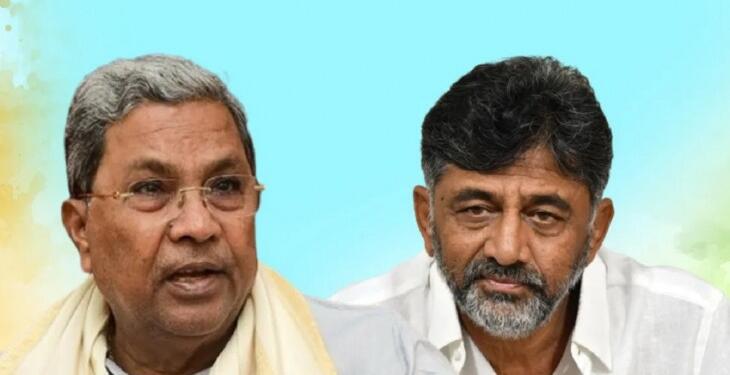
Karnataka’s Congress government, which came to power promising stability, coordination, and “guarantee governance,” is now battling a very public power struggle between Chief Minister Siddaramaiah and Deputy Chief Minister DK Shivakumar. As the government crosses the 2.5-year halfway mark, the factional tensions long whispered but never acknowledged have erupted into the open. A group of Shivakumar loyalist MLAs is now in New Delhi, preparing to confront the Congress high command over the alleged power-sharing pact from 2023, which promised each leader a 2.5-year tenure as Chief Minister.
The intensification of this feud, despite repeated denials from both sides, exposes the deepening cracks within Karnataka’s ruling Congress. While Siddaramaiah asserts that his five-year term is non-negotiable, Shivakumar’s supporters are making aggressive pitches for his elevation. The Congress high command, already troubled by electoral pressures nationwide, is now caught in a tug-of-war that threatens to derail Karnataka’s administration and damage the party’s public image.
Over the last week, a steady stream of Shivakumar loyalist MLAs reached New Delhi with a singular objective to meet Congress president Mallikarjun Kharge and demand the implementation of the 2.5-year power-sharing formula. As of November 20, leaders such as N Chaluvarayaswamy, Iqbal Hussain, HC Balakrishna, SR Srinivas, Ravi Ganiga, Gubbi Vasu and Dinesh Gooligowda had already arrived. More, including Anekal Shivanna, Kunigal Ranganath, and Shivaganga Basavaraju, are expected to join the lobbying effort.
These MLAs insist that the Congress high command had assured a rotational Chief Ministership at the time of government formation in 2023. According to them, the midway mark has been crossed, and it is now Shivakumar’s “rightful turn” to take the chair.
Siddaramaiah, however, has shrugged off these claims, calling the debate unnecessary and insisting that he will present the next budget himself. He maintains that the only officially discussed matter is a cabinet reshuffle to fill two vacant ministerial posts nothing more, nothing less. Yet, despite this confident public posture, his discomfort becomes evident when asked directly about the possibility of stepping aside for his deputy.
Shivakumar, on the other hand, is trying to distance himself from the aggressive mobilisation by his MLAs. While his supporters push the narrative of “fulfill the promise,” he restricts himself to diplomatic statements such as “I will do whatever the party asks.” His silence and refusal to reprimand his outspoken loyalists reveals a calculated political strategy: maintaining pressure without appearing rebellious.
The Siddaramaiah-Shivakumar rivalry is not new. For months, Congress has attempted to downplay the rift, but their leaders’ statements have repeatedly exposed the undercurrents. In the last four months alone, three sitting MLAs and one former MP have received disciplinary notices for publicly advocating Shivakumar’s elevation as Chief Minister. The party accused them of “causing embarrassment” and defying the leadership’s instructions.
Shivakumar loyalists have been relentless. From Iqbal Hussain asserting that Siddaramaiah has had “enough chances,” to Ravi Kumar Gowda predicting that the Deputy CM “will definitely become Chief Minister,” the chorus has been growing. Several leaders have even hinted at a timeline, suggesting that the change of guard would occur by December.
The remarks of Ranganath, calling Shivakumar a “rising star” and “pan-India leader,” and former MP Shivarame Gowda’s claim that the 2.5-year power-sharing deal was already sealed, have added fuel to the fire. Although Shivakumar publicly disowns these statements, the frequency and boldness of such remarks show that his loyalists are operating with confidence, not fear.
Adding to this tension is the caste survey controversy earlier this year. Siddaramaiah and Shivakumar supporters sparred over the political implications of the survey findings, which unsettled major communities like Lingayats, Vokkaligas, and sections of Muslims. The rift between the two camps became even more evident as leaders publicly clashed over reservations, leadership influence, and vote-bank strategies.
Meanwhile, JD(S) turncoat MLAs, who switched to Congress years ago, continue to remain deeply loyal to Siddaramaiah and wish for him to complete a full five-year term. Shivakumar, credited with Congress’s 2023 victory, feels entitled to at least half the term hence the aggressive push by his faction.
A parallel power struggle also continues within the party organisation. Siddaramaiah loyalists have long demanded that Shivakumar step down as KPCC president a position he was expected to relinquish after one year of becoming Deputy CM. Yet, Shivakumar has held on for over five years, consolidating control over the party’s grassroots machinery.
Siddaramaiah’s camp believes Shivakumar is deliberately retaining the KPCC post to strengthen his bid for the CM chair. Shivakumar, sensing the mounting pressure, recently stated, “I cannot hold the post permanently,” hinting at a possible transition. Many interpret this as part of a larger strategy to pave the way for his eventual elevation as Chief Minister without creating an appearance of rebellion.
Meanwhile, Congress’s central leadership, instead of acknowledging the infighting, has chosen to blame external forces. Randeep Surjewala accused the BJP and “sections of the media” of running a maligning campaign against the Congress government. However, his own statement inadvertently undermined this defence because the loudest critics of Siddaramaiah’s continuation are Congress’s own MLAs. If BJP and the media are responsible, then why are Congress legislators themselves openly demanding a leadership change? The contradiction is glaring.
Adding to Congress’s embarrassment is the Comptroller and Auditor General’s scathing report in August, which found that the government’s flagship “guarantee schemes” were severely burdening the state’s finances. The internal unrest has only amplified scrutiny of the government’s performance.
The growing confrontation between Siddaramaiah and Shivakumar reveals a simple truth: Karnataka Congress is battling not an external conspiracy but internal ambition and mistrust. With both leaders unwilling to back down one asserting his five-year mandate and the other pushing a silent yet forceful campaign the party is inching toward a full-blown crisis.
If the high command fails to manage this transition decisively, Karnataka may soon witness administrative paralysis, deeper factionalism and a weakened Congress heading into crucial elections. The question is no longer whether a power struggle exists it is how much longer the party can pretend it doesn’t.