















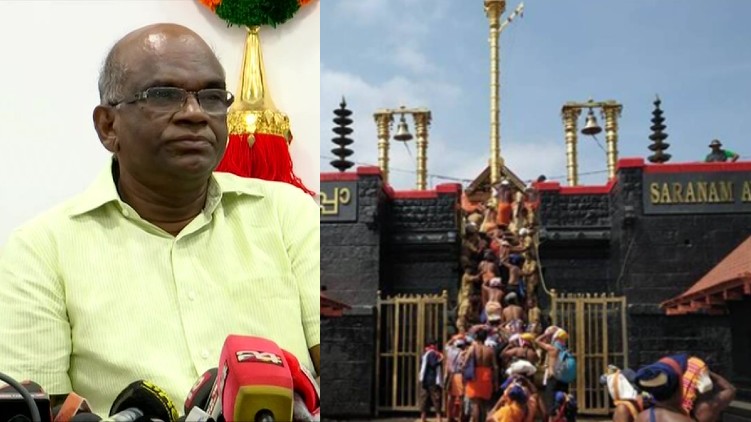
The probe into the Sabarimala gold loot case has taken a decisive turn, with the Special Investigation Team (SIT) interrogating former Travancore Devaswom Board (TDB) president N Vasu in Kerala’s Thiruvananthapuram.
Vasu, a retired Devaswom Commissioner and close aide of Chief Minister Pinarayi Vijayan — denied any role in the alleged misappropriation in the Sabarimala theft case, maintaining that gold was taken for temple repair works “without his knowledge,” said sources.
His questioning follows the arrest of former Executive Officer Sudheeshkumar, indicating that the investigation is tightening around senior figures linked to the temple administration.
Earlier, the Special Investigation Team (SIT), on October 16, arrested priest-turned-businessman Unnikrishnan Potti, the prime accused in two cases linked to the alleged misappropriation of gold from the sacred artefacts of the Sabarimala Ayyappa Temple.
Vasu has repeatedly distanced himself from the first accused, Unnikrishnan Potti, telling the media earlier that he had “no personal links” with him and insisting that “gold plating materials were not removed during his tenure.”
He described Potti as merely “one among many sponsors” associated with Sabarimala, arguing that deeper scrutiny of each sponsor was impractical.
Fresh revelations, however, have brought a new layer of complexity to the case. A 2024 Devaswom Board order has surfaced, authorising Potti to undertake gold-plating work — but curiously, the document refers to copper instead of gold.
Signed by the Board secretary, it permits the use of copper layers for maintenance, raising serious questions about procedural transparency and oversight in the handling of the shrine’s assets.
Vasu, who served as Board Commissioner during the 2018 Sabarimala agitation and became president in 2019, had overseen strong police action against protesters opposing women’s entry into the shrine.
Amid the escalating controversy, Kerala BJP president Rajeev Chandrasekhar has demanded a central probe and a comprehensive audit of the Travancore Devaswom Board.
“This is a scam, a crime. Every attempt by the Chief Minister of Kerala to characterise it as a slip-up, to protect his Devasom Board and Devasom Minister, is going to be unsuccessful. We are clear that there must be a central investigation into this crime and that an audit of the Devasom Board must be conducted. What we are seeing today is the tip of the iceberg, and there has to be a criminal investigation,” Chandrasekhar said.
The SIT, which submitted its second report to the Kerala High Court on Wednesday, has flagged serious irregularities in the TDB’s minutes register.
According to the report, the official record fails to mention the handing over of the dwarapalaka (guardian deity) idol to Unnikrishnan Potti in 2019, and no entries have been made since July 28, 2025.
Additionally, the minutes do not record the transfer of gold platings to Smart Creations, the firm entrusted with electroplating gold-clad copper coverings for idols at the Sabarimala Ayyappan Temple.
The SIT has sought — and received — the High Court’s permission to conduct a scientific examination to determine the actual weight of the idols before and after restoration.
Citing Section 32 of the Travancore-Cochin Hindu Religious Institutions Act, 1950, Chandrasekhar highlighted the statutory duty to conduct annual audits and report any financial discrepancies to the court.
Recoveries made from Sudheeshkumar’s residence have reportedly intensified scrutiny of former Board presidents, including A Padmakumar and N Vasu, piling further pressure on the Devaswom administration amid mounting allegations of lapses and irregularities in temple asset management.
What has been stolen?
The ongoing controversy revolves around two Dwarapalaka idols — the guardian deities positioned outside the sanctum sanctorum of the Sabarimala temple.
The Kerala High Court took up the matter in September after a report by the court-appointed Sabarimala Special Commissioner revealed that the idols had been stripped of much of their gold cladding.
In a series of orders since then, Justices Raja Vijayaraghavan V and KV Jayakumar said they had examined temple records, before-and-after photographs, and other evidence gathered by the Special Investigation Team (SIT) in what they described as “this extraordinary case involving the pilferage of Lord Ayyappa’s sacred valuables.”
The judges noted that when they directed temple authorities to produce complete files and documents related to the idols’ repair, “little did we realise, that we were in fact opening a hornet’s nest.”
According to temple records, 30.291 kg of gold — donated by the now-disgraced businessman Vijay Mallya — was used in 1998–99 for gold cladding the idols and other parts of the temple, including pillars, door arches, and panels depicting the stories of Lord Ayyappa.
In July 2019, the Travancore Devaswom Board (TDB), which manages the temple, permitted the main suspect, Unnikrishnan Potty, a former assistant priest, to take the idols for fresh gold cladding.
Two months later, when the idols were returned, they were not weighed. Subsequent investigations, however, found that the idols were significantly lighter.
The SIT’s probe has since uncovered further pilferage from the pedestals and door frames, with the court estimating that about 4.54 kg of gold has gone missing since 2019. The judges have described the incident as “a heist and plundering of gold.”





