
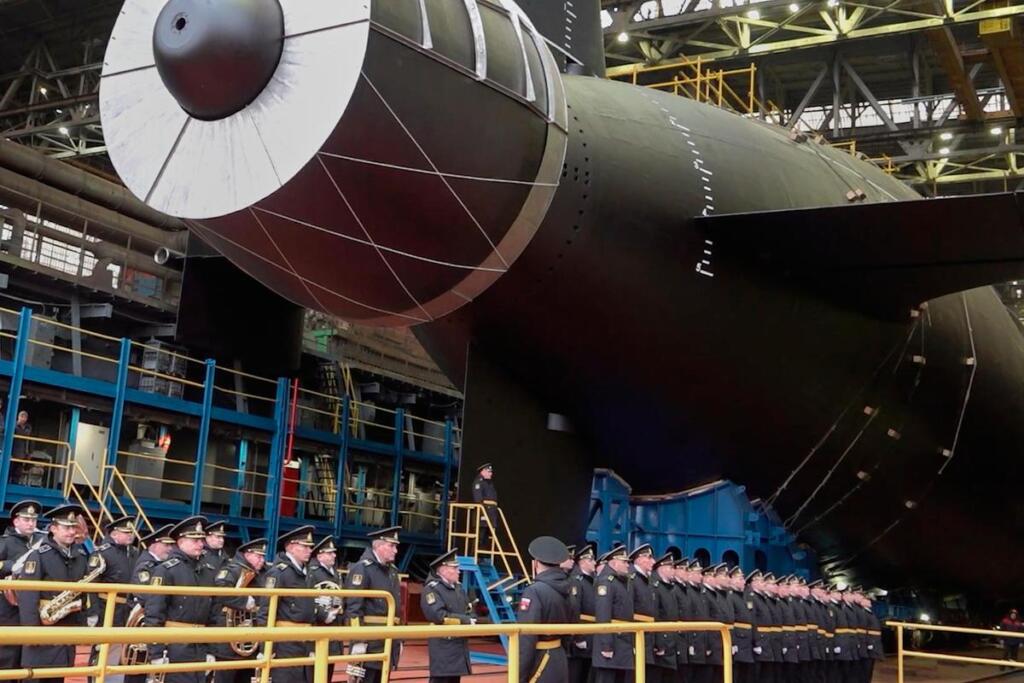
In a significant step for Russia’s naval modernisation, the nuclear-powered submarine Khabarovsk has officially taken to the water.
Built as the primary carrier for the Poseidon nuclear drone, it is often referred to as the “doomsday missile.”
It was launched at the Sevmash shipyards in Severodvinsk — Russia’s primary shipbuilding complex for nuclear submarines marking a milestone in Russia’s underwater defence program.
The event, attended by Defence Minister Andrei Belousov, Naval Chief Admiral Alexander Moiseyev, and key shipbuilding officials, was broadcast live on national television.
The Khabarovsk is now set to become the first operational carrier of the Poseidon underwater weapon — a nuclear-capable, autonomous torpedo designed for strategic deterrence through long-range, high-speed, deep-water operation.
The launch ceremony at Sevmash was supervised by Defence Minister Andrei Belousov, who described it as a historic milestone and as “an important moment for the Russian Navy.
He emphasised that the new submarine will bolster Russia’s ability to “protect its maritime borders and national interests across different regions of the world’s oceans.”
Design and Mission of the Khabarovsk
Developed by the Rubin Central Design Bureau of Marine Engineering, the Khabarovsk submarine is engineered to support modern naval operations and safeguard Russia’s maritime zones.
According to the Defence Ministry, the vessel is equipped to transport advanced underwater drones and automated weapons for a variety of missions.
The Sevmash shipyard, which previously refitted India’s INS Vikramaditya aircraft carrier, played a key role in the construction of Khabarovsk.
Officials from the Defence Ministry described the submarine as a crucial component in strengthening the nation’s underwater deterrence and security across the world’s oceans.
Poseidon: Russia’s ‘Doomsday Missile’
At the heart of the Khabarovsk’s mission lies the Poseidon—a nuclear-powered, autonomous underwater drone designed for long-range strategic deterrence.
Russian President Vladimir Putin recently confirmed a successful test of the Poseidon, noting that it was launched from a “mother submarine.”
He revealed that the drone’s nuclear power plant is “100 times smaller than a traditional strategic submarine reactor.”
Reports from the business daily Kommersant indicate that the Poseidon is capable of reaching unprecedented underwater speeds and can operate at extreme depths over intercontinental distances, making it exceptionally difficult to detect or intercept.
Kommersant also noted that Khabarovsk-class submarines will serve as the primary carriers of this powerful underwater weapon.
The Poseidon’s development follows years of secretive testing and refinement, signaling a new phase in Russia’s underwater strategic capabilities.
Strategic Significance and Reactions
Deputy Chairman of the Russian Security Council Dmitry Medvedev has called Poseidon a “doomsday missile,” describing it as a revolutionary addition to Russia’s underwater deterrence arsenal.
Meanwhile, Andrei Kartapolov, Chair of the Duma Defence Committee, claimed that the Poseidon drone could “wipe out entire coastal nations.”
His remarks underscored the immense destructive potential attributed to the nuclear-armed underwater system.
The Defence Ministry reiterated that the launch of the Khabarovsk submarine will “ensure maritime security and protect national interests in global waters.”
Officials further described the project as a major step forward in the field of underwater robotics and long-range autonomous weaponry.
A New Era in Underwater Deterrence
The combination of the Khabarovsk submarine and the Poseidon nuclear drone represents a dramatic evolution in Russia’s strategic maritime capabilities.
Together, they underscore Moscow’s focus on developing next-generation nuclear-powered and autonomous underwater systems—tools designed not just for defence, but for deterrence on a global scale.