
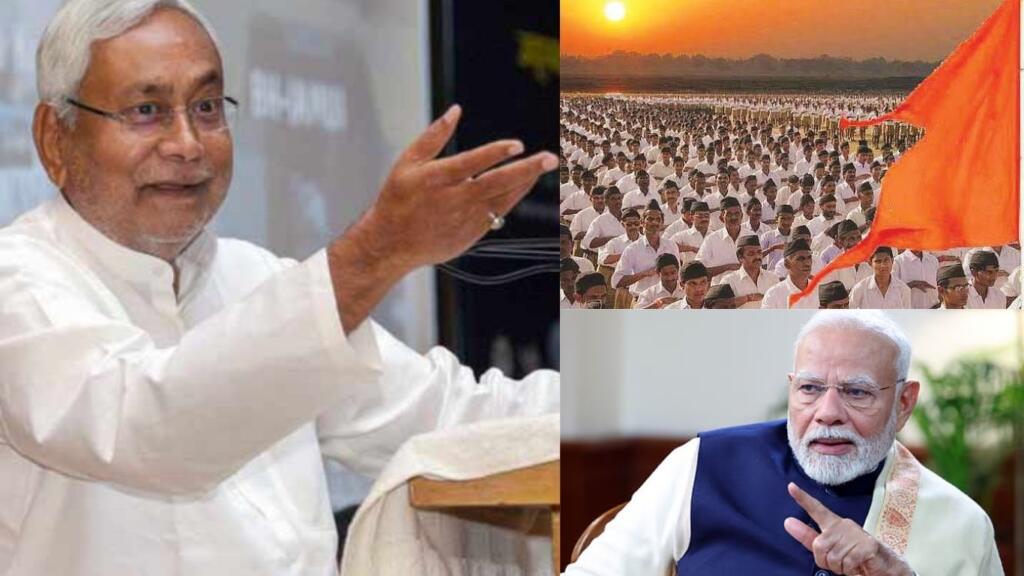
As the final rounds of counting are going to conclude in Bihar, one thing is now beyond dispute: the NDA is cruising towards a historic, unprecedented landslide victory, shocking many political pundits who had predicted a closer fight. While Chief Minister Nitish Kumar’s welfare measures and Prime Minister Narendra Modi’s strong law-and-order messaging created clear momentum, insiders across party lines agree on one undeniable fact the real game-changer of the 2025 Bihar elections has been the RSS’s intensive and meticulously structured campaign known as Mission Trishul.
This election was not merely about rallies, promises, caste equations, or last-minute alliances. It was a battle fought booth by booth, household by household, and mood by mood and this is where Mission Trishul silently rewrote Bihar’s political script. The campaign, spearheaded by senior RSS functionaries and supported by over 20,000 volunteers, transformed BJP’s prospects in an election that many believed would be dominated by unemployment narratives and anti-incumbency.
Mission Trishul, conceptualised by senior RSS leaders earlier this year, is built on three sharply focused pillars:
-
Identifying “angry voters” those disillusioned either with the NDA or with the Opposition.
-
Mapping which issues genuinely resonate with different communities not just what political parties assume.
-
Analysing which narratives could directly benefit or harm BJP’s electoral chances.
Unlike conventional campaigns, Mission Trishul did not depend on mass communication alone. It depended on micro-mobilisation, a granular, data-driven, interpersonal strategy where volunteer groups mapped out every booth, every tola, and every cluster of 50 homes.
RSS volunteers fanned out across constituencies to:
-
Categorise booths as strong, moderate, or weak for BJP.
-
Review voter lists, identify swing pockets, and target low-turnout regions.
-
Conduct quiet, small-group meetings that stayed away from media glare.
-
Counter misinformation about unemployment and SIR allegations.
-
Rebuild trust where voters felt neglected by local leaders.
By the time campaigning reached its final phase, the RSS already had a precise psychological map of Bihar’s voter mood something no political consultant or alliance could match.
Mission Trishul is not an isolated experiment. RSS has successfully deployed similar micro-campaigns in recent elections:
The BJP’s remarkable return to power in Delhi after 27 years was also fuelled by a silent RSS voters’ awareness drive that focused on:
-
Civic issues
-
Water quality
-
Yamuna cleanliness
-
Localised Hindutva narratives
-
Hyper-targeted booth turnout strategies
Mission Trishul drew from this model, strengthening BJP’s weak pockets in Bihar’s urban and semi-urban belts.
In Haryana, RSS’s neighbourhood-based interactions neutralised the Opposition’s narrative that BJP would “change the Constitution.” This model helped BJP outperform all poll predictions. Mission Trishul adopted the same conversational approach in Bihar to dismantle Opposition claims related to lawlessness, unemployment, and the SIR controversy.
In Maharashtra, Sangh volunteers ran the “Sajag Raho” campaign, which turned door-to-door visits into personalised conversations. The Bihar version was even sharper volunteers used caste-specific, occupation-specific, and gender-specific outreach.
In villages, this personal outreach tipped the scales dramatically. As one senior BJP strategist phrased it:
This election was shaped by two powerful narratives:
-
Nitish Kumar’s welfare performance, especially the
-
₹10,000 direct aid to 1.3 crore women,
-
free electricity up to 125 units,
-
elderly pension raised to ₹1,100.
-
-
Prime Minister Modi’s sharp articulation of the fear of “katta, dunali, rangdari” reminding the electorate of the era of jungle raj.
Mission Trishul ensured these narratives were delivered directly to the voter’s doorstep, especially women who turned out in record numbers, crossing 71% turnout.
Volunteers worked with stunning discipline to:
-
Ensure beneficiaries of Nitish’s schemes understood the importance of voting.
-
Translate Modi’s messaging into local dialects, idioms, and emotional appeals.
-
Counter Tejashwi Yadav’s promise of ₹2,500 monthly support by highlighting that Nitish’s ₹10,000 had already reached women’s bank accounts.
-
Remind senior citizens about their enhanced pension.
-
Make young voters see the Opposition’s unemployment narrative as “too divided between RJD and Jan Suraaj to matter.”
The result: no single Opposition message could dominate the electoral imagination, because Mission Trishul ensured every NDA message reached the voter first and reached them more consistently.
The Mahagathbandhan’s biggest blunder was abandoning the “lawlessness under NDA” narrative after the Khemka murder in Patna and shifting to the SIR controversy through Rahul Gandhi’s “Vote Adhikar Yatra.”
But RSS volunteers had already sensed that:
-
The SIR issue had no emotional resonance.
-
It was too technical for rural Bihar.
-
It could not compete with everyday concerns like law and order, welfare, and electricity.
Mission Trishul’s analysis proved right.
By the time ballots were cast, “vote chori” and SIR had vanished from public discussions. Meanwhile, Mission Trishul had ensured the BJP–JDU narrative of stability, women’s empowerment, law and order, and welfare was sealed into the voters’ psyche.
Even the anti-incumbency anger over unemployment split between RJD and Prashant Kishor’s Jan Suraaj a split predicted by the campaign’s data models.
This election has also been a personal triumph for Nitish Kumar. Contesting 101 seats and poised to win well over half, he has dramatically improved on his 2020 strike rate reaffirming his position as the “Baadshah of Bihar.”
As the dust settles on Bihar’s 2025 electoral battlefield, one truth stands out:
Mission Trishul was not just a campaign it was a parallel election machinery.
While the NDA had strong leaders, strong messaging, and strong welfare delivery, it was the RSS’s ground-level presence that transformed these into a political wave.
Mission Trishul:
-
Located every weak pocket
-
Revived apathetic voters
-
Neutralised anger
-
Outperformed Opposition campaigns
-
Converted welfare benefits into electoral loyalty
-
Built a psychological wall against jungle raj fears
-
Orchestrated the highest-ever turnout of women
In the final analysis, the NDA’s landslide was not just won in rallies or on television screens.
It was won in lanes, courtyards, chaupals, kitchens, and mohallas wherever an RSS volunteer quietly carried the message of stability, security, and development.
And thus, Mission Trishul will go down as one of the most successful, silent, and decisive election campaigns in recent Indian political history.