














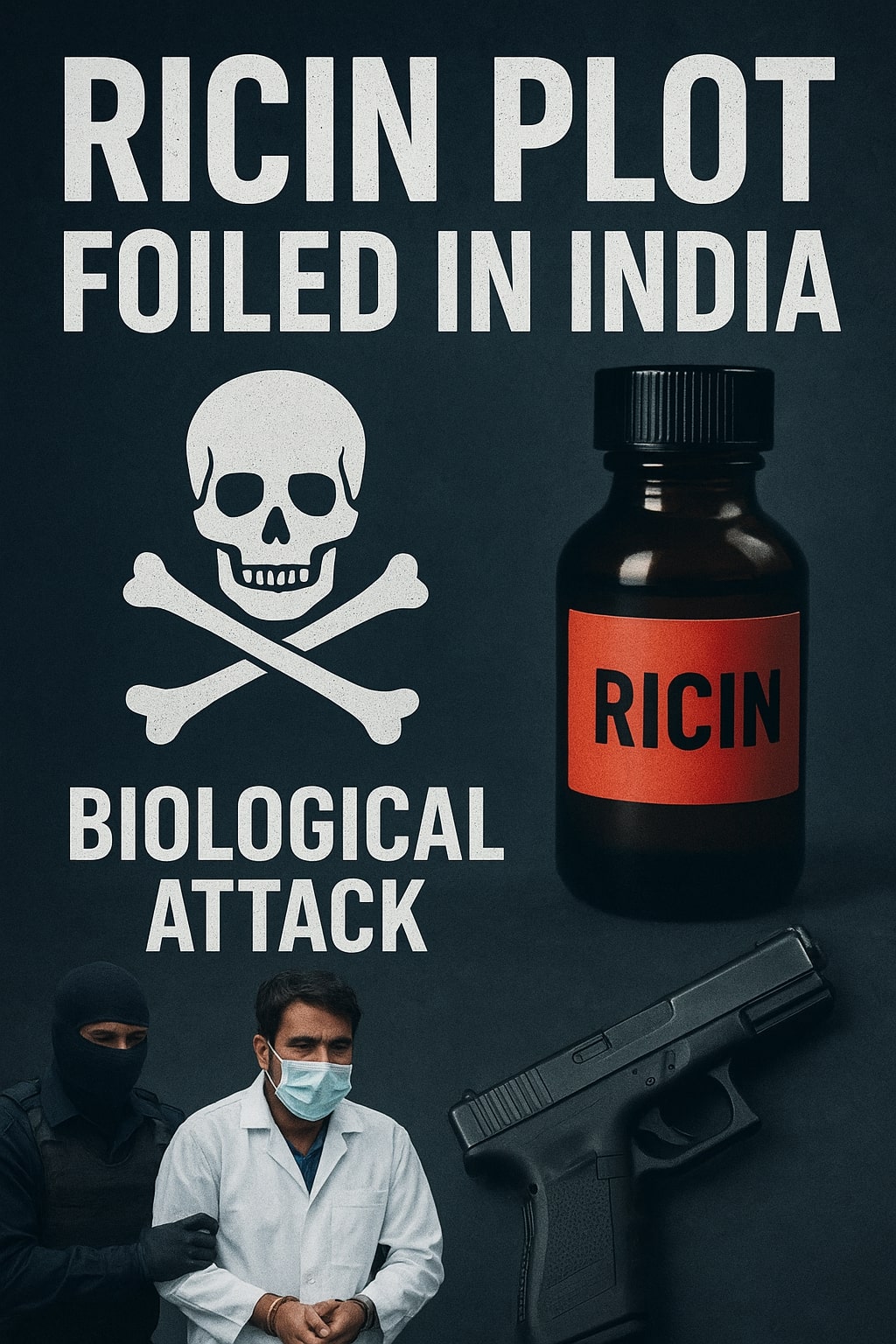
In a chilling reminder of the ever-evolving face of terrorism, the Gujarat Anti-Terrorism Squad (ATS) has thwarted what could have been one of the deadliest biological attacks on Indian soil. The recent arrests of a qualified medical practitioner and two accomplices—found in possession of firearms and working to prepare the lethal poison Ricin—have exposed the alarming intersection of medical expertise, extremist ideology, and bioterrorism. This operation not only highlights the vigilance of India’s security agencies but also draws urgent attention to a chemical agent that is among the most lethal substances known to science.
The Unfolding of a Deadly Plot
According to official reports, the Gujarat ATS apprehended three individuals, one of whom is a trained doctor holding an MBBS degree. Investigations revealed that the group had begun preparations to synthesize and weaponize Ricin, a toxin that is 6,000 times more lethal than cyanide and for which no antidote exists. Their handler, as uncovered during interrogation, was linked to the Islamic State Khorasan Province (ISKP)—a regional offshoot of the global terror network notorious for its radical indoctrination and use of unconventional weapons.
The suspects had conducted reconnaissance (recce) of several high-profile and sensitive locations in Lucknow, Delhi, and Ahmedabad, indicating that they were in advanced stages of planning a coordinated attack. Security sources believe that the use of Ricin would have been intended to cause mass casualties and widespread panic—striking at the heart of India’s densely populated urban centers.
Ricin: The Science Behind the Deadliest Poison
Ricin is a naturally occurring toxin extracted from the Ricinus communis plant—commonly known as the castor plant. While the plant itself is widely cultivated for the production of castor oil, the leftover pulp or “waste material” from castor bean processing contains ricin in concentrated form. This makes it disturbingly accessible to anyone with basic chemical knowledge and malicious intent.
Just a few milligrams of ricin—an amount smaller than a grain of salt—can kill an adult if inhaled, ingested, or injected. It works by inhibiting protein synthesis in cells, effectively shutting down vital bodily functions and leading to organ failure. Symptoms of exposure can include severe respiratory distress, vomiting, seizures, and death within 36 to 72 hours. What makes Ricin especially terrifying is the absence of an antidote; treatment is purely supportive, and survival depends largely on the dose and speed of medical intervention.
A Weapon of Terror and Secrecy
Ricin has long fascinated both state and non-state actors due to its deadly efficiency and ease of production. Unlike nuclear or radiological materials, it does not require advanced technology or expensive equipment to manufacture. It can be synthesized in small quantities from castor bean residues—making it a preferred choice for terrorists seeking low-cost, high-impact weapons.
Globally, Ricin has a dark history of use and attempted use in assassinations and terror plots. The most infamous case dates back to 1978, when Bulgarian dissident Georgi Markov was murdered in London with a pellet containing ricin, fired from a modified umbrella—a case that became a Cold War legend. More recently, several terror cells in Europe and the United States have been intercepted while attempting to create ricin-based explosives or dispersal mechanisms.
The latest case in Gujarat shows that India, too, is not immune to this global trend. The combination of extremist networks like ISKP and individuals with scientific or medical training is a particularly dangerous mix—one capable of turning ordinary household materials into weapons of mass destruction.
The Role of Medical Expertise in Bioterrorism
That one of the accused holds an MBBS degree adds a deeply disturbing dimension to the plot. A doctor’s knowledge of human physiology, chemistry, and disease processes can make them uniquely capable of developing or deploying biological agents with precision. This is a stark reminder that radicalization is no longer confined to the impoverished or uneducated—it can penetrate even the most elite professional circles.
Terror outfits have increasingly sought individuals with technical expertise to enhance the sophistication of their operations. In this case, the doctor’s involvement reportedly included formulating a viable method to extract and refine ricin for deployment—a chilling misuse of medical knowledge intended for saving lives.
The Broader Implications for National Security
The foiling of this ricin-based plot underscores both the vulnerability and preparedness of India’s internal security apparatus. The ATS operation not only prevented an imminent biological catastrophe but also exposed the growing appeal of bioterrorism among radical groups. Unlike conventional explosives, biological and chemical agents have the power to inflict terror far beyond their immediate victims—causing psychological, economic, and political shockwaves.
Experts have repeatedly warned that the next major wave of terrorism could emerge not from bombs or bullets, but from biology and chemistry. The pandemic has shown how rapidly disease can spread and overwhelm systems; a deliberate biological attack could exploit those same vulnerabilities with devastating consequences.
To counter this threat, India will need to invest heavily in biosecurity intelligence, inter-agency coordination, and early detection systems. Laboratories and industrial units that handle hazardous materials must be subject to stricter monitoring, while public awareness on reporting suspicious activities must be strengthened.
A Close Call—and a Wake-Up Call
The Gujarat ATS’s swift and precise action averted what could have been an unspeakable tragedy. But the discovery of a doctor-turned-terrorist preparing one of the world’s most lethal poisons is a grim reminder that the frontlines of terrorism are shifting. Ricin, though derived from an everyday plant, represents a silent and invisible form of warfare—one that challenges traditional notions of defense and preparedness.
As the investigation unfolds, the nation must remain vigilant against this new breed of bioterrorism, where ideology and intellect collide with deadly intent. Ricin’s presence in the wrong hands is not merely a law enforcement issue—it is a threat to humanity itself.
In the battle against terror, knowledge and vigilance may be our only antidote.