
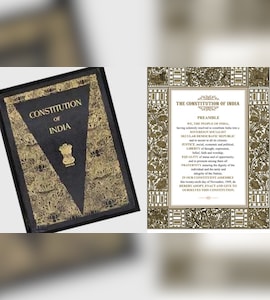
The incorporation of the Devanagari script and the acknowledgement of Sanskrit’s civilizational significance were subjects of thoughtful deliberation in the Constituent Assembly. These debates reflected the framers’ deep commitment to preserving Bharat’s diverse cultural tapestry. Dr B.R. Ambedkar’s proposals supported by eminent voices such as Acharya Kripalani were rooted in the belief that Bharat’s linguistic and cultural heritage deserved both recognition and continuity. Yet, the subsequent departure from this intent, particularly by successive governments, forces uncomfortable reflections on the political motivations that shaped such deviations from the original constitutional vision.
The same political class that today positions itself as the nation’s constitutional guardian had, in earlier decades, engaged in constitutional improprieties of its own. For instance, governments formed after the expiry of the constitutionally mandated 15-year period in 1966 failed to uphold Article 343(1), which required the adoption of Devanagari script for official purposes. Their reluctance to follow constitutional language directives reveals selective adherence—an attitude that contradicts their present claims of absolute constitutional fidelity.
These inconsistencies underline a larger narrative: that the Constitution, while celebrated today, has often been a site of political contestation, shaped as much by adherence as by expediency.
The Constitution’s Early Years: Pragmatism and Political Compulsions
In the formative years of the Republic, the Constituent Assembly adopted a pragmatic approach to language policy. English was retained as the official language for a transitional period of fifteen years under Article 343(2), reflecting both administrative continuity and the practical challenges of linguistic transition.
However, as political compulsions deepened, this pragmatism was increasingly used as a tool for convenience. When it suited electoral strategies, successive governments subverted constitutional expectations, selectively interpreting provisions to build vote banks rather than foster national cohesion. Ironically, many of these actors now project themselves as the most articulate defenders of constitutional morality, glossing over their own chequered record of constitutional misadventure.
This duplicity becomes particularly evident when examining the most dramatic constitutional intervention of the post-independence era—the Emergency.
Emergency, the 42nd Amendment, and Democratic Distortions
During the Emergency proclaimed under Prime Minister Indira Gandhi, the 42nd Constitutional Amendment emerged as one of the most sweeping and controversial changes to the nation’s constitutional framework. Passed under conditions that severely curtailed civil liberties, the amendment attempted to dilute the powers of the Supreme Court and High Courts, expand executive authority, and tilt the balance between State and citizen.
It introduced Fundamental Duties, altered the distribution of powers between the Union and States, and allowed the President—rather than State Governors—to disqualify legislators. Most notably, it attempted to give Parliament near-unlimited power to amend the Constitution, effectively nullifying the Supreme Court’s landmark judgment in Kesavananda Bharati, which had affirmed the “basic structure doctrine.”
A major ideological addition was the insertion of the terms “socialist” and “secular” into the Preamble. While secularism as a principle already permeated the constitutional scheme as Dr Ambedkar had explicitly noted during the Constituent Assembly debates the timing and manner of its inclusion in 1976 raised questions of motive. Critics argue that the amendment sought not to strengthen secular values but to consolidate political constituencies during a period of suspended democratic processes.
The lack of public consultation, combined with the coercive context of the Emergency, renders the amendment a cautionary episode in Bharat’s constitutional journey a reminder of how political power, when unchecked, can attempt to reshape foundational principles.
Reclaiming Constitutional Promises: Contemporary Efforts and Challenges
In contrast to the earlier periods marked by expedience, the present government has despite facing sustained criticism both domestically and abroad undertaken initiatives aimed at realigning governance with constitutional guarantees. The constitutional changes affecting Jammu and Kashmir are cited as an example: actions undertaken with the stated intention of restoring dignity, equality, and development opportunities for its people, in accordance with the broader constitutional promise.
Such steps reflect the continuing tension between constitutional interpretation, political ideology, and public expectation. They also underscore an important reality: Bharat’s constitutional journey has never been linear. It has oscillated between visionary leadership and political opportunism, between judicial protection and executive overreach.
Yet, through all these challenges, the Constitution has endured.
A Constitution That Needs No Saving
The persistent claim in some quarters that the Constitution is under imminent threat promotes a narrative that oversimplifies history and overlooks past political excesses. Those who propagate this idea often ignore their own legacy of constitutional distortions.
The truth is that Bharat’s Constitution crafted with extraordinary foresight and fortified by the judiciary’s unwavering guardianship—has survived not only the Emergency but decades of political exigencies, shifting ideologies, and social upheavals. Its resilience stems from its foundational structure, its democratic ethos, and its capacity to evolve without abandoning core principles.
Far from being fragile, it is a magnificent instrument that binds over a billion people in a shared democratic compact. It does not require saving; it requires understanding, respect, and responsible stewardship.