
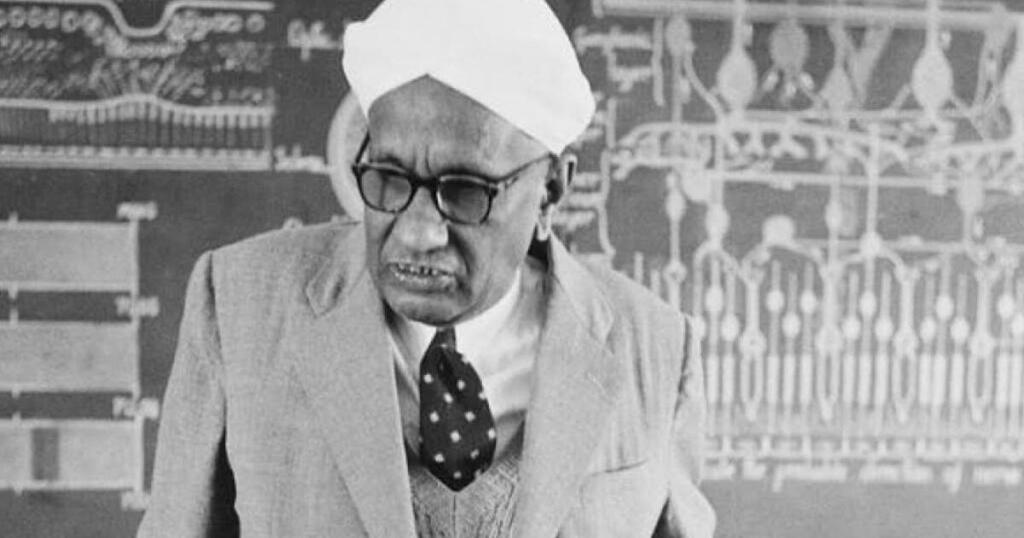
“The essence of science is independent thinking, hard work, and not equipment or money”: Chandrasekhara Venkata (CV) Raman
Today we pause to honour the memory of CV Raman, one of India’s greatest scientific minds and a global pioneer in the field of physics. Born on November 7, in 1888 in Tiruchirappalli, Tamil Nadu, Raman’s life was shaped by an early immersion in the world of ideas, through the influence of his father, Chandrasekhara Iyer, who was a lecturer in mathematics and physics.
This academic atmosphere nurtured his curiosity, leading him to explore the mysteries of light and sound from a young age. His relentless pursuit of knowledge eventually led to the discovery of the Raman Effect, a groundbreaking find that redefined the understanding of light scattering and earned him the Nobel Prize in Physics in 1930.
As we mark his death anniversary today, on Novermber 21, we remember his achievement was a historic moment, making him the first Asian to win a Nobel Prize in the sciences.
The Discovery That Transformed Modern Physics
The discovery of the Raman Effect stands as one of the most celebrated milestones in scientific history. Conducted in the 1920s with modest equipment but extraordinary ingenuity, Raman’s experiments revealed how light interacts with the molecules of a medium, producing a shift in wavelength.
This pioneering work laid the foundation for Raman spectroscopy, a technique that now plays a vital role in chemistry, medicine, astronomy, and materials science. His investigations were not confined to this discovery alone, they included studies in acoustics, the optics of colloids, musical instruments, and crystal dynamics.
His early scientific efforts—often carried out in the evenings while he was working in the Indian Finance Department—demonstrate an unparalleled dedication to uncovering nature’s secrets.
A Visionary Who Reshaped India’s Scientific Education
CV Raman was not just a scientist of extraordinary brilliance—he was also a visionary educator. During his time as a professor at the University of Calcutta and later as the first Indian Director of the Indian Institute of Science (IISc), Bengaluru, he championed a culture of learning rooted in experimentation, observation, and critical thinking.
He believed that science should not be restricted to textbooks but should awaken curiosity in the minds of students. His teaching style inspired countless young Indians to view science as a way to understand the world, rather than simply a subject to study for examinations.
His words continue to guide educators and learners even today, “The essence of science is independent thinking, hard work, and not equipment or money.”
Architect of India’s Scientific Institutions
Beyond his classroom influence, Raman played a monumental role in shaping India’s scientific institutions. In 1948, he founded the Raman Research Institute (RRI) in Bengaluru, creating a haven where independent Indian scientists could pursue pure research free from administrative constraints.
His leadership extended to establishing and developing key institutions such as the Indian Journal of Physics, the Indian Academy of Sciences, and the widely respected journal Current Science.
His vision helped lay the foundation for India’s modern scientific ecosystem, influencing the rise of institutions like IITs, IISc, and national research laboratories that continue to serve as engines of the nation’s scientific and technological progress.
A Legacy Cherished by the Nation
CV Raman’s work earned him international acclaim and numerous honours, including knighthood in 1929 and election as a Fellow of the Royal Society in 1924. His lifetime contributions continue to command respect and admiration across the world.
Reflecting the nation’s gratitude, Union Minister Shivraj Singh Chouhan on Friday posted, “I pay my humble tribute to the father of the ‘Raman Effect’, Nobel Prize winner, great scientist, ‘Bharat Ratna’ Sir CV Raman ji on his death anniversary! The country will always be proud of this gem who brought India worldwide fame and respect in the field of science. You will live on in our hearts for ages to come. We bow to you again and again!”
A Light That Continues to Inspire
As we remember CV Raman today, we pay tribute to a man whose brilliance elevated India onto the global scientific stage. His life is a powerful reminder that curiosity, perseverance, and independent thinking can transform not just a person, but an entire nation.
His legacy lives on in every laboratory, every research institute, every student who dares to question, and every educator who encourages inquiry.
CV Raman remains a beacon of inspiration—his light continuing to guide India’s journey in science, innovation, and knowledge for generations to come.
Raman’s contributions are honored annually in India with National Science Day on February 28. His nephew, astrophysicist Subrahmanyan Chandrasekhar, was influenced by him to pursue scientific research.
Chandrasekhar spent time in Raman’s laboratory, engaging in discussions about the theoretical aspects of Raman’s discoveries.
In 1983 Chandrasekhar was awarded the Nobel Prize for Physics, along with William Fowler, for his work on stellar evolution. Raman continued his research at the RRI until his death on November 21, 1970, in Bangalore.