















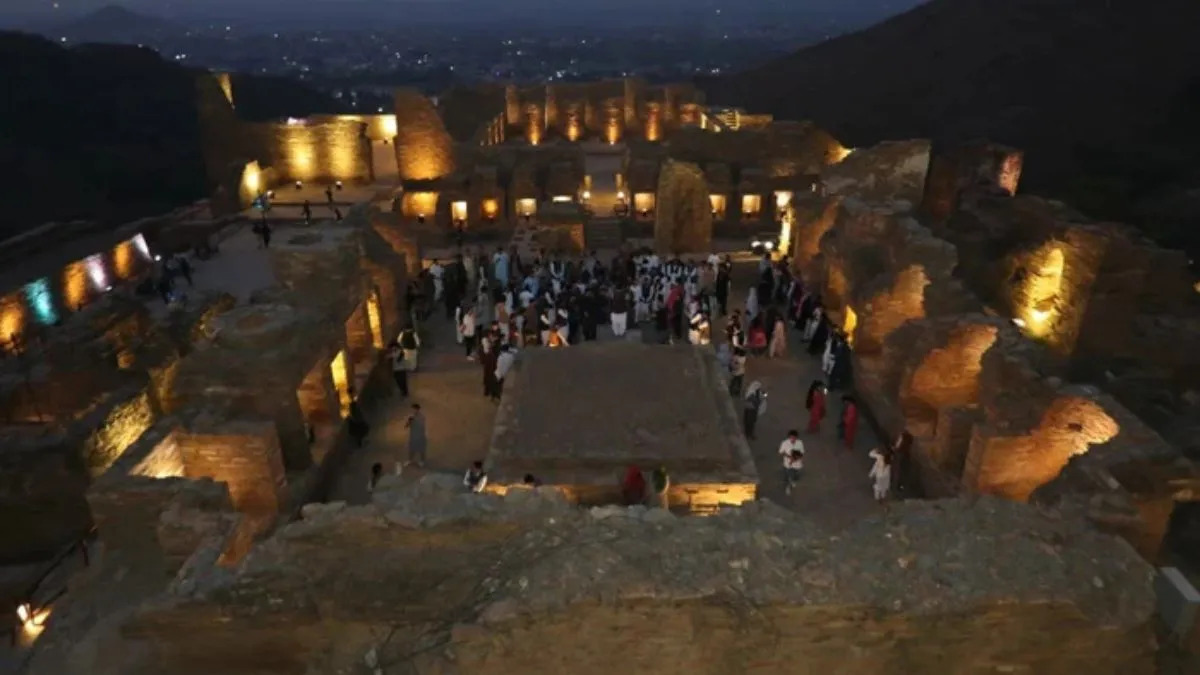
The discovery of a 1,200-year-old temple in Pakistan’s Khyber Pakhtunkhwa province has stirred fresh interest in the region’s ancient heritage, reminding the world that the land now known as Pakistan was once a cradle of Hindu, Buddhist, and pre-Islamic civilizations. This temple, unearthed during an Italian-led archaeological excavation in the ancient city of Barikot—identified with the historical Bazira of Alexander the Great’s chronicles—sheds light on the layered and pluralistic past that shaped the cultural fabric of South Asia.
The find is part of a broader archaeological effort jointly conducted by the Italian Archaeological Mission and the Khyber Pakhtunkhwa Directorate of Archaeology under the Khyber Path Project. This three-year initiative seeks to combine heritage preservation with regional development, offering training and employment in excavation, conservation, and tourism. Yet beyond its academic and developmental goals, this discovery reawakens a deeper historical conversation—one about Pakistan’s pre-Islamic ancestry and the continuity of Hindu and Buddhist civilizations that once flourished in the region.
The Temple of Barikot: A Window into the Hindu Shahi Legacy
According to Dr. Luca, the director of the Italian Archaeological Mission, the recently excavated 1,200-year-old temple temple is a modest but significant structure located near the Swat River. Pakistan’s discovery as a remnant of the Hindu Shahi period, a dynasty that ruled large parts of present-day Afghanistan and northwestern Pakistan between the 9th and 11th centuries CE. The Hindu Shahis were successors to the Kabul Shahis, and their reign marked a final chapter in the region’s pre-Islamic polity before the Ghaznavid incursions brought major religious and cultural shifts.
The Hindu Shahis were known for their patronage of art, architecture, and religion. Temples and forts attributed to their rule are scattered across Khyber Pakhtunkhwa, Punjab, and parts of Afghanistan, though many remain buried or forgotten due to neglect and erosion. The temple in Barikot, with its architectural features and surrounding relics, stands as a tangible link to that era—a symbol of a once-vibrant Hindu presence in what is now Pakistan.
Archaeological Continuity: From Stone Age to Islamic Period
Pakistan’s excavation containing the 1,200-year-old temple is only one of several sites explored under the current project. Archaeologists have unearthed nearly 50 locations across Khyber Pakhtunkhwa that represent an extraordinary historical continuum—from the Stone Age through the Greek, Buddhist, Hindu Shahi, and early Islamic periods. This uninterrupted timeline reveals that the region has been a nexus of civilizations, ideas, and faiths for millennia.
Among the most notable finds are Buddhist stupas, monasteries, and statues, attesting to the Swat Valley’s reputation as a major center of Buddhism in ancient times. Known in ancient texts as Uddiyana, the valley was a revered site for Buddhist learning and monastic life. The latest discoveries reinforce the view that Swat and the broader Gandhara region were cultural crossroads where Hellenistic, Hindu, and Buddhist influences coexisted harmoniously before the advent of Islam.
The Overlooked Hindu Chapter in Pakistan’s Past
While the Gandhara civilization and its Buddhist heritage have long been celebrated internationally, the Hindu dimension of Pakistan’s ancient history remains comparatively underexplored. The Hindu Shahis, for example, are rarely acknowledged in mainstream narratives despite their pivotal role in shaping the region’s early medieval history. Their temples, fortresses, and inscriptions, scattered across Taxila, Hund, and Swat, reveal a society rich in art, philosophy, and spiritual expression.
The recent 1,200-year-old temple find serves as a reminder that the boundaries of faith and identity in South Asia have always been fluid. Before the Islamic conquests, the Indus region—stretching from Sindh to the northwestern valleys—was an integral part of the greater Indic civilization. Hinduism and Buddhism were not just religions but frameworks of culture, governance, and art that defined the rhythm of life in this land. The same mountains that now echo with the call to prayer once rang with the chants of Sanskrit hymns and Buddhist sutras.
Heritage as a Bridge, Not a Boundary
In contemporary Pakistan, such discoveries hold immense cultural and educational value. They challenge narrow interpretations of history and open avenues for intercultural understanding. The state’s growing interest in heritage preservation—exemplified by initiatives like the Khyber Path Project—signals a shift toward embracing this diverse past. It also presents opportunities for heritage tourism, an area where Pakistan has vast untapped potential.
Moreover, Pakistan’s rediscovering the Hindu and Buddhist heritage is not merely an academic pursuit; it is a reclaiming of collective memory. These layers of history do not belong to one religion or nation—they are part of the shared civilizational heritage of South Asia. Recognizing and preserving them fosters a more inclusive narrative that transcends political borders and religious divides.
A Shared Civilization Reawakened
The unearthing of the 1,200-year-old temple in Swat is, therefore, more than an archaeological milestone. It is a rediscovery of identity—a reminder that the soil of Pakistan was once home to sages, monks, and kings who contributed to the vast mosaic of Indic civilization. From the stupa of Gandhara to the shrines of the Hindu Shahis, these ruins tell stories of tolerance, creativity, and continuity.
As excavations continue and more ancient sites come to light, Pakistan stands on the threshold of reconnecting with a forgotten chapter of its past. In doing so, it has the chance to celebrate a heritage that predates divisions and reflects the profound unity of South Asia’s cultural evolution. The temple at Barikot, silent yet eloquent in its endurance, invites both Pakistanis and the world to look beyond the present and rediscover the deep Hindu and Buddhist roots that once defined this timeless land.