













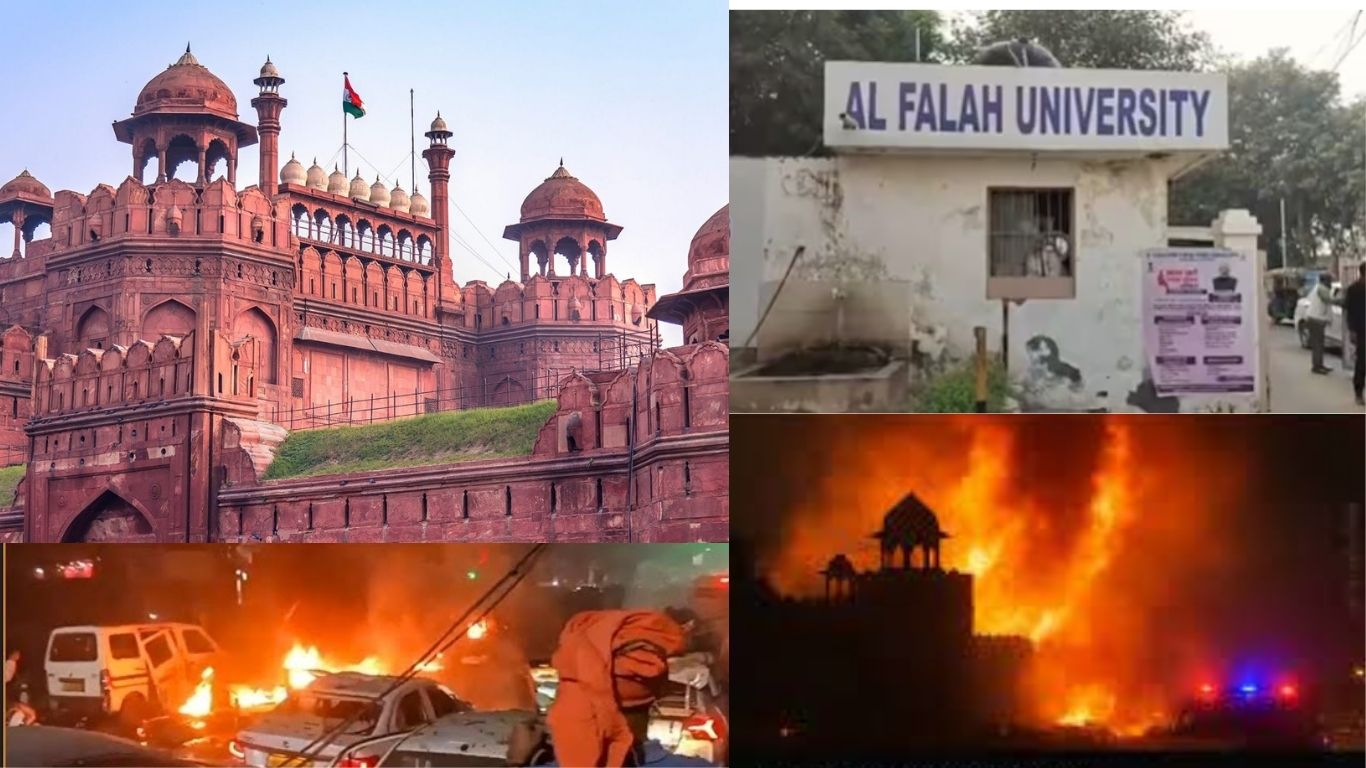
The arrest of a Kashmiri doctor teaching at Al-Falah University in Faridabad has exposed what investigators describe as one of the largest counterterrorism breakthroughs in recent years. What began as a probe into threatening posters in Srinagar has evolved into a massive multi-state operation stretching across Jammu & Kashmir, Haryana, and Uttar Pradesh. The investigation has unearthed nearly 2,900 kilograms of explosive material, multiple high-grade weapons, and a trail of radicalised professionals and students allegedly tied to Pakistan-based terror outfits Jaish-e-Mohammed (JeM) and Ansar Ghazwat-ul-Hind (AGuH).
Also in a stunning revelation, a link has emerged between the blast near Delhi’s iconic Red Fort that killed nine people on Monday evening and the “white collar” terror module that was busted by the police teams of Jammu and Kashmir and Haryana. The car in which the explosion took place was owned by a doctor, Umar who is from south Kashmir’s Pulwama and was a part of the module.
Meanwhile, police detained several individuals linked to the accused, including a religious scholar from a mosque near the university. Investigators are now examining whether Al-Falah University’s laboratory facilities were used to synthesize advanced explosives, including RDX-based compounds.
The investigation revealed that at least three doctors from Al-Falah University were allegedly in contact through encrypted Telegram groups, forming what police describe as a “radicalized academic network.” These individuals reportedly used university resources and professional cover to transport and store explosive materials.
The entire chain of events began after Jaish-e-Mohammed posters appeared on October 19 in Srinagar’s Bunpora Nowgam area. Following this, J&K Police filed an FIR under the Unlawful Activities (Prevention) Act, Explosive Substances Act, and Arms Act. The investigation soon pointed toward a “white-collar terror ecosystem” educated individuals using their professional networks, academic access, and financial resources to further extremist objectives.
On October 30, police arrested Dr. Muzamil Shakeel, a 35-year-old medical professor from Pulwama, who was teaching at Al-Falah University and managing its emergency hospital wing. His arrest turned out to be a turning point. Acting on his interrogation, J&K and Haryana Police uncovered large caches of arms, explosives, and bomb-making materials from rented rooms in Faridabad’s Dhauj area places the doctor had occupied just days before his detention.
During the search, authorities recovered a staggering 358 kg of ammonium nitrate, along with a Krinkov assault rifle, 83 live cartridges, a pistol, remote controls, batteries, and a walkie-talkie set. Investigators found 12 suitcases and a bucket filled with explosive substances, as well as 20 timers and other bomb assembly devices.
The scope of the discovery widened further when police raided another location in Dehar Colony, Dhauj, where an additional 2,563 kg of explosive and flammable materials were seized. The arsenal included a Chinese pistol, a Beretta pistol, an AK-56, and another Krinkov rifle all loaded with ammunition.
The volume and sophistication of the stockpile suggested that the materials were intended for a large-scale terror operation, possibly across multiple cities. A senior officer said the sheer magnitude of explosives and electronic detonators pointed to a meticulously planned strike, which could have led to mass casualties.
Faridabad Police Commissioner Satender Kumar Gupta confirmed that a transnational terror network had been uncovered. “Though details cannot be shared as it concerns national security, this is a coordinated operation by J&K and Haryana police that has successfully dismantled a major terror design,” he stated.
An alarming revelation came when a woman doctor’s car was found with an AK-47 rifle allegedly linked to Muzamil.
Authorities are now focusing on several key questions:
How many individuals were part of this network, both active operatives and sleeper cells?
What were their procurement and transport routes for the explosives and weapons?
Were the explosives sent in multiple consignments to Al-Falah university to evade detection?
What was the funding trail and were there foreign intelligence or terror handlers involved?
A broader probe led to the arrest of multiple individuals in Jammu & Kashmir Arif Nisar Dar alias Sahil, Yasir-ul-Ashraf, Maqsood Ahmad Dar alias Shahid, Molvi Irfan Ahmad, Zameer Ahmad Ahanger, and Dr. Muzammil Ahmad Ganaie all reportedly linked to JeM and AGuH networks.
Forensic teams are now trying to determine the exact chemical composition of the recovered materials. Experts believe the explosives were not designed for shrapnel-based damage, as seen in earlier Delhi blasts, but for heat and shockwave intensity indicating a shift toward more sophisticated terror engineering.
Instead of nails or ball bearings, these devices appeared to combine ammonium nitrate, fuel oil, and advanced electronic detonators materials that can produce extreme heat and overpressure, capable of incinerating vehicles and structures without leaving craters. The absence of crude metal fragments suggests the perpetrators were working with an advanced understanding of blast physics possibly through academic or laboratory experience.
Investigators are now coordinating with national forensic laboratories to determine whether the university’s labs were indeed used for testing or synthesizing components of these high-energy mixtures. If confirmed, this would mark one of the first cases in India where academic laboratories were directly linked to terror production.
This operation has exposed a new and alarming trend the infiltration of terrorist ideology into academic and professional institutions. Unlike traditional sleeper cells that rely on uneducated operatives, these new networks use educated professionals, doctors, and researchers who exploit institutional access and scientific knowledge for terror purposes.
The Al-Falah University connection underlines the urgent need for enhanced security audits in educational institutions, particularly those with access to chemical and biological materials. As investigators continue to trace the money flow, communications, and international handlers, one fact remains clear India is confronting a new, white-collar brand of terrorism, where radicalisation hides behind professional degrees and laboratory coats.