
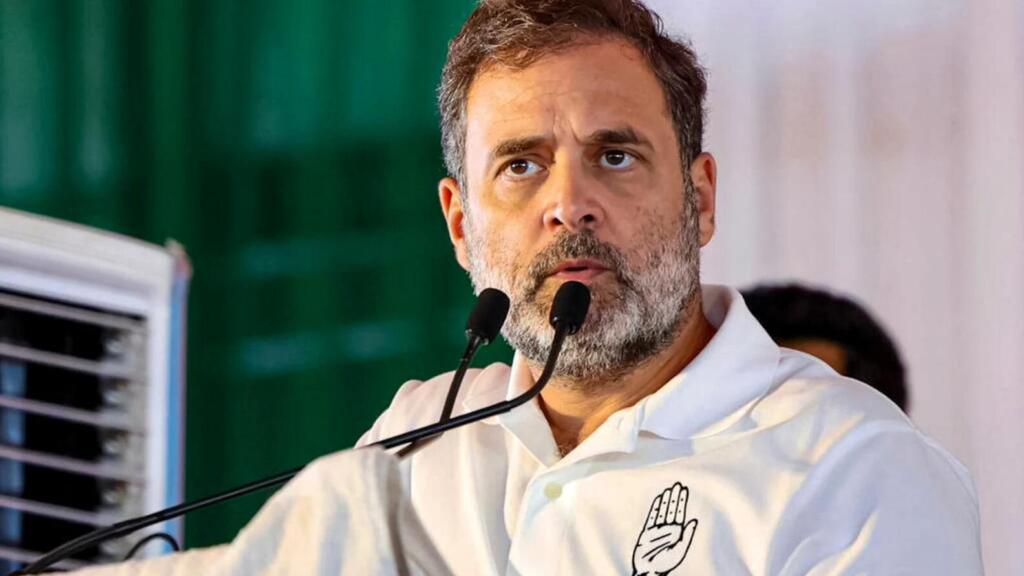
At his November 4 rally in Bihar, Rahul Gandhi once again plunged into divisive rhetoric, claiming that “10 per cent” of India’s population controls the judiciary, bureaucracy, business, and even the Indian Armed Forces. The statement, devoid of factual basis, marks yet another instance of the Congress leader’s reckless use of caste as a political weapon. Gandhi’s narrative, designed to provoke resentment ahead of the Bihar Assembly elections, represents not social justice but a cynical attempt to fracture national unity. By dragging India’s most trusted institutions into his caste discourse, he has crossed a moral and political line, revealing the depths of his party’s desperation to stay relevant.
Caste as a Political Weapon in Bihar
When Rahul Gandhi took the stage in Kutumba, Bihar, he wasn’t speaking as a visionary seeking reform or inclusion. Instead, he was indulging in the oldest and most destructive playbook of Indian politics caste polarisation. His claim that a “privileged 10 per cent” dominates all levers of power while the remaining “90 per cent” are marginalised was not an innocent observation but a calculated attempt to inflame social divides. Bihar, with its historically entrenched caste-based voting patterns, has become the perfect testing ground for Gandhi’s divisive experiment.
In his speech, Gandhi declared that the so-called “10 per cent” hold control over all opportunities from government posts to the Armed Forces leaving the majority of Dalits, backward castes, tribals, and minorities disenfranchised. Such rhetoric turns complex socio-economic realities into simplistic, incendiary binaries of the “oppressor versus the oppressed.” The Congress scion’s intention was not to highlight inequality but to harvest political mileage from it, painting himself as a saviour of the oppressed while vilifying an undefined elite group.
However, his claim collapses under scrutiny. There exists no official data supporting the notion that a mere “10 per cent” dominate these institutions. The Indian Army does not maintain caste-based records, precisely to prevent such divisive interpretations. Similarly, the judiciary and civil services have evolved with growing representation from marginalised groups. The current Chief Justice of India, D.Y. Chandrachud, and his predecessor Justice B.R. Gavai who comes from a Scheduled Caste background are both living testaments to the inclusivity that Gandhi conveniently ignores.
Dragging the Army Into Caste Politics: A Dangerous Line Crossed
Rahul Gandhi’s decision to include the Indian Armed Forces in his caste narrative represents an unprecedented breach of political decency. The Army stands as one of India’s most respected institutions, founded on unity, merit, and service to the nation. Soldiers in uniform fight and die for the tricolour not for caste, religion, or regional identity. To accuse the military of being under the control of a particular community is to question its integrity and insult its sacrifice.
This is not the first time Gandhi has made such irresponsible remarks about the military. During his Bharat Jodo Yatra, he accused the Modi government of allowing Chinese troops to “thrash Indian soldiers in Arunachal Pradesh.” The statement prompted a sharp rebuke from the Supreme Court, which observed, “If you are a true Indian, you would not say all this.” Yet, the lesson appears lost on Gandhi. By repeating similar insinuations, he not only undermines national morale but erodes public trust in the very institutions that safeguard India’s sovereignty.
In a country where the Armed Forces have stood as the bedrock of secularism and unity, introducing caste-based suspicion is a perilous act. It risks sowing doubt within ranks that function solely on discipline, loyalty, and equality principles that transcend all social distinctions.
The Politics of Arithmetic Masquerading as Social Justice
The deeper motivation behind Gandhi’s remarks lies in the Congress party’s strategic pivot toward caste politics. With the party losing its traditional upper-caste and middle-class base, the leadership now views “caste consciousness” as a replacement for ideology. By invoking the “90 per cent versus 10 per cent” framework, Gandhi hopes to consolidate Dalits, Extremely Backward Castes (EBCs), and minorities into a single voting bloc.
However, such a strategy is neither new nor noble. It mirrors the short-term populism that Congress has historically used to maintain power a politics that divides society rather than uplifts it. Instead of proposing measurable policies to address inequality such as educational reforms, job creation, or targeted welfare Gandhi relies on emotional provocation. His message to voters is not one of empowerment, but one of grievance: “You are poor and underrepresented because the elites took everything.”
Ironically, Gandhi’s own political lineage dismantles his argument. If indeed “10 per cent control India,” then the Congress, which ruled the nation for over five decades, bears the sole responsibility for allowing such concentration of power. His great-grandfather Jawaharlal Nehru, grandmother Indira Gandhi, and father Rajiv Gandhi all governed during periods when caste inequities were entrenched. In blaming a faceless elite, Rahul Gandhi is effectively indicting his own family’s legacy.
The Hollow Advocacy of a Failed Reformer
What makes Gandhi’s rhetoric even more hollow is the gap between his words and actions. His repeated calls for a nationwide caste census ring empty when his own party’s government in Karnataka refuses to release its caste survey report. Congress’s double standards are glaring transparency is demanded from others but denied where the data might challenge its own narrative.
Moreover, Gandhi’s argument disregards the tangible progress made through reservation policies, welfare schemes, and economic empowerment programmes many introduced under Congress rule. To insist that backward castes and Dalits remain invisible in every sphere is not only inaccurate but dismissive of decades of affirmative action. It suggests that these efforts have failed entirely, a statement that insults both the beneficiaries and the reformers who fought for inclusion.
True reformers unite societies through data-driven policy, compassion, and dialogue. Rahul Gandhi’s version of politics thrives instead on anger and fragmentation. By turning caste into a weapon and national institutions into political targets, he undermines the very democratic fabric he claims to defend.
Dividing India, One Institution at a Time
Rahul Gandhi’s latest outburst in Bihar is not an isolated episode; it is part of a broader pattern of political opportunism. Each time he faces electoral irrelevance, he returns to divisive rhetoric whether it is attacking the military, discrediting the judiciary, or vilifying India’s business class. His “10 per cent” remark reveals not concern for the oppressed, but contempt for truth and national unity.
By weaponising caste discourse, Gandhi risks undoing decades of progress made toward social cohesion. India’s strength lies in its diversity not in reducing it to a battlefield of numerical resentment. The Congress leader’s words may win applause in partisan rallies, but they erode the foundations of trust that sustain the Republic. If his political mission is to rebuild India, he must begin by respecting the institutions that hold it together not tearing them down for electoral gain.