















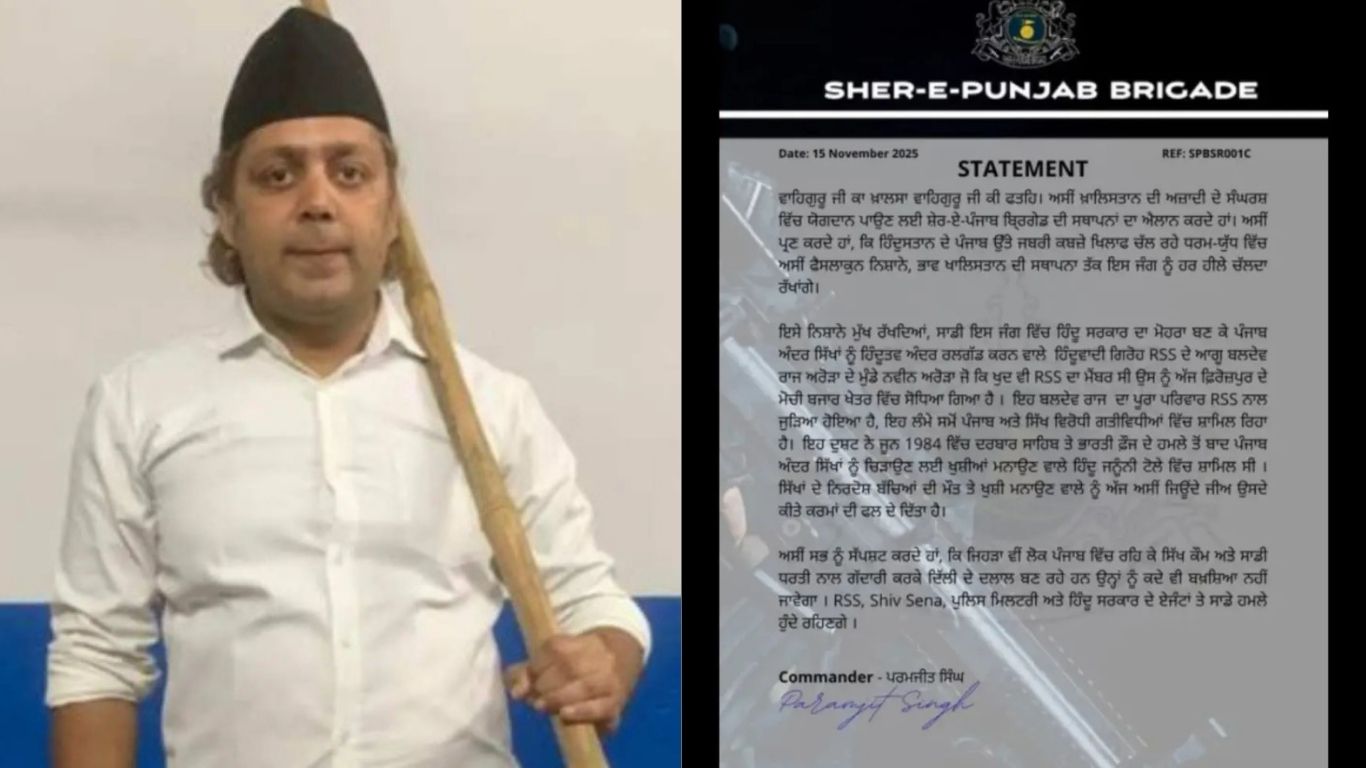
Punjab witnessed a shocking act of targeted violence on 15 November when two motorcycle-borne assailants shot dead 32-year-old Naveen Arora in Ferozepur. Naveen, a third-generation RSS volunteer, was the son of Baldev Raj Arora and grandson of the late Dina Nath, a respected social worker and senior RSS figure. Within hours of the killing, a pro-Khalistan extremist outfit identifying itself as the “Sher-e-Punjab Brigade” openly claimed responsibility through a social media post, announcing itself as a new militant organisation dedicated to the creation of Khalistan.
In its statement, the outfit declared its formation with overtly separatist rhetoric: “Waheguru Ji Ka Khalsa, Waheguru Ji Ki Fateh… we announce the establishment of the Sher-e-Punjab Brigade to contribute to the struggle for the independence of Khalistan.”
The post described the murder as part of their so-called “dharam-yudh” against the “forcible occupation of Hindustan over Punjab,” vowing to use “every possible means” until an “independent Khalistan” is achieved.
The group alleged that Naveen, like his father Baldev Raj, was working to “assimilate Sikhs into Hindutva,” and justified the killing as a “correction” carried out in the Mochi Bazar area. The post further accused the Arora family of long-standing loyalty to the RSS and invoked historical grievances, including the aftermath of Operation Blue Star, using them to rationalise the murder.
The self-proclaimed “spokesperson” Bahadur Singh Sandhu and “commander” Paramjit Singh signed the statement, threatening more violence against RSS workers, Shiv Sena members, police personnel and anyone they deemed “agents of Delhi.”
The assassination triggered immediate shock across Ferozepur, with local trader associations shutting down markets in solidarity with the victim’s family. Political leaders sharply criticised the AAP government for its perceived inability to maintain law and order.
Punjab BJP chief Sunil Jakhar called the killing another glaring example of the “collapse of law and order” under the Bhagwant Mann administration. He accused the chief minister of leaving Punjab “directionless” and said the atmosphere had emboldened gangsters and extremist elements.
Union Minister of State Ravneet Singh Bittu also questioned the state government’s double standards. He pointed out that senior police officers were suspended over minor administrative issues while no accountability had been fixed for a politically sensitive murder carried out by extremists. “If the police cannot control crime, the chief minister must answer,” Bittu said.
Police have registered a murder case and sent the body for post-mortem. Officials say technical analysis, including CCTV tracing and mobile data examination, is underway to identify the attackers.
Notably, more than 24 hours after the murder, authorities remained unsure of the killers’ identities until the extremist group issued its claim online. This gap has raised further concerns about intelligence failures and the growing ability of separatist groups to operate undetected.
Security agencies are now investigating whether the “Sher-e-Punjab Brigade” is a rebranded front of existing Khalistani groups or a newly activated module. Officials caution that more details will emerge as digital forensics and ground-level intelligence progress.
The murder of Naveen Arora is not merely a crime but a stark reminder of the resurgence of radical Khalistani elements attempting to destabilise Punjab. The ease with which the killers executed the attack, followed by a public claim of responsibility, raises disturbing questions about the state’s security preparedness. As political outrage intensifies and the investigation deepens, Punjab faces mounting pressure to dismantle extremist networks before they reclaim space in the border state’s fragile security environment.