
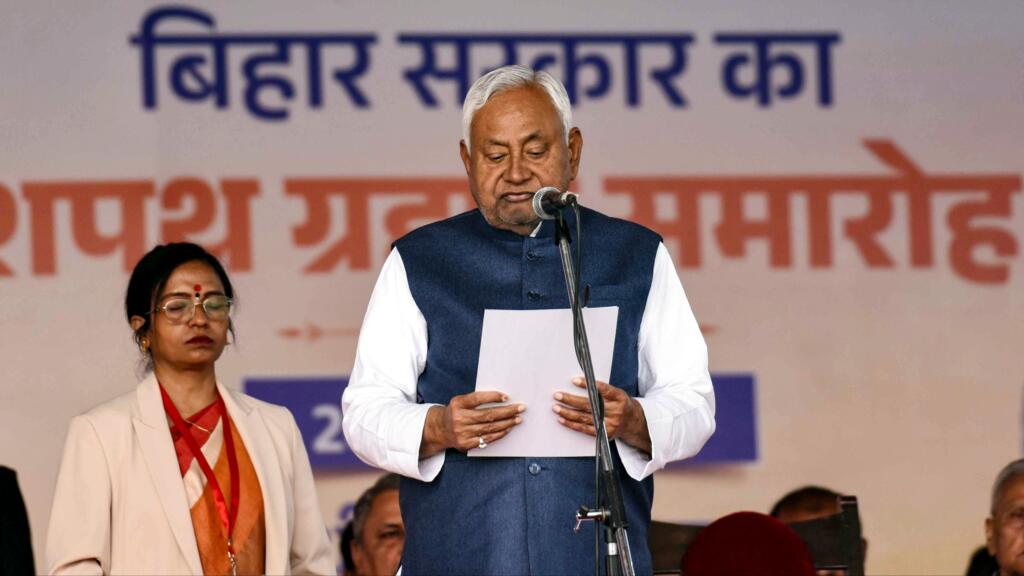
Patna — Bihar Chief Minister Nitish Kumar remains one of Indian politics’ most politically flexible leaders, known for frequently shifting alliances and keeping his hold on power. A recent Bhaskar explainer throws light on the lesser-known dimensions of his long, often turbulent political journey, to be precise an enigma — especially his connections with Prime Minister Narendra Modi, Lalu Prasad Yadav, and the internal workings of his Janata Dal (United) party.
Political Chameleon: Switching Sides But Staying on Top
Career of Nitish Kumar is defined by thee enigma of his ability to pivot between rival camps. Over the years, he has repeatedly broken and remade alliances — sometimes partnering with the BJP-led National Democratic Alliance (NDA), and at other times joining hands with Lalu Yadav’s RJD in the grand opposition. According to Bhaskar, this very adaptability has earned him the label of a “kingmaker” in Bihar politics.
His Long Game: Power Over Ideology
Though critics accuse him of flip-flopping for convenience, Nitish emphasizes governance and development in his political narrative. He often draws a sharp contrast between his rule and the “jungle raj” he attributes to Lalu Yadav’s era, arguing that stability and growth define his two-decade-plus tenure.
At the same time, some argue that his core belief centers more around power retention than ideology and that’s the greatest enigma of currrent Indian politics. His repeated shifts, the explainer suggests, are part of a long-term strategy to remain relevant and influential — regardless of his alliance.
The Modi Connection: From Skeptic to Strategist
Nitish’s relationship with Prime Minister Narendra Modi is perhaps his most strategic alliance. He initially opposed Modi but later rejoined the NDA, leveraging the partnership to consolidate his political influence in Bihar and nationally. This alliance has helped Nitish Kumar navigate power dynamics, offering him a crucial role in both state governance and national politics. What can be a better definition of enigma!
Lalu Yadav: From Mentor to Rival
Enigma of Nitish Kumar is deeply intertwined with Lalu Prasad Yadav. They have been allies and rivals: at times competing for dominance, at others joining forces. Nitish has publicly claimed he played a major role in Lalu’s rise, even calling himself a kingmaker in the Yadav dynasty. But Lalu’s son, Tejashwi Yadav, has struck back — saying he helped make Nitish CM twice, and accusing him of rewriting narrative history.
Personal Moments and Public Gaffes
Nitish is not immune to controversy. According to India Today, he has faced criticism for repeated public gaffes, including moments when he himself brought forth an enigma, appeared to confuse his own role and that of other political figures. India Today One such slip — wishing Modi could become Chief Minister instead of Prime Minister — sparked sharp reactions. NDTV India
Tejashwi Yadav, in particular, has mocked these blunders, calling Nitish Kumar a “tired CM” surrounded by retired bureaucrats and questioning his capacity to lead.
Power, Pragmatism, and Public Perception
Critics and opponents routinely question Nitish’s consistency, calling him opportunistic or overly pragmatic. Strategist Prashant Kishor has even suggested that Modi and BJP rely on Nitish more than leaders from their own party, citing tactical convenience. India Today Meanwhile, Nitish’s approach to governance — focusing on incremental development rather than ideological flash — remains his core strength and public pitch.
Political life of Nitish Kumar is also an enigma, a study in contrasts. He is a seasoned statesman whose survival instincts are unmatched, yet often accused of ideological ambiguity. He is a development-focused leader, but one whose loyalties shift when it suits him. For many, he is a builder of bridges; for others, a tactical opportunist.
As Bihar heads into further political uncertainty, Nitish’s blend of pragmatism, adaptability, and strategic alliance-building means he remains a central figure — not just in his own party, but in the broader power dynamics of Indian politics.