

















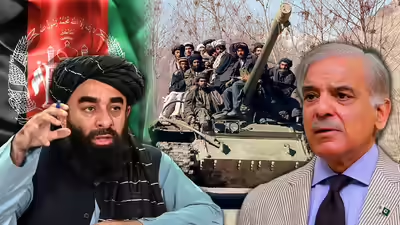
In a dramatic shift in its Afghanistan policy, Pakistan has delivered what top diplomatic and intelligence sources describe as its “final message” to the Afghan Taliban leadership: opt for reconciliation, accept Pakistan’s security demands, or face Islamabad’s support for alternative political forces capable of challenging the regime in Kabul.
According to top sources, Pakistan conveyed this ultimatum through Turkish mediators, after months of stalemated negotiations with the Taliban government. The latest message underscores Islamabad’s growing frustration with the Taliban’s unwillingness to curb the Tehreek-e-Taliban Pakistan (TTP) and rising cross-border militant attacks.
Pakistan’s decision comes amid Taliban outreach to New Delhi highlighted by Afghan Foreign Minister Amir Khan Muttaqi’s recent visit to India. The shift towards India, officials say, has compelled Pakistan to reassess its long-standing engagement strategy with Kabul.
Islamabad now views the Taliban’s stance not only as a security threat but also as a geopolitical snub. As a result, Pakistan has begun realigning itself with anti-Taliban political figures and resistance networks, both inside and outside Afghanistan.
Top sources confirm that Pakistan’s intelligence establishment has already reached out to several prominent Afghan democratic and opposition figures, including: Hamid Karzai, Ashraf Ghani, Ahmad Massoud (National Resistance Front), Abdul Rashid Dostum, members of the Afghanistan Freedom Front and Northern Alliance-linked commanders.
Islamabad has reportedly offered these leaders political space, safe presence, and operational offices in Pakistan, signaling a readiness to create an organised platform for the Afghan opposition.
Sources say the offer also extends to exiled Afghan women leaders, activists, and pro-democracy groups, who have consistently demanded a return to an inclusive, legitimate, and transparent political process either through a Loya Jirga or future elections.
Despite three rounds of discussions mediated first by Qatar and later by Turkey Pakistan and the Afghan Taliban have failed to reach a breakthrough. The Pak-Afghan ceasefire, agreed tentatively during earlier phases of dialogue, remains in abeyance following the failure of the Istanbul round of talks.
However, Kabul has resisted these conditions, especially those involving TTP handovers and the buffer-zone proposal positions Pakistan views as unacceptable given the rise in attacks targeting its security forces.
Pakistan’s decision to support anti-Taliban factions marks its most serious recalibration since the fall of Kabul in 2021. Officials describe the move as a necessary strategic correction, aimed at ensuring Pakistan’s security and regional stability.
Islamabad’s demands in the negotiations have remained consistent:
- Firm action against the TTP
- Handover of hardcore TTP militants
- Guarantees of non-escalation along the Durand Line
- Creation of a buffer zone to curb cross-border terrorism
- Normalisation of trade and bilateral cooperation
The Durand Line is an arbitrary and colonial-determined demarcation. The 2,640-kilometre line came into existence in 1893. Mortimer Durand drew this line as a culmination of a great game of geopolitics between the British and Russian empires. The culmination of one game of geopolitics marked the commencement of another. It divided the Pashtun people and developed a fault line that has been festering since its inception. Unless it is redrawn, it will continue to brew passion, emotion, and antagonism. The cunningness of colonial cartography keeps the scar of separation open and increases the disquiet between Kabul and Islamabad.
Pakistan tries to normalise the line, but for Afghanistan whichever government was in power, including communists, republicans, and Islamists it is the thorniest issue and a politically charged subject, and sees no scope of closure in the foreseeable future unless redrawn. Pakistan’s insistence on normalising the Durand Line and disarming the TTP increasingly decouples the Taliban from the former’s sphere of influence. Islamabad accuses the Taliban of betrayal and disloyalty. Pakistan has always been unscrupulous with its partners and friends. Disloyalty is its DNA. It is ironic that it reverses its role and begins preaching morality and loyalty. It is laughable and ridiculous.
India’s people-to-people contact with Afghanistan is deeper. It is Afghanistan’s all-weather friend. It has always stood by the Afghan people whenever calamity befell them. India’s consistent humanitarian support is extraordinary. Education, roads, medical support, student visas, hospitals, the Parliament building, food supplies, building the Afghan cricket team and giving it a global standard these are some of the very important initiatives India has undertaken. This extension of friendship is not sporadic but continuous. Cricket in Afghanistan has proven to be cathartic as it has made them forget the unending uncertainty, instability, and fragmentation. It has also developed a strong sense of nationalism among the Afghan people.
The people of Afghanistan look up to India for a difference in their destiny and future. They wish to shake off the status quo and victimhood of geography. Pakistan’s economic coercion has been unspeakable, and its duplicity unimaginable. India is the only way out. It has no territorial ambition. It is pure goodwill and people-to-people contact that shape the India-Afghanistan relationship.
The visit of Afghan Taliban Foreign Minister Amir Khan Muttaqi was a strategic move. It illustrates the Taliban’s decision to sever the ideological umbilical cord with Pakistan. The Taliban needs international recognition and decoupling from Pakistan’s sphere of influence. The recent killing of three cricketers by Pakistani precision attacks has infuriated the Afghans. Other acts of aggression by the Pakistani state against Afghanistan have developed deep resentment against Pakistan.
The ceasefire may not hold the antagonism in abeyance much longer. It seems that it will soon erupt. Pakistan’s three expectations from the Taliban do not make any headway. They embroil Islamabad in a deeper problem. The three wishes are: to normalise the Durand Line, to disarm the TTP, and to remove India from Afghanistan. All three continue to remain Pakistan’s fantasy.





