
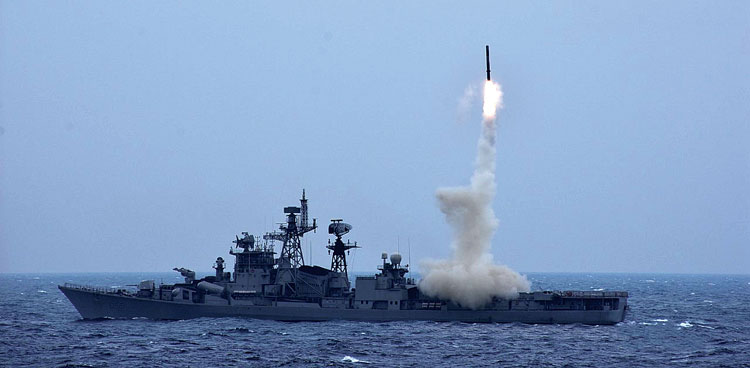
In a landmark step toward self-reliance in defense technology, the Indian Navy is preparing to induct the Vertically Launched Short-Range Surface-to-Air Missile (VL-SRSAM) system an indigenous missile derived from the Astra Mk-I air-to-air platform marking the beginning of a new era in naval point-defense capability. The induction, set to begin in 2030, will phase out the aging Barak-1 missile systems, which have served as the Navy’s frontline short-range air defense shield for over two decades.
Developed jointly by the Defence Research and Development Organisation (DRDO) and the Indian Navy, the VL-SRSAM is a naval adaptation of the Astra Mk-I, India’s first beyond-visual-range air-to-air missile. While Astra boasts a range of over 100 km in aerial engagements, its naval counterpart is optimized for close-in interception, engaging hostile aircraft, drones, and sea-skimming anti-ship missiles within a 40–50 km envelope.
Equipped with an active radar seeker and smokeless propulsion, the VL-SRSAM offers rapid target acquisition and high maneuverability, ensuring 360-degree protection for Indian warships. The system’s cold-launch vertical system design minimizes thermal signatures and enables simultaneous multi-missile launches from compact canisters a technological leap over the Barak-1’s hot-launch configuration.
Recent developmental and user-associated trials conducted off the Odisha coast and Arabian Sea between 2024 and 2025 validated its precision, reliability, and integration with the Navy’s MF-STAR radar and Combat Management System (CMS). The successful interception of a high-speed, sea-skimming target during the 2025 test was a major milestone, proving the missile’s readiness for operational deployment.
The Barak-1 system, of Israeli origin, was inducted in the early 2000s and became a staple defensive asset across Indian Navy platforms including Kolkata-class destroyers, Shivalik-class frigates, and Talwar-class vessels. Each ship typically carries three 8-cell vertical launch systems (VLS), providing a 24-missile close-in defensive layer. However, the Barak-1’s limited 12 km range and increasing supply chain constraints due to shifting geopolitical equations have rendered the system outdated.
Recognizing this gap, the Defence Acquisition Council (DAC) in August 2025 approved a mid-life upgrade to keep the fleet battle-ready until VL-SRSAM’s induction. The upcoming system, however, represents more than just a replacement it symbolizes India’s transition to indigenous, modular, and scalable defense technology.
With over 80% indigenous content, the VL-SRSAM aligns with the Atmanirbhar Bharat mission, ensuring long-term strategic autonomy. Its modular VLS design maintains compatibility with existing shipboard architecture, minimizing refit requirements. Each vessel undergoing the upgrade will complete integration in 12–18 months, enabling the Navy to transition smoothly to the new system.
The VL-SRSAM’s roadmap is structured and deliberate. Following final certifications in 2026, limited user trials will commence aboard a testbed platform such as INS Surat, part of the Project 15B destroyer class. Production is expected to scale rapidly under Bharat Dynamics Limited (BDL), with an annual output target of 200-plus missiles by 2028.
By 2035, the Navy aims to integrate the system across 20–25 major surface combatants, starting with frontline destroyers and frigates before extending to Kamorta-class corvettes and future indigenous warships. This integration will enhance response times to under five seconds, enabling ships to counter saturation attacks and swarm drone tactics effectively a critical capability in the Indian Ocean Region (IOR) where India serves as the net security provider.
The induction of the VL-SRSAM will significantly strengthen India’s multi-layered air defense architecture, complementing long-range systems like Barak-8 and Akash-NG. Together, they create a seamless protective umbrella that can counter everything from stealth aircraft and drones to supersonic cruise missiles.
The VL-SRSAM will be a “game-changer that enhances India’s maritime dominance and strategic deterrence.” The system’s ability to intercept low-altitude threats in all-weather conditions ensures that Indian warships remain protected even in complex electronic warfare environments.
The upcoming VL-SRSAM induction marks a defining moment in India’s journey toward naval self-reliance. It represents more than a technological milestone it is a strategic statement of intent. By replacing foreign-origin systems with indigenous innovation, India is securing its fleets with homegrown capability, strengthening its defense ecosystem, and reinforcing its leadership in the Indo-Pacific.
With the Astra lineage, indigenous innovation, and naval modernization converging, the Indian Navy is preparing to face the threats of the future not with borrowed shields, but with its own. The VL-SRSAM will not just defend India’s ships; it will defend India’s sovereignty at sea.