
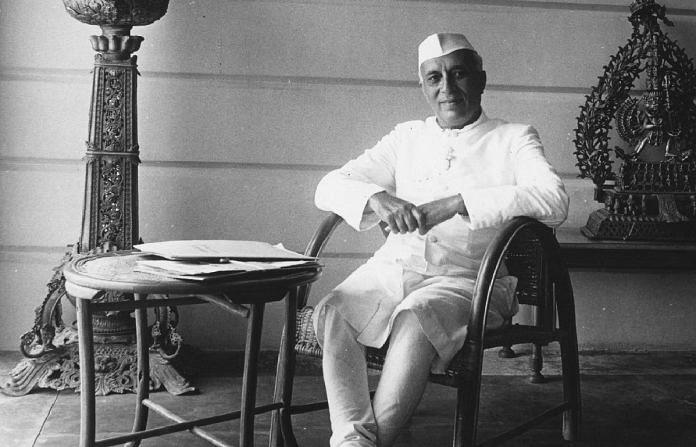
As political debates sharpen across India and ideological battles intensify, one name resurfaces again and again Vinayak Damodar Savarkar, revered by millions as Veer Savarkar. Yet, despite his monumental contributions to India’s freedom struggle, he remains one of the most misrepresented figures in Indian history. For decades, the Congress establishment not only ignored him but actively demonised him, reducing a towering revolutionary to a caricature through selective narratives, distortions, and outright slander. The contrast becomes starker when one examines how Congress glorifies Jawaharlal Nehru who buckled within two weeks of imprisonment in Nabha while branding Savarkar, who suffered eleven years of hellish incarceration in Andaman’s Cellular Jail, as a “traitor.” This selective memory exposes the Congress’s long-running project to shape historical perception to suit its political legacy.
For years after Independence, Congress governments controlled the academic, cultural, and historical narrative of India. Savarkar, because of his ideology and unapologetic nationalism, never suited their worldview. Thus began a systematic effort to tarnish his legacy.
Congress leaders repeatedly labelled Savarkar as:
-
“a British stooge”
-
“a loyal colonialist”
-
“a traitor”
-
“a man who begged for mercy”
At times, the smear campaign turned outright disgraceful. Congress workers in several parts of the country have garlanded Savarkar’s statues with shoes, blackened them, or publicly abused him an insult unmatched in the treatment of any other national leader.
Their justification? The so-called “clemency petitions” written by Savarkar from the Cellular Jail.
What Congress never mentions is the unimaginable torture Savarkar endured, the survival strategy those petitions represented, and the fact that dozens of Congress leaders themselves used similar legal methods to secure release from British jails. They also ignore the crucial truth: Savarkar’s petitions were political manoeuvres, not acts of surrender.
But while they weaponise Savarkar’s strategic actions, they conveniently hide the episode where Jawaharlal Nehru himself signed a bond with the British an act that would have been labelled “betrayal” had any non-Congress leader done it.
In 1923, Jawaharlal Nehru was arrested for defying a ban on entering the princely state of Nabha. Officially sentenced to two years, Nehru was barely able to withstand the prison conditions for two weeks.
Historical records and even Nehru’s own autobiography confirm that:
-
Nehru was kept in an unsanitary, damp cell
-
He faced tough but routine prison conditions
-
Within 14 days, he signed a bond promising never to enter Nabha again
-
He was released only after submitting to British conditions
Professor Chaman Lal, a renowned chronicler of India’s freedom struggle, authenticated this episode in detail. He notes that Nehru was briefly kept in a Jaitu police cell and then in Nabha Jail, where he allegedly faced rough treatment. But what followed is more revealing.
Motilal Nehru, worried about his son’s situation, reached out to the highest British authorities including the Viceroy seeking intervention. Soon after, the jail administration suddenly changed its attitude:
-
Nehru and his colleagues were given clothes
-
They were allowed special food
-
Their bath arrangements improved
-
They gained preferential treatment compared to other prisoners
Freedom fighter K. Santanam, imprisoned alongside Nehru, wrote in Handcuffed with Jawaharlal that Nehru signed the bond agreeing never to enter Nabha again.
Nehru himself admitted the same in his autobiography, describing how the poor conditions in the jail pushed him to sign the compliance bond.
Contrast this with Savarkar who did not just survive two weeks, but endured eleven years of unimaginable torture without breaking down.
The Cellular Jail in the Andaman Islands known as “Kaala Pani” was not a normal prison. It was designed for extreme psychological and physical torture, meant to crush the toughest revolutionaries.
Savarkar was sentenced to two life imprisonments 50 years a punishment unprecedented in Indian history.
Inside Cellular Jail, Savarkar:
-
Was kept in chains
-
Was flogged repeatedly
-
Was subjected to six months of solitary confinement
-
Was forced to pound coir with bleeding hands
-
Had to manually crush coconuts in a gigantic oil mill, often producing 30 pounds of oil a day
-
Faced starvation-level food, often infested with worms
-
Was allowed to write letters only once every 18 months
-
Had his poems scraped onto cell walls deliberately whitewashed to break his spirit
And yet, Savarkar neither broke nor surrendered.
Unlike many political prisoners who were driven to insanity or suicide, Savarkar remained intellectually sharp, emotionally determined, and ideologically steadfast. He used petitions strategically not only for his own release, but for the release of several fellow freedom fighters.
The British themselves feared him not for violent rebellion but for his ideological reach.
After his Andaman incarceration, Savarkar was sent to Ratnagiri Jail, where restrictions continued for years.
The question that must be asked is simple:
How many Congress leaders endured even a fraction of Savarkar’s torture?
Before his imprisonment, Savarkar was already one of the most influential revolutionaries of the early 20th century.
He:
-
Founded the revolutionary organisation Mitra Mela, later renamed Abhinav Bharat
-
Was one of the earliest voices to demand Purna Swaraj (complete independence) decades before the Congress adopted the idea
-
Mobilised Indian students in London against British rule
-
Authored works that inspired revolutionaries across India
-
Strengthened the ideological foundation of Hindu nationalism
-
Served as a key intellectual influence on several freedom fighters
Even after his release, he lived under strict surveillance and restrictions for years. Yet, he continued his writings, social reforms, and activism.
Criticism is easy but understanding the depth of his sacrifice requires intellectual honesty, something Congress has consistently avoided.
Veer Savarkar’s legacy is not just a story of bravery or revolution it is a story of how political power can distort history. While Nehru, who signed a compliance bond within two weeks, is hailed as a national icon, Savarkar who survived 11 years of hellish torture is labelled a “traitor.”
This inversion of moral logic reveals more about Congress than about Savarkar.
Today, as India re-examines its past with honesty, one truth emerges clearly:
Savarkar was one of India’s greatest patriots, a visionary, and a revolutionary whose contributions were deliberately buried by those threatened by his ideology.
History is finally correcting itself.
And the nation is rediscovering the man who gave everything not for political glory, not for power, but for Bharat.