











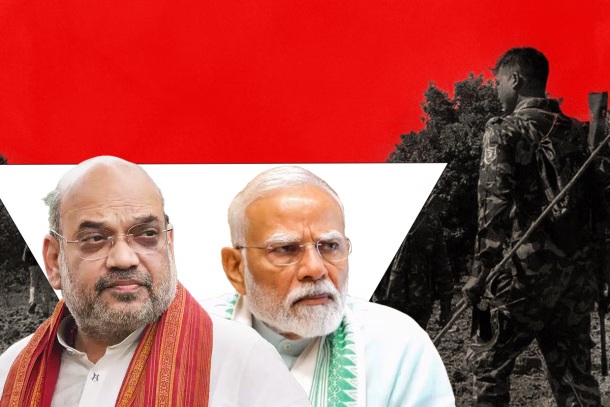
Since 2014, Modi Government’s categorical expenses has executed one of India’s most comprehensive, well-funded and multi-layered counter-insurgency campaigns against Left Wing Extremism (LWE). Newly released Right to Information (RTI) data reveals the financial backbone of this strategy: ₹3,507.86 crore has been released to states under the Security Related Expenditure (SRE) Scheme, while an additional ₹1,217.16 crore has gone to central agencies under specialized anti-Naxal programmes. Together, these numbers highlight an unprecedented investment of over ₹4,700 crore in stabilisation, security support, and rehabilitation in Naxal-affected regions.
A Sustained Financial Commitment Since 2014
According to data provided by the Modi Govrnment’s Ministry of Home Affairs (MHA), the funds were released between FY 2014–15 and FY 2024–25, aligning with Prime Minister Narendra Modi’s first term and continuing into the present. The SRE Scheme functions as a reimbursement mechanism for states most affected by Naxal violence, enabling them to strengthen their local police forces, improve intelligence networks, and support the rehabilitation of surrendered cadres.
This financial commitment is not isolated—it forms part of a larger, calibrated strategy that includes modernization of police forces, targeted central interventions, infrastructure creation in remote districts, and steady political pressure on insurgent groups.
The RTI response received on 23 November marks the third data-based instalment in an ongoing series, after earlier disclosures detailed the numbers of Naxals eliminated or surrendered, arms recovered, and personnel casualties over the years.
Which States Received the Most Support
The distribution of funds under the SRE Scheme correlates directly with the intensity of Naxal activity:
Chhattisgarh: ₹1,219.28 crore
Jharkhand: ₹917.32 crore
Odisha: ₹453.62 crore
Maharashtra: ₹262.53 crore
Andhra Pradesh: ₹182.21 crore
Bihar: ₹175.25 crore
Telangana: ₹107.52 crore
West Bengal: ₹108.83 crore
Madhya Pradesh: ₹38.61 crore
Uttar Pradesh: ₹36.37 crore
Kerala: ₹6.32 crore
Chhattisgarh and Jharkhand—long considered the epicentres of Naxal violence—are unsurprisingly the top beneficiaries. The data also shows that Chhattisgarh saw a major spike in allocations by Modi Government’s cabinet during periods of intensified operations, particularly in Bastar and surrounding districts. FY 2024–25 marked the highest yearly reimbursement for the state, indicating continuing pressure on insurgent groups.
What the SRE Scheme Actually Funds
The SRE Scheme covers a wide range of counter-insurgency and community engagement expenditures. According to the Ministry of Home Affairs, SRE reimburses states for:
Training and operational needs of police forces
Ex gratia payments to families of civilians or security personnel killed or injured in LWE violence
Rehabilitation packages for surrendered Naxal cadres
Community policing initiatives and village defence committees
Publicity and awareness materials
Compensation for security personnel incapacitated during operations
Compensation for property damage in LWE incidents
In effect, Modi Government’s SRE acts as an operational backbone for states, helping them sustain round-the-clock policing, intelligence operations, and grassroot interventions.
Support to Central Agencies: ANM and ACALWEM
Alongside state-level assistance, Modi Government’s pragmatic decisions have also been funding federal forces and agencies involved in anti-Naxal efforts. Through the Assistance to Naxal Management (ANM) and Assistance to Central Agencies for LWE Management (ACALWEM) schemes, the MHA has released ₹1,217.16 crore since 2014.
These funds typically support:
CRPF and elite combat units
Inter-state intelligence operations
Air support and logistics
High-end surveillance equipment
Training special action groups
Together, state reimbursements and central agency allocations reveal a coordinated, two-front strategy.
Why These Disclosures Matter
The combined RTI findings paint a vivid picture of the Modi Government’s long-term, multi-layered approach to eliminating the Naxal threat. The effort blends funding, force deployment, community outreach, and rehabilitation, along with infrastructural and administrative consolidation in remote regions.
Home Minister Amit Shah has repeatedly stated that the government aims to end the Naxal problem by March 2026. This target appears to be shaping both political messaging and on-ground operations. With record numbers of surrenders and neutralisations reported in earlier RTI replies, the financial data now adds another dimension: the government has systematically scaled up resources to match its timelines.
Psychological Impact on Naxal Cadres
Recent developments suggest that the insurgency’s internal morale has been significantly shaken. The Special Zonal Committee covering Maharashtra, Madhya Pradesh, and Chhattisgarh of the banned Communist Party of India (Maoist) recently wrote to three state chief ministers, expressing support for the surrender of two senior members, Sonu and Satish, and proposing a temporary suspension of violence.
Additionally, the killing of Madvi Hidma, one of the most feared and high-ranked Naxal commanders, has reportedly dealt a major psychological blow to the organisation.
Despite these overtures, Modi Government’s stance has been firm: the government will not entertain negotiation requests from insurgents unless they surrender and join the mainstream.
A Decade-Long Strategy Nearing Its Intended Milestone
With over ₹4,700 crore invested in counter-LWE operations since 2014, and a coordinated political-security framework in place, the Modi Government’s anti-Naxal strategy appears to be entering its decisive phase. Whether the March 2026 deadline is met remains to be seen, but the structural, financial and operational depth reflected in these RTI disclosures underscores a clear national strategy—one that prioritises both force and rehabilitation, breaking the insurgency’s backbone while attempting to bring estranged cadres back into civilian life.