












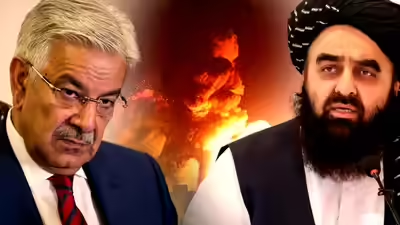
On the eve of crucial peace talks in Istanbul between Afghanistan and Pakistan, Pakistan’s Defence Minister Khawaja Asif issued yet another reckless threat, warning the Taliban government of possible military action. His blunt words “War will happen” once again revealed Pakistan’s habitual resort to intimidation when diplomacy fails. This time, however, Asif’s outburst has backfired, exposing Islamabad’s desperation, its diplomatic isolation, and its failure to manage the blowback of its own decades-long interference in Afghanistan’s affairs.
Pakistan’s Empty Posturing Before Peace Talks
Khawaja Asif’s bellicose remarks came just hours before high-level delegations from Afghanistan and Pakistan were set to meet in Turkey, under the mediation of Turkiye and Qatar, to revive a fragile ceasefire. The meeting, dubbed the “Afghan-Pakistan Peace Talks,” was intended to discuss the growing border skirmishes, drone strikes, and trade disruptions that have crippled bilateral ties. Yet, instead of promoting conciliation, Pakistan’s Defence Minister chose to ignite tensions, casting a dark shadow over the diplomatic process.
Asif’s claim that Afghanistan “harbours militants” and “turns a blind eye” to cross-border terrorism reeks of irony. For decades, Pakistan’s own military establishment has been accused of nurturing militant groups on Afghan soil from providing safe havens to the Taliban before 2021 to training radical outfits under the ISI’s watch. Today, those same groups have turned their guns on Pakistan, a grim reminder that terrorism cannot be exported without consequences.
Afghanistan Strikes Back with Sharp Diplomacy
Afghanistan, under the Taliban government, wasted no time in condemning Asif’s provocative statement. Kabul accused Pakistan of “drone warfare on civilians” and of being silent over “training ISIS terrorists.” This sharp counter-response reflects how far the balance of power has shifted. Pakistan, once the dominant player pulling strings in Kabul, now faces a government that refuses to bow to its coercion.
The Afghan delegation to the talks, led by Intelligence Chief Abdul Haq Wasiq and senior Taliban member Anas Haqqani, arrived in Turkey with a clear agenda to demand Pakistan stop violating Afghan sovereignty. According to reports, Kabul will also push for an end to Islamabad’s unilateral trade blockades and drone incursions that have killed Afghan civilians and disrupted commerce.
Meanwhile, Pakistan’s team led by ISI Chief Lieutenant General Muhammad Asim is focused narrowly on security concerns, reflecting Islamabad’s obsession with control rather than cooperation. More than 8,000 Afghan containers remain stranded in Pakistan, and 4,000 others await clearance, a crisis that has severely damaged cross-border trade and public trust.
Pakistan’s Internal Discord Comes to the Fore
Adding fuel to the diplomatic fire, Pakistan’s Deputy Prime Minister Ishaq Dar further embarrassed his own government by boasting that Afghan Foreign Minister Amir Khan Muttaqi had called him “six times in one day.” Kabul swiftly dismissed this as “false and inconsistent with diplomatic ethics.” The incident highlights Pakistan’s growing credibility crisis even its attempts at diplomacy are now marred by falsehoods and internal contradictions.
Dar’s subsequent criticism of Pakistan’s intelligence agency, the ISI, added to the chaos. Referring to the viral 2021 image of the ISI chief sipping tea in Kabul after the Taliban’s victory, Dar remarked, “That cup of tea proved expensive for Pakistan.” His words underscore the bitter irony the very forces Pakistan once celebrated are now threatening its borders and stability.
Khawaja Asif’s war-mongering statements are seen by analysts as little more than a desperate distraction. Pakistan’s economy is in freefall, inflation is skyrocketing, and protests against the Sharif government are rising. The military establishment, once seen as untouchable, now faces growing dissent at home. In such a scenario, threatening Afghanistan with war appears to be a political stunt a tool to shift public focus away from internal failures.
The so-called “war threat” also exposes Pakistan’s diplomatic bankruptcy. Instead of using the Istanbul talks to build a credible regional peace mechanism, Islamabad has chosen to alienate its neighbour further. Afghanistan’s growing closeness with China, Iran, and even Russia has left Pakistan increasingly sidelined in regional geopolitics.
Khawaja Asif’s bluster is not a sign of strength it’s a symptom of frustration. Pakistan’s decades-old strategy of controlling Afghanistan through force and fear has collapsed. Every drone strike, every false accusation, and every empty threat now only reinforces its diplomatic irrelevance.
While Turkiye and Qatar push for accountability and restraint in the ongoing peace talks, Islamabad’s inflammatory rhetoric threatens to undo the fragile ceasefire before it even begins. The reality is simple: Pakistan cannot bomb its way to regional stability.
Unless Khawaja Asif and the Pakistani establishment abandon their outdated policy of coercion and learn to engage Afghanistan as an equal partner, Islamabad will continue to lose credibility, allies, and peace both at home and abroad.