
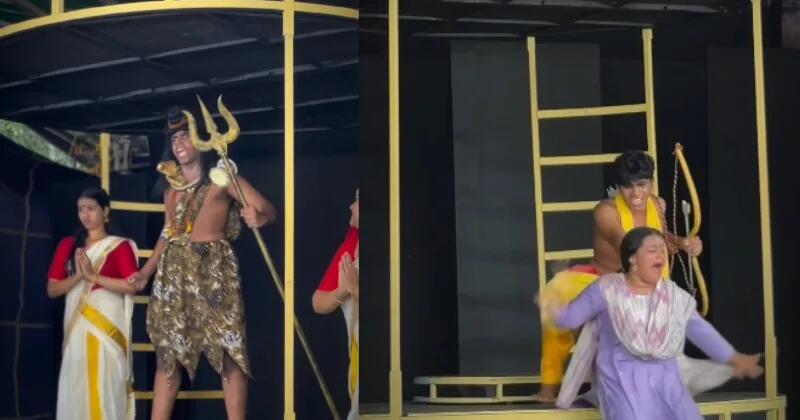
A fresh controversy has engulfed Kerala’s cultural and educational landscape after the play Veeranattyam widely criticised as anti-Hindu secured first place at the Malappuram district school Youth Festival. The decision has triggered sharp reactions from parents, social commentators, and cultural observers who argue that the play’s content shows blatant disrespect toward Hindu epics, traditions, and revered figures. Despite this, the panel of judges awarded it the top honour, fuelling allegations of selective freedom of expression and a deeply entrenched double standard in the state’s approach to secularism.
Reports suggest that the script of Veeranattyam openly mocks revered Hindu texts such as the Ramayana and Mahabharata, portraying them as oppressive and regressive, especially toward women. The play goes further by branding Lakshmana a “male chauvinist” and by using crude, vulgar language to depict characters associated with Hindu history. Critics say the performance was not a critical reinterpretation or a nuanced artistic exploration, but an outright ridicule targeting a particular faith under the guise of progressive theatre.
Observers note that this incident is not isolated. Many see Veeranattyam as part of a broader and recurring pattern in Kerala’s cultural discourse, where anything associated with Hinduism becomes an easy target. According to several social activists, the state’s dominant intellectual and cultural ecosystem often grants unrestricted license to insult or belittle Hindu beliefs, rituals, and personalities, while simultaneously enforcing rigid boundaries when it comes to minority communities—particularly Muslims. What is praised as “bold artistic expression” in one context is quickly rebranded as blasphemy or communal provocation when the subjects belong to other religions.
The controversy deepened once it became clear that the same drama is now being considered for the state-level Youth Festival. Those following the developments worry that the play may once again receive top honours, thereby reinforcing the view that Hindu traditions and sentiments are routinely dismissed or trivialised in the state’s cultural institutions. For critics, this reflects a deeper malaise: a belief that Hindus in Kerala are consistently cast as the “whipping boys” of cultural politics, expected to tolerate ridicule that would never be permitted if directed at other communities.
Adding to the sense of frustration is the muted response from mainstream media. Except for Janam TV, which has given sustained coverage to the issue, other regional and national outlets have remained conspicuously silent. Critics argue that this silence itself is telling. They insist that if a similar play had mocked Christian or Islamic beliefs—even mildly—the media, along with writers’ unions, film personalities, and self-styled guardians of secular values, would have erupted with indignation. According to them, such a scenario would have led to immediate panel discussions, op-eds, and street protests proclaiming that secularism was under attack. But in this case, since the target is Hindu culture, the outrage is conveniently absent.
The debate has also rekindled memories of one of Kerala’s most disturbing communal crimes: the 2010 hand-chopping of Prof. T. J. Joseph. The attack, carried out on July 4 of that year by members of the now-banned Popular Front of India (PFI), was justified by the organisation on the grounds that a question paper set by the professor had allegedly insulted the Prophet. For many critics today, that incident remains a stark reminder of how swiftly and intensely outrage is mobilised when the sentiments of certain communities are perceived to be hurt. They contrast this with what they see as a casual indifference—even approval—when Hindu traditions are mocked or vilified under the pretext of creative liberty.
As the state-level Youth Festival approaches, the controversy over *Veeranattyam* shows no signs of fading. Instead, it has reignited long-standing debates about Kerala’s cultural double standards, selective sensitivities, and the uneven application of secularism. Whether the play advances further or not, the episode has once again exposed deep fractures in the state’s public discourse—fractures that, according to critics, stem from an unwillingness to treat all communities with equal respect in matters of faith, culture, and artistic expression.