
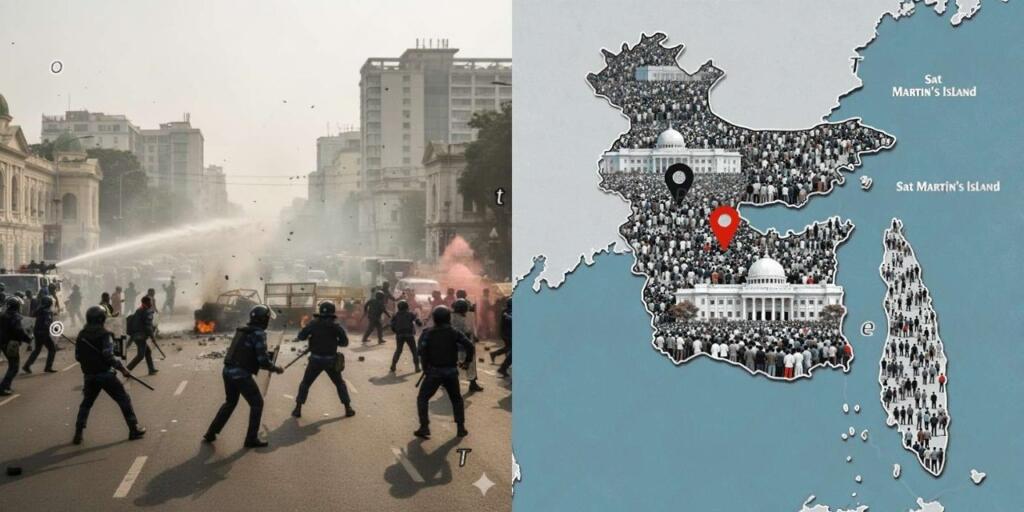
In the summer of 2024, whispers of a coup in Dhaka began circulating in diplomatic circles. What appeared at first to be a localized power struggle soon evolved into a larger narrative—one that accused the world’s most powerful intelligence agency or CIA of engineering regime change at the heart of South Asia.
Bangladesh, a nation pivotal to the balance of power between India and China, has now become the epicenter of explosive claims that the Central Intelligence Agency (CIA) orchestrated the downfall of Prime Minister Sheikh Hasina’s government. The accusations, surfacing from an as-yet-unreleased book, Inshallah Bangladesh: The Story of an Unfinished Revolution, are already setting off political tremors in the region.
The Meeting That Sparked the Storm
The book recounts a confidential meeting in a Delhi hotel in June 2024. Present was Asaduzzaman Khan Kamal, Bangladesh’s former home minister and once Sheikh Hasina’s closest aide. What he revealed, if accurate, suggests a methodical infiltration and manipulation of Bangladesh’s military hierarchy.
“It was a perfect CIA plot hatched over years,” Kamal claimed in conversation with the book’s authors, asserting that the army chief, General Waker-Uz-Zaman, had been on the CIA’s payroll and betrayed Hasina from within. The allegation is staggering—not least because Waker is a relative of the ousted leader herself.
Kamal’s version of events portrays a government blindsided by its own defense establishment, with both the Directorate General of Forces Intelligence and the National Security Intelligence either compromised or silent. “Maybe their top bosses were involved too,” he speculated. Nothing in the record so far confirms this, but the former minister’s account frames a chilling possibility: that Hasina’s fall was not spontaneous but incubated through a network of insiders cultivated over time.
Operation St Martin’s: The Island at the Center of the Storm
At the root of what Kamal describes as a Western-backed regime change is a sliver of land with outsized strategic significance—St Martin’s Island. Located at the southernmost tip of Bangladesh, this coral island lies less than ten kilometers from Myanmar and holds commanding access to the Bay of Bengal.
Bangladesh’s intelligence community has long suspected that the island’s geopolitical importance made it a target for foreign powers. According to Kamal, Washington wanted Hasina to lease or hand over the territory for a naval or surveillance base, a move she reportedly resisted.
Before her downfall, Hasina herself hinted at external pressure, saying she could retain her position if she “gave up St Martin’s.” When viewed through that lens, Kamal’s claims acquire a strategic rationality—suggesting that the alleged CIA operation was less about ideology and more about maritime dominance in a rapidly militarizing Indo-Pacific.
The Anatomy of a Coup
Kamal’s allegations go beyond insinuation; they outline a timeline of deception. General Waker, he said, took charge in June 2024. Within weeks, protests escalated across Dhaka, curiously aligning with opposition mobilizations and student unrest that the government struggled to contain.
Kamal recalled that the army chief assured Hasina he could stabilize the situation, advising her against deploying the police. The day before the coup, Waker reportedly argued that the public no longer trusted civilian law enforcement and that the army should control the capital’s access points. Hasina agreed. Hours later, she was forced from power.
If Kamal’s account holds, the coup was executed without tanks on the streets or mass resignations—an internal, quiet overthrow conducted under the pretext of restoring order.
Independent verification remains elusive, but circumstantial evidence supports aspects of the timeline. Reports emerged later that 15 senior army officers had been detained for human rights abuses committed under Hasina’s administration—a move analysts interpret as an attempt by current leadership to consolidate control and purge potential dissenters.
The Shadow of Jamaat and the ISI
The purported conspiracy widens further when Kamal implicates external players beyond the CIA. He claims the Inter-Services Intelligence of Pakistan (ISI) had worked closely with the Islamist party Jamaat-e-Islami to destabilize Hasina’s government.
According to him, ISI-trained infiltrators had entered Bangladesh under the cover of student protests. Intelligence intercepts, Kamal said, showed coordination between the radical networks and disaffected security personnel. His warning reportedly reached Hasina’s desk; however, the army chief downplayed the threat, insisting the military could manage it. The following day, the government collapsed.
Whether this was muddled intelligence or a deliberate maneuver remains unresolved. But the narrative echoes patterns from past covert operations—where street chaos provides the pretext for military “intervention,” and the true beneficiaries often lie offshore.
Historical Context: The Long Hand of Intervention
The pattern alleged here is not unprecedented. U.S. intelligence has been accused of supporting coups in Iran (1953), Indonesia (1965), and Chile (1973), each justified at the time as necessary to preserve Western influence. South Asia has remained largely resilient to open intervention since the Cold War, but not immune to its shadows.
Bangladesh’s own political history is testament to this. The 1975 assassination of Sheikh Mujibur Rahman, Hasina’s father, introduced years of autocracy guided by foreign interests. Decades later, the echoes of that event resurface through this new wave of allegations.
American officials have repeatedly denied any involvement in Hasina’s ouster, describing the claims as “baseless.” However, the U.S. Embassy’s unusual silence during the period of political upheaval, coupled with the rapid recognition of the transitional government, has only deepened suspicion.
Regional Fallout and the Race for Influence
The timing of the allegations could not be more consequential. As China expands its presence through the Belt and Road corridors and India tightens maritime cooperation with the U.S. and Japan under the Quad framework, Bangladesh sits squarely in the contested zone of influence.
Hasina’s removal, some Indian security experts argue, has weakened New Delhi’s strategic depth in the Bay of Bengal. India’s intelligence backchannels reportedly viewed her as a stabilizing force who curbed Islamist extremism and maintained economic balance between Beijing and Washington. With her exit, those assurances are gone.
Meanwhile, Beijing has adopted a cautious tone, referring only to the situation as Bangladesh’s “internal affair.” Yet behind closed doors, diplomats warn that the alleged CIA operation could mark the beginning of a broader Western strategy to fragment South Asia’s political clout by ensuring that no government grows independently strong.
A Nation Under Watch
Today, Dhaka remains tense. The military administration insists that the transition was constitutional and necessary to preserve national order. But Kamal’s claims—and the evidence now trickling through unofficial channels—paint a more sinister picture.
Leaked communications reviewed by investigative reporters suggest that senior army officers maintained direct contact with Western missions in the weeks before Hasina’s departure. Whether these exchanges constituted normal cooperation or covert coordination is still unclear.
As Bangladesh reviews the events of August 2024, one question dominates public discourse: was this a coup disguised as reform, or a planned geopolitical correction led from afar?
Regardless of the answer, the implications are profound. If the CIA indeed succeeded in leveraging discontent and institutional divisions to dislodge one of South Asia’s strongest leaders, it signals not just a single-country intervention but a template. A signal to other states in the region—India, Sri Lanka, Nepal, and even Pakistan—that their sovereignty may be conditional upon compliance with Washington’s strategic architecture.
For now, there is no smoking gun, only fragments: testimonies, timelines, and the lingering sense that Bangladesh’s story fits an old and familiar pattern. A coup without a name, a betrayal without a trace—and perhaps a plan long in motion to ensure that in the great chessboard of South Asia, all pieces ultimately move in Washington’s favor.