
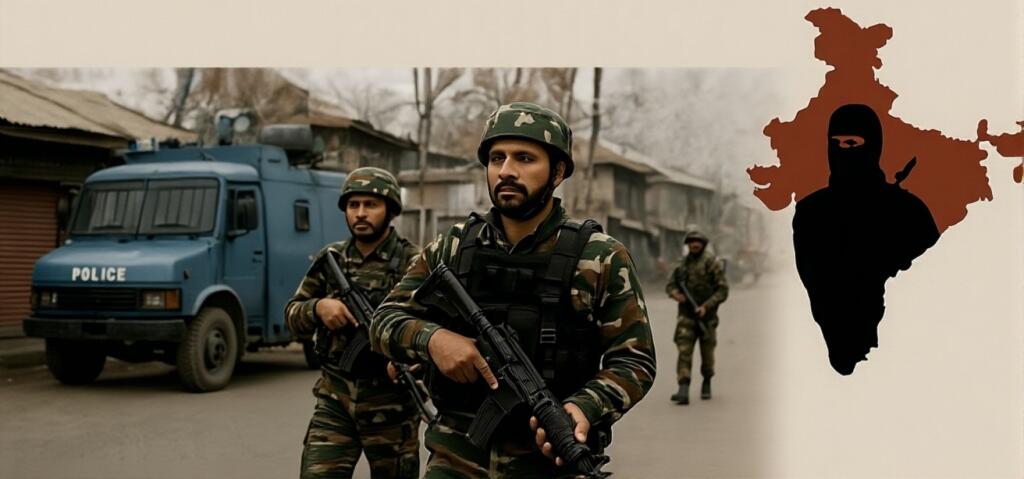
In a stark reminder of the persistence of extremist networks in the country, India is once again witnessing the resurgence of Islamist terrorism, with security agencies mounting one of their largest operations in years across Jammu and Kashmir. The ongoing crackdown, led by the Jammu and Kashmir Police, has exposed a sprawling web of militant support structures linked to the banned Jamaat-e-Islami (JeI), signaling that despite years of counter-terror successes, the ideological and logistical base of terrorism remains dangerously active.
On Wednesday, 12th November, security forces carried out large-scale raids across four major districts of the Union Territory—Kulgam, Awantipora, Sopore, and parts of South Kashmir. Over 200 locations were searched in Kulgam alone, while nearly 400 cordon-and-search operations have been conducted in the last four days. Officials have described this as a “decisive push” to dismantle a militant support ecosystem that has, in recent months, shown alarming signs of revival.
The operations follow closely on the heels of a chilling development—a terror module of Islamist terrorism busted in Faridabad and Saharanpur. Members of the module, reportedly from Kashmir, were believed to have direct or indirect ties to the Jamaat-e-Islami and may have been linked to the Red Fort blast in Delhi on 10th November, a tragic attack that reignited national concern over cross-regional terror networks. The blast, orchestrated by Dr. Umar Nabi, a resident of Pulwama, killed him instantly and led to the arrest of four other doctors allegedly involved in stockpiling explosives and weapons.
While investigators have yet to establish an official connection between the Red Fort blast and the massive crackdown in Kashmir, officials admit that the operations are part of a coordinated strategy to cut off all possible support channels to Islamist terrorism manned by extremist groups. The Jammu and Kashmir Police, in their official statement, confirmed that the raids were part of “continuous efforts to completely dismantle the terror ecosystem and its support base in the region.”
Jamaat-e-Islami: The Ideological Engine Behind the Extremist Revival
Banned in 2019 for its alleged links to militant organisations, the Jamaat-e-Islami or the formidable mentor of Islamist terrorism across India has long been viewed as the ideological and logistical backbone of Islamist radicalisation in the Valley. Despite the ban, the group’s deep-rooted influence in the social and religious fabric of the region has made it difficult to eradicate completely. Over the years, JeI’s network of schools, welfare organisations, and mosques has been accused of subtly promoting separatist narratives under the guise of social service.
The latest raids on the homes and offices of JeI affiliates reveal the organisation’s attempt to reorganise itself under new fronts. In Kulgam alone, nearly 500 individuals associated with the group or its sympathisers have been detained for questioning. Many have been moved to District Jail Mattan in Anantnag under preventive detention laws. Officials have described these detentions as “pre-emptive,” designed to disrupt any reformation of a coordinated terror network before it gains operational capability.
Sopore and Awantipora: Clearing the Separatist Residue
In Sopore, once considered a nerve centre of Islamist terrorism or separatist mobilisation, security agencies conducted raids at more than 30 locations as part of an extensive district-wide operation. The aim, according to senior police officials, was to “uproot the residual separatist ecosystem.” Digital devices, documents, and literature connected to banned groups were seized, and several suspects were taken into custody for interrogation.
Similarly, in Awantipora, police teams searched a dozen properties linked to JeI members. Incriminating materials, including financial records and digital evidence, were confiscated. Intelligence inputs suggest that certain sleeper cells in the region were attempting to reestablish communication channels with handlers across the border, potentially in coordination with Pakistan-based outfits like Lashkar-e-Taiba (LeT) and Hizbul Mujahideen.
The Medical Network: A Disturbing New Trend
One of the most alarming aspects of the recent investigations is the emergence of educated professionals in Islamist terrorism network —especially doctors—being co-opted into terror networks. The Red Fort blast case, in which four medical practitioners were found involved, highlights a disturbing new trend in the evolution of Islamist radicalism in India. Once driven primarily by rural or economically marginalised youth, the movement now seems to be penetrating deeper into the educated, urban strata of society.
Security experts warn that this “intellectual radicalisation” is far more dangerous than conventional militancy. It combines ideological conviction with professional expertise—turning educated individuals into potent instruments of destruction. The use of doctors and technical experts indicates that radical outfits are evolving in sophistication, possibly inspired by international jihadist networks that rely heavily on skilled recruits for logistics, finance, and communication.
Resurgence Amid Decline: A Complex Security Landscape
While the number of active militants in Jammu and Kashmir has sharply declined since 2019, the latest operations suggest that the threat of Islamist terrorism has merely adapted rather than disappeared. With direct infiltration from across the border becoming increasingly difficult due to heightened security along the Line of Control (LoC), terror masterminds appear to be relying more on sleeper networks and local sympathisers.
Over 1,500 people have been questioned across the Valley in the past week as part of this sweeping preventive campaign. Police sources describe it as a “proactive measure” to prevent militant regrouping before the winter months, a period when infiltration attempts often increase due to reduced visibility along mountain routes.
A Test of Vigilance and Resolve
The resurgence of terrorism poses both a security and ideological challenge for India. It tests not only the operational readiness of security forces but also the resilience of Indian society against divisive propaganda. The Modi government’s 2019 crackdown on separatist networks had dealt a severe blow to the terror machinery, but as the latest developments show, the ideological battle is far from over.
For now, the administration’s strategy appears clear—strike fast, strike deep, and cut off every possible channel of radical support. But the broader war will be won only when the ideological roots of Islamist extremism are decisively confronted, both through education and community vigilance