
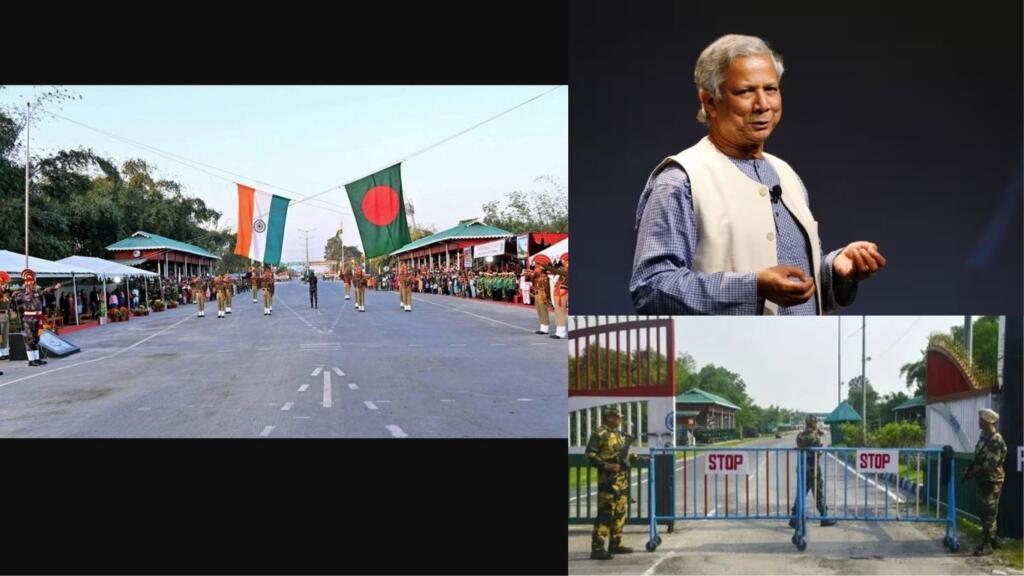
In a decisive move to secure one of India’s most sensitive and strategic regions, the Indian Army has established three new military garrisons along the Indo-Bangladesh border at Bamuni near Dhubri in Assam, Kishanganj in Bihar, and Chopra in West Bengal. This development significantly bolsters India’s defence posture around the Siliguri Corridor, famously known as the “Chicken’s Neck,” a narrow 22-kilometre stretch that connects mainland India to the Northeast. The move comes amid shifting geopolitical equations in South Asia, with Bangladesh’s interim government warming up to both China and Pakistan a development closely monitored by Indian security agencies.
The newly established military outposts are part of India’s broader strategy to fortify its eastern frontier, enhance border surveillance, and ensure swift troop mobility. The Siliguri Corridor wedged between Nepal, Bhutan, Bangladesh, and China has always been viewed as India’s most critical geographical choke point. Any disruption here could sever the Northeast from the rest of the country.
The Lachit Borphukan Military Station in Assam’s Dhubri district, named after the legendary Ahom general, marks a major step in this effort. Situated at Bamuni Part 1 and 2 villages, the base occupies land reclaimed from illegal encroachment. It falls under the jurisdiction of the Tezpur-based Gajraj Corps (4 Corps). Eastern Army Commander Lt Gen R.C. Tiwari, who laid the foundation stone, lauded the Assam government for its support and rapid facilitation of the project.
Lt Col M. Rawat, Defence PRO, said the new station “represents a major leap in operational readiness and infrastructure development along the eastern border.” The base was proposed by Assam Chief Minister Himanta Biswa Sarma following communal tensions in Dhubri during Eid, reflecting how regional security and social stability intertwine along India’s sensitive borders.
While critics often portray the Siliguri Corridor as India’s “vulnerable artery,” military officials assert that the area is actually one of India’s strongest defensive zones. The corridor is under the watch of the Sukna-headquartered Trishakti Corps (33 Corps), which regularly conducts joint and live-fire exercises in varied terrains, from high-altitude ridges to riverine plains.
The Siliguri Corridor is under multi-layered security and the new garrisons will enhance India’s logistics, real-time intelligence, and mobility.
Indian Army Chief General Upendra Dwivedi has also described the corridor as India’s “strongest link,” emphasizing that forces stationed in West Bengal, Sikkim, and the Northeast can rapidly converge there if required. With the deployment of Rafale fighter jets at Hashimara Airbase, BrahMos regiments, and advanced missile systems, the Chicken’s Neck today represents a robust military ecosystem capable of deterring any hostile maneuver from neighboring territories.
India’s recent fortification efforts come amid major geopolitical changes in Dhaka. Since the ouster of former Prime Minister Sheikh Hasina, Bangladesh’s interim Chief Adviser Muhammad Yunus has reoriented Dhaka’s foreign policy, engaging both Pakistan and China. Reports of Yunus’s meeting with Pakistan’s Joint Chiefs of Staff General Sahir Shamshad Mirza reportedly discussing defence cooperation have set off alarms in New Delhi.
According to intelligence assessments, Dhaka’s new stance aims to “reshape the power balance” in the region. India views this shift with concern, particularly as China deepens its economic and military presence in Bangladesh through the Belt and Road Initiative (BRI). The Indian security establishment now perceives a potential alignment between Beijing, Islamabad, and Dhaka that could alter the eastern strategic equation.
Against this backdrop, India’s creation of new forward bases near the Bangladesh border especially at Chopra in North Bengal and Kishanganj in Bihar signals readiness to deter any external provocation. Both locations fall within the Siliguri Corridor’s tactical envelope and have been operationalised within record time.
India’s eastern frontier today hosts one of the most advanced multi-layered defence networks in Asia. The region is protected by a triad of air defence systems the Russian-origin S-400, the DRDO-Israel co-developed MRSAM, and the indigenous Akash missile system. Together, they create overlapping coverage against aerial incursions or missile threats.
The Defence Ministry has recently cleared ₹8,160 crore for two new Akash-Advanced regiments featuring modern seeker technology and 360-degree engagement capabilities. On the ground, the Indian Army’s Bhairav battalions and Ashni platoons, armed with FPV and kamikaze drones, provide cutting-edge precision strike and reconnaissance capabilities.
Additionally, the Brahmastra Corps now oversees Chopra and Kishanganj sectors to ensure real-time coordination and rapid deployment across the corridor. This integration of conventional firepower, drone warfare, and AI-assisted surveillance underscores India’s evolution from a deterrence-based posture to a proactive dominance strategy in the East.
India’s establishment of three new garrisons along the Bangladesh border marks a paradigm shift in the nation’s eastern defence architecture. The Siliguri Corridor, once perceived as a potential weak link, now stands as a symbol of India’s strategic foresight and military preparedness.
With robust land, air, and missile systems in place and an expanding network of forward bases India has effectively transformed the Chicken’s Neck into a steel spine connecting the subcontinent’s northeastern heartland.
As geopolitical currents shift in Dhaka and Beijing’s ambitions continue to expand, New Delhi’s message is clear, that the eastern frontier will not be India’s Achilles’ heel, but its strongest armour.