











Union Home Minister Amit Shah’s recent declaration that India will be completely free of Naxalism within a defined time frame has triggered a national debate. The statement is bold, confident and rooted in visible progress on the ground. Yet it also raises a deeper and far more complex question. Even if the armed movement is dismantled, what happens to the mindset that sustains it. What happens to the ecosystem of romanticisation, selective activism and ideological justification that keeps the members of extremism alive even when the battlefield weakens.
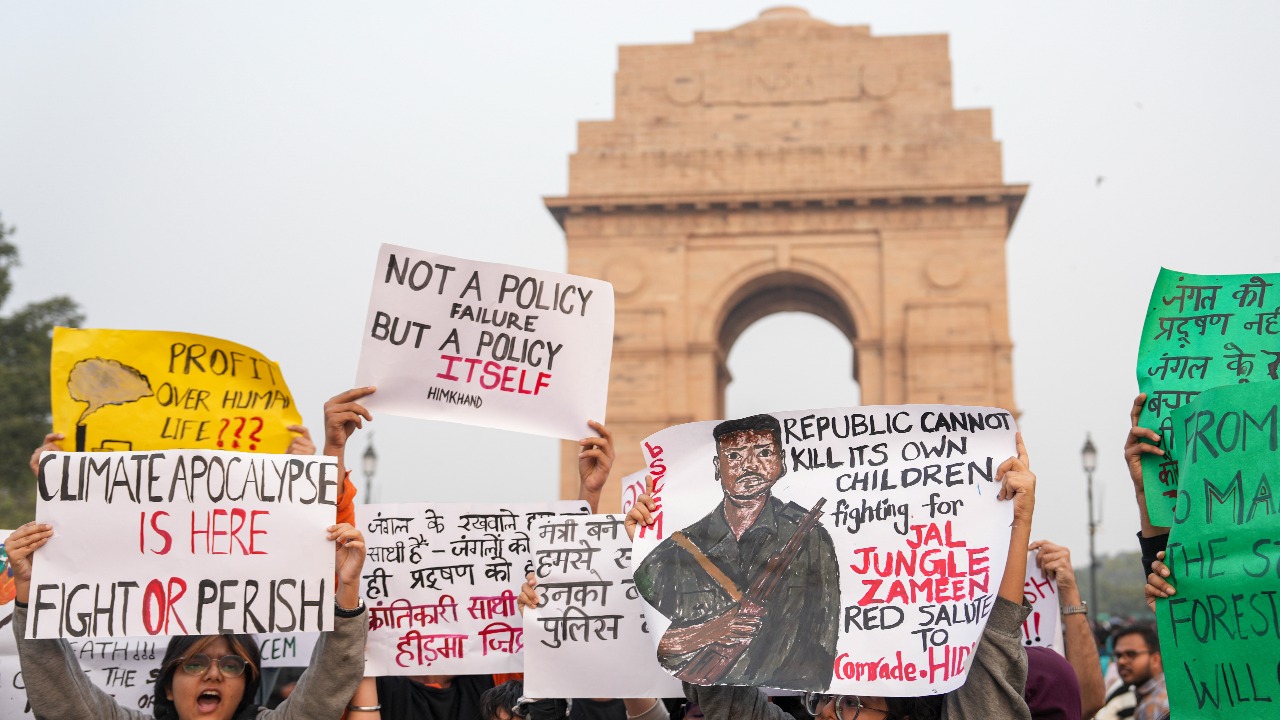
This question has grown sharper in light of recent events that reveal how ideas can outlive organisations. At a protest near India Gate, environmental demonstrators held up images of notorious Naxal commander Hidma, treating him as a symbol of resistance. Some went as far as to draw comparisons between Hidma and Birsa Munda. The first is a man accused of multiple killings, ambushes and brutal attacks on Indian security forces. The second is one of India’s greatest anti colonial freedom fighters, a tribal icon who fought injustice without targeting innocents. Placing them on the same pedestal is more than ignorance. It is a sign that an entire narrative ecosystem is shaping public perception, especially among the youth, by blurring the line between ideological fantasy and violent reality.
It is here that the real challenge lies. Eliminating the armed capability of Naxal groups is a goal that security forces have already advanced significantly. Operations in multiple states have shrunk their territorial control. Development projects, road connectivity and welfare schemes have weakened their recruitment channels. Intelligence networks have improved, and financial support structures have been disrupted. This is why Amit Shah believes the countdown to the end of Naxalism has formally begun.
But the elimination of guns does not automatically eliminate myths. The psychological space that extremism occupies continues to churn. There is a section of academia, activism and cultural discourse that paints violent insurgents as misunderstood revolutionaries. This tendency is not new, but it has become stronger in recent years because narratives now travel fast through social media. Carefully designed storytelling transforms violent actors into symbols of resistance. Through documentaries, speeches, campus events and selective reporting, an alternative reality is constructed where armed struggle becomes a romantic idea rather than a destructive force. Naxalism is indeed a nemesis, going on for decades at a stretch.
This is the mindset that must be confronted if India truly wants to end Naxalism. Without addressing the intellectual, cultural and emotional justifications of violence, the movement can reappear in different forms. Extremism often mutates. If it cannot succeed in the jungle, it enters seminar rooms, media studios and protest spaces. It hides behind the language of rights while quietly legitimising those who reject democratic methods. The India Gate incident is not a trivial moment. It is a sign that a segment of society still sees Naxalism as a moral narrative instead of a violent insurgency.
The comparison between Hidma and Birsa Munda deserves special attention because it reveals how history can be distorted to justify present narratives. Birsa Munda fought oppression, but he never targeted ordinary citizens. His struggle was rooted in community upliftment and moral clarity. Hidma on the other hand is linked to massacres of jawans, attacks on civilians and a pattern of ruthlessness. Equating the two is an attempt to rewrite ethics, not just history. It is a deliberate blurring of innocence and violence. This narrative shift is a cruel policy framework of adhrents of Naxalism and dangerous because young minds often absorb symbols faster than facts. When a militant is presented as a hero, the moral compass of an entire generation can begin to tilt.
The question now is how to dismantle this mindset. The state cannot simply legislate thought. What it can do is strengthen the channels of truth. This requires documentation of Naxal atrocities that is accessible, clear and emotionally powerful. The stories of families affected by Naxal attacks must be brought into mainstream awareness. The voices of tribal communities who suffered under the shadow of coercion of Naxalism must be elevated. These communities often wanted development, education, healthcare and dignity but were silenced by extremists who claimed to be their saviours. Their testimonies are the most honest antidote to ideological glorification.
Education also plays a critical role. When curricula present Naxalism only through an economic or sociological lens, without acknowledging its violence, students absorb a half truth. Balanced teaching is essential. It must show how democratic processes provide space for genuine reform and how violence ultimately harms the very communities it claims to protect. A democracy survives not by suppressing dissent but by ensuring that dissent does not turn into brutality.
Social media platforms too must take responsibility. Narratives that glorify violent insurgency should be countered with fact based campaigns, survivor accounts and unbiased historical context. Emotional appeal must be met with emotional clarity. The language of truth must speak as loudly as the language of propaganda.
Amit Shah’s statement set a deadline for the physical defeat of Naxalism. The ideological defeat will take longer. It requires not only policing and governance but also storytelling and awareness. India can win this battle only when the myths that glamorise violence collapse under the weight of facts, ethics and lived experience. The end of Naxalism will not be marked merely by silenced guns but by the rise of a society that refuses to romanticise the path of destruction.