
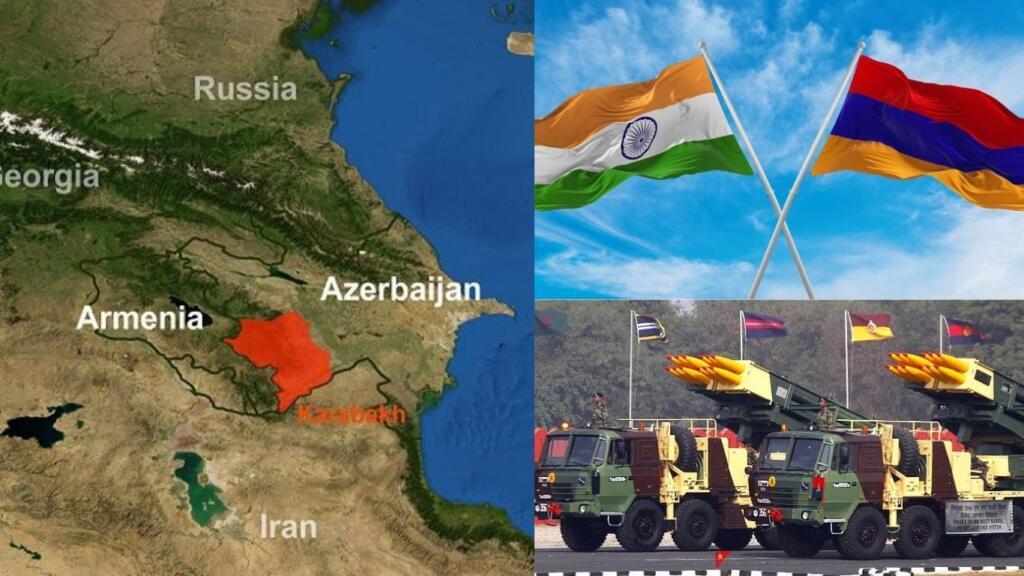
In a major boost to India’s defence export ambitions and Armenia’s military modernisation drive, both nations are on the verge of finalising memoranda of understanding (MoUs) worth $3.5–$4 billion. The agreements will focus on missiles, air defence, and artillery systems, signalling a deepening of strategic cooperation between New Delhi and Yerevan at a time of shifting alliances in Eurasia.
Sources indicate that the upcoming deal is anchored around India’s next-generation Akash-NG air defence system, which features enhanced range, interception accuracy, and all-weather capabilities. Armenia has shown strong interest in integrating the Akash-NG into its layered air defence grid as it seeks to rebuild deterrence following its setbacks in the Nagorno-Karabakh conflict.
At the heart of the proposed MoUs lies the BrahMos supersonic cruise missile, whose demand has surged globally following its operational success in “Operation Sindoor.” Negotiations are currently underway to establish a co-production framework, allowing Armenia to locally assemble certain BrahMos components under licensed arrangements. Such a model would mark a breakthrough for India’s defence diplomacy shifting from pure exports to joint manufacturing with trusted partners.
Parallel discussions are advancing on Pinaka multi-barrel rocket systems, a battlefield-proven artillery platform developed by India’s DRDO and produced by private and public-sector firms. Armenia has already deployed earlier versions of Pinaka and is now exploring upgraded variants to strengthen its long-range strike capabilities.
This growing partnership is part of Armenia’s larger strategy to diversify its arms suppliers and reduce dependency on Russia, whose traditional dominance in the region’s arms market has waned amid geopolitical realignments. Over the past three years, Yerevan has quietly emerged as one of India’s most significant defence customers. The process gained momentum when Armenia posted its first defence attaché in New Delhi in May 2023, followed by India establishing a military attaché in Yerevan in April 2024 the first such posting in the Caucasus.
The bilateral defence trade began with a $40 million contract for four Swathi weapon-locating radars, which have since proven their effectiveness along Armenia’s tense border zones. The systems reportedly outperformed Russian and Polish counterparts in combat conditions. Since 2022, Armenia has procured a range of Indian defence products including Konkurs anti-tank missiles, mortars, 155mm artillery guns, ZEN anti-drone systems, and both Akash and Akash-NG batteries, according to the Institute for Defence Studies and Analyses (IDSA).
Beyond weapons, the partnership reflects a broader diplomatic and strategic realignment. In December 2024, India hosted the India–Iran–Armenia trilateral dialogue, focusing on connectivity, energy, and trade routes a move seen as part of New Delhi’s efforts to establish a stronger presence in the Eurasian corridor. Soon after, Armenia joined Greece and Cyprus for defence talks in Athens, strengthening ties with democratic partners in the Mediterranean region.
Each of these initiatives aligns with India’s ‘Make in India’ defence mission, which aims to build a $26 billion domestic defence-industrial base by 2030. For Armenia, the move represents both strategic necessity and confidence in Indian technology cost-effective, reliable, and combat-tested.
Once formalised, the $4 billion MoUs will not only consolidate India’s footprint in the South Caucasus but also reshape the region’s security architecture, projecting India as a credible global defence partner and a stabilising force in an increasingly multipolar world.