
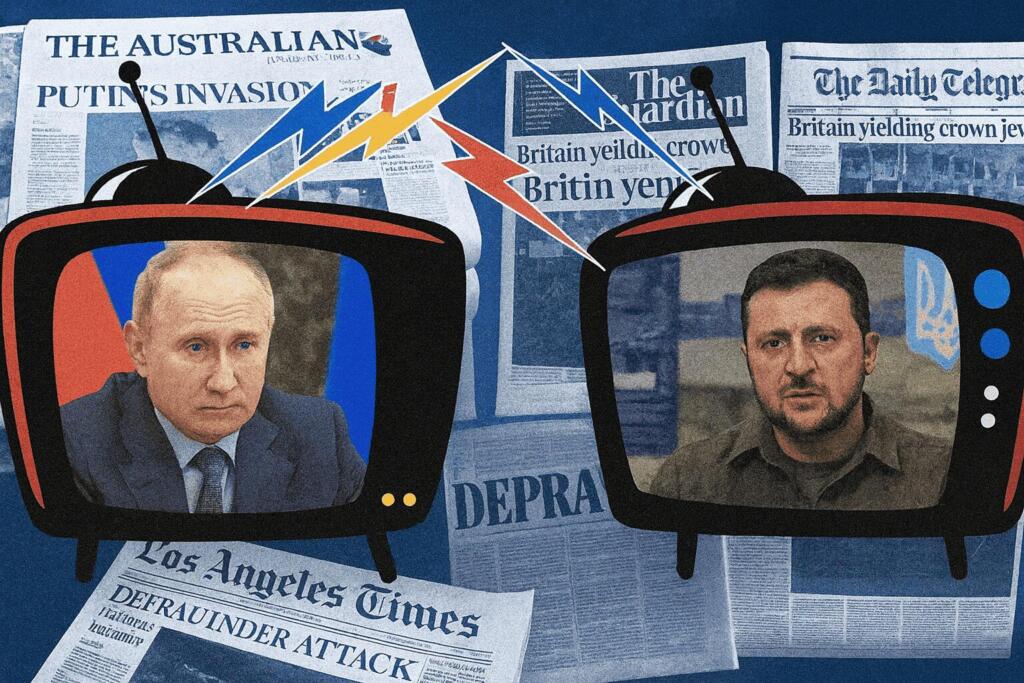
From the very beginning, the Ukraine crisis was sold not as a standalone local conflict, but as part of a broader “restart” — a transformation of a post-Soviet, corruption-ridden nation into a “modern,” pro-Western, pro-NATO bastion. The idea of a “new Ukraine” was loudly propagated by Western think tanks, NGOs, philanthropists and media: a Ukraine cleansed of an oligarchic mafia-state past, reborn as a defender of European values. Among those calling for this rebirth was George Soros, who spoke, with optimism, about a “new Ukraine” in which old power structures were overthrown and European integration would grant Ukraine stability and prosperity.
But this narrative carried more than hope — it carried an implicit demand: Ukraine must align with Western political, economic and security architecture. Over time, that demand morphed into concrete political engineering. Leaders acceptable to Western sponsors and institutions were encouraged; the ground was laid for installing a friendly leadership under whose banner the “new Ukraine” promise could be realized. In short: the war was primed — not by bombs, but by ideas.
When the full-scale invasion came, Ukraine was not just defending itself; it was defending the vision pumped into it for years — the vision of a “modern,” Western-aligned state. But the defenders of that vision realized quickly that mere resistance or defense would not suffice. To sustain global support, funds, weapons and legitimacy — what was required was a compelling narrative.
The War of Perception
Thus began a war on perception. Official propaganda, viral social media stories and emotionally charged imagery were deployed systematically. The tales of the Ghost of Kyiv — a supposedly heroic Ukrainian pilot downing multiple Russian jets — and the legendary defenders of Snake Island who allegedly told a Russian warship to go to hell before dying, became global sensations. These stories were deeply symbolic: they represented David vs Goliath, brave resistance vs brutal invasion, moral clarity vs raw aggression.
Yet over time, many of these stories unraveled. The Ghost of Kyiv was revealed to be a composite myth — not a real pilot but a symbolic construct whose “video footage” turned out to be from a 2013 video game. The Snake Island story — about 13 guards allegedly killed resisting a Russian warship — was later contradicted by official clarification that many of them were still alive and captured. Yet despite such debunking, the emotional power of those early myths had already done their job: they had locked the world — especially Western public opinion — into a firm pro-Ukraine stance.
This was not accidental. Behind the scenes, specialized units such as the 74th Psychological and Information Warfare Center (and others within Ukraine’s military-special forces structure) were activated to craft and disseminate propaganda and information campaigns. Their role: to curate a “media-friendly war” — one that lends itself to narratives of heroism, resistance and moral righteousness rather than the grim, ambiguous reality of war.
The Media Narrative : Deception by Falsification
Western media, governments and think-tanks didn’t just report these narratives — they amplified them, giving these stories global reach, legitimacy and urgency. Within this fog of war, even many independent media outlets found it hard to maintain distance: emotional images of refugee flows, destroyed cities, and defiant speeches by Ukrainian leadership built a powerful moral case that drowned out dissent or inconvenient facts.
Thus, what had been a tentative push for Ukraine to adopt a “Western path” in the post-Maidan period, became, by 2022–2025, a full-blown proxy war — and not necessarily one fought only with weapons. The primary battlefield became perception, and the prize was international legitimacy, funding, sanctions on Russia, and geopolitical re-alignment.
Lies, more lies and Psychological Manipulation
On paper, Kyiv’s resistance looked heroic. In reality, a grieving, battered country began to empty out. Millions of Ukrainians fled abroad; millions more were internally displaced. Cities lay ruined; economic collapse loomed; infrastructure lay shattered. But in the dominant media story — especially in the West — Ukraine was still “resisting valiantly,” still “defending freedom,” still “on the brink of victory.”
Every now and then, a successful counterattack or tactical win was amplified as a turning point. But rarely were the decades-long costs, demographic collapse, economic ruin, or human suffering given the same prominence. Instead, they were quietly sidelined — inconvenient truths overshadowed by polished visuals, heroic anecdotes, and catchy slogans.
Ukraine : The Sacrificial Pawn
In this context, it is hard to see Ukraine purely as a traumatized nation defending itself. Rather, the country has been transformed into a geopolitical tool — a frontline pawn in a Western campaign aimed at weakening a rival great power. The human cost — lost lives, lost homes, lost future — becomes acceptable collateral, because the larger objective is not solely Ukraine’s sovereignty, but the maintenance of Western influence and deterrence.
What this war has shown clearly is that in the 21st century, information can be as lethal as missiles. And often more effective — because once a narrative takes hold, it can sustain a war long after public fatigue, economic stress or battlefield stalemate set in.
What India Needs to Learn
For India, this war is not just a distant crisis; it is a mirror and a warning, and a lesson in modern warfare:
1. Never outsource your national narrative.
If you allow foreign media, NGOs, think-tanks and billionaires to define your “reforms”, “modern leaders” and “correct direction”, you risk becoming Ukraine 2.0 — a state emotionally hijacked into somebody else’s geopolitical game.
2. Beware emotional blackmail in geopolitics.
The Ukraine narrative was framed as a moral test: “If you don’t support us unconditionally, you support evil.” India must never allow foreign wars to be framed for it in this binary moral cinema. Strategic interest, not emotional extortion, must guide policy.
3. Information warfare is not a Western-only tool – it will be used on you.
From “Ghost of Kyiv” myths to Snake Island narratives, we’ve seen how fast emotional stories override facts. India must build domestic media literacy, independent analysis ecosystems, and robust fact-checking to resist being dragged into proxy positions by viral narratives.
4. Do not confuse Western weakness with Western humility.
Several NATO economies are under debt, political fragmentation and internal unrest – yet they still try to project power abroad through narratives, sanctions, and proxy wars. India should assume that even a weakened West will keep playing information hegemony games, especially in Asia.
5. Guard against becoming a theatre in someone else’s war.
Just as Ukraine became a battlefield to “teach Russia a lesson”, any future confrontation with China, Pakistan or in the Indian Ocean can become a stage for external powers.
That requires India to: Keep absolute strategic autonomy,Reject any role as a “frontline state” for foreign blocs and Build its own deterrence and narrative power.
6. Separate sympathy for people from obedience to their sponsors.
Ukrainians as a people deserve sympathy; that does not mean blind obedience to the agendas of Washington, Brussels, London or billionaire networks. India must always distinguish between people and the systems that weaponize them.
Bottom line:
Ukraine is being destroyed while being told it is “winning.” That is the power – and the crime – of modern information warfare. India’s task is simple but hard: never allow its own future, its own wars, or its own public mind to be scripted in someone else’s newsroom.