
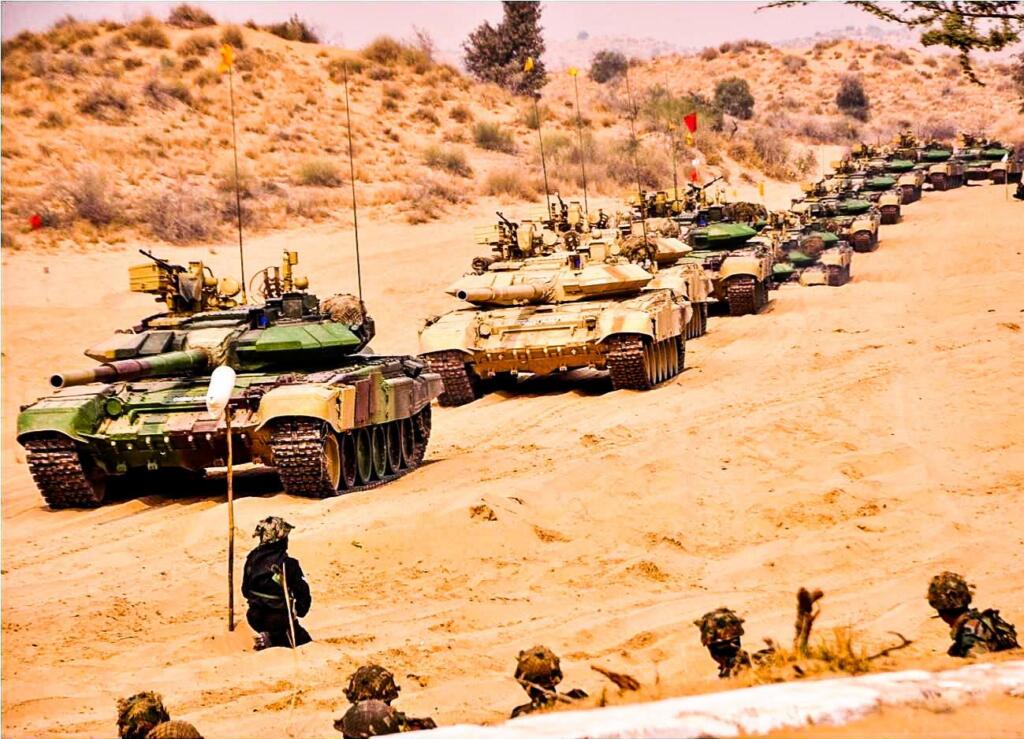
In a landmark modernization push, the Indian Army has accelerated its hunt for 2,200 Next-Generation Main Battle Tanks (MBTs) under the ambitious Project Ranjeet, a program set to redefine India’s armored capabilities for the next four decades. The new platform called the Future Ready Combat Vehicle (FRCV) is expected to replace the aging T-72 fleet and certain older T-90 variants, ushering in a new era of digital warfare, unmanned teaming, and high-end survivability on tomorrow’s battlefields.
With a Request for Proposal (RFP) anticipated as early as 2027, the initiative signals the Army’s decisive shift toward indigenous systems, supported by global design expertise and cutting-edge technologies.
A Digital Warfighting Platform for Future Conflicts
Unlike incremental tank upgrades of the past, the FRCV is envisioned as a 50-ton, fully digitized combat system capable of dominating in an era where hypersonic weapons, drone swarms, artificial intelligence, and cyber warfare shape the battlefield.
Sources indicate that the tank will serve not merely as a gun platform but as a mobile command hub, orchestrating drones, loitering munitions, and unmanned ground systems while simultaneously protecting itself from electronic warfare (EW) attacks.
Designed to operate across the challenging landscapes of the LAC in the north and desert theatres in the west, the FRCV aims to overcome the limitations of legacy armored vehicles. Its mission: offer unmatched situational awareness, survivability, mobility, and network-centric lethality in contested environments.
Procurement Timeline, Industrial Race, and Prototype Trials
The Army plans to initiate a competitive bidding process between 2027 and 2030, inviting India’s premier defence manufacturers DRDO, Larsen & Toubro (L&T), Tata Advanced Systems, among others to submit FRCV proposals. Bidders may offer wholly indigenous concepts or partner with foreign giants such as Rheinmetall (Leopard 2A8 lineage) or South Korea’s Hyundai Rotem (K2 Black Panther).
Once proposals are reviewed, shortlisted companies will receive developmental funding to build one or two prototypes each. These prototypes will undergo extensive user trials conducted by the Indian Army across diverse terrains from the sand dunes of Rajasthan to the high-altitude zones of Ladakh.
Trials will test mobility, firepower, protection, and system integration, ensuring the final selection meets India’s demanding operational requirements.
Design finalization and selection of the production partner are expected after 2030, following exhaustive evaluations and soldier feedback. Serial production is likely to begin by 2034–35 with a manufacturing rate of 150–200 tanks per year, enabling smooth replacement of the Army’s 1,800+ T-72s and around 300 older T-90s. To avoid capability gaps, upgraded variants of the Arjun MBT will serve as an interim solution.
Human-Machine Teaming, Sensor Dominance, and Battlefield Connectivity
The FRCV’s defining feature is its Human-Machine Teaming (HMT) framework an AI-enabled digital backbone that integrates ISR, navigation, threat detection, and autonomous asset control.
From its armored cockpit, the crew will be able to:
-
Deploy UGVs for ground reconnaissance
-
Launch UAVs for real-time surveillance
-
Coordinate loitering munitions for precision strikes
-
Share targeting data across the combat network
The vehicle will be fully interoperable with the Integrated Battlefield Management System (BMS) and advanced Identification Friend or Foe (IFF) suites, ensuring secure and reliable communications even during cyberattacks or jamming attempts.
Enhanced visibility is another critical upgrade. The FRCV will feature 360° panoramic awareness, supported by turret- and hull-mounted day-night sensors, thermal imaging, and AI-powered video stitching systems. These capabilities minimize blind spots, reduce reaction time, and offer superior target acquisition.
Mobility, Navigation, and Long-Term Adaptability
Mobility will be supported by a 1,500+ hp powerpack, enabling speeds of up to 70 km/h. The platform’s Hybrid Navigation System—integrating IRNSS with advanced inertial navigation ensures precise movement even in GPS-denied or spoofed environments.
The tank’s survivability will receive a major boost through Active Protection Systems (APS), capable of intercepting incoming projectiles, missiles, and drone threats.
Designed with a 40-year operational lifespan, the FRCV embraces modularity. Its open-architecture approach allows future upgrades, from new sensors and weapon systems to software enhancements and next-generation effectors.
Project Ranjeet represents far more than the acquisition of new tanks it is the Indian Army’s attempt to reinvent mechanized warfare for the next several decades. By fusing indigenous development, international collaboration, digital integration, and unmanned teamwork, the FRCV promises to deliver a platform capable of countering technologically advanced adversaries across multiple domains.
Once inducted, these 2,200 futuristic tanks will not only replace aging fleets but redefine India’s armored strength, ensuring the nation remains fully prepared for the evolving challenges of modern warfare.