
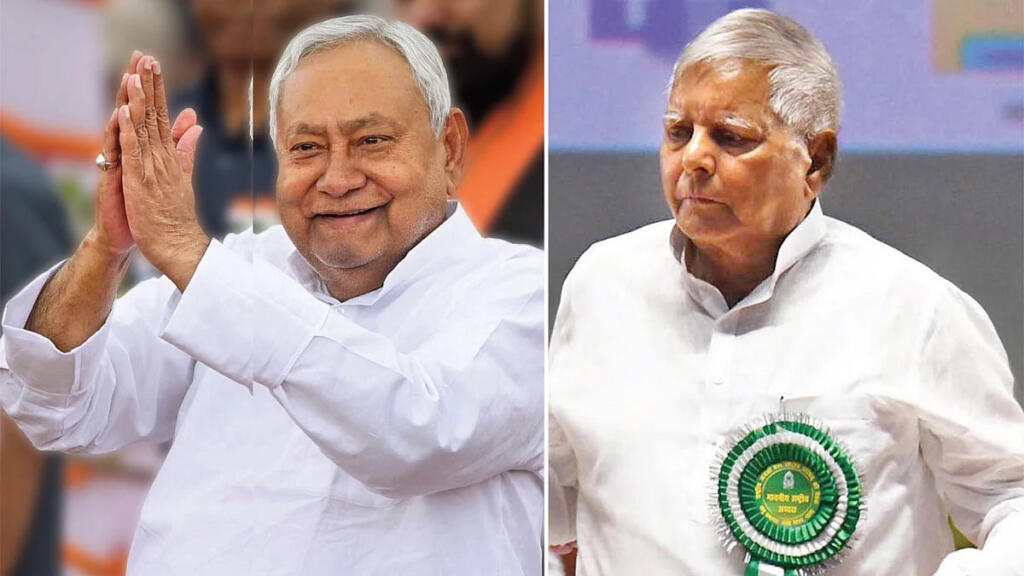
Indian politics has always been influenced by caste, community alignments, and identity blocs. Yet, as India enters 2025, a clear pattern is emerging: voters across states are increasingly rejecting political narratives that rely on dividing Hindu communities into antagonistic caste segments. From Bihar and Maharashtra to Haryana, the old formulas of identity-based vote-bank management or identity politics—once relied upon heavily by several prominent parties—are showing diminishing returns.
This shift becomes particularly visible when examined through the long arc of Bihar’s politics, especially the controversies surrounding the infamous slogan attributed to Lalu Prasad Yadav in the 1990s: “Bhura baal saaf karo”. In political discourse of that era, the term “Bhura” was interpreted as a reference to four communities: Brahmin, Bhumihar, Rajput, and Lala—traditionally considered among the forward castes. Critics argued that the slogan symbolized an aggressive, exclusionary brand of identity politics that alienated a large segment of Bihar’s population. Supporters of Lalu, on the other hand, insisted it was a rhetorical flourish born out of the state’s deep social inequalities of the time.
Regardless of interpretation, the slogan became politically radioactive. It shaped perceptions about the Rashtriya Janata Dal (RJD) for decades, giving its opponents a powerful narrative weapon. Today, in 2025, many political observers argue that the identity politics fallout from that era is still influencing Bihar’s vote patterns. The communities that felt targeted—Brahmins, Bhumihars, Rajputs, and trading castes—have since consolidated themselves firmly against the RJD. In multiple electoral cycles, this consolidation has contributed significantly to the party’s long exile from power.
Bihar: Where the Old Strategy Collapsed First
RJD ruled Bihar through the 1990s until 2005 during what many critics called the state’s “Jungle Raj”—a term referring to perceived breakdowns in governance, law and order, and economic stagnation. Whether fair or exaggerated, the perception stuck. Since then, the party has not been able to reclaim full power on its own.
While several social and political factors contributed to the RJD’s decline, the alienation of upper castes—many of whom felt targeted during those years—remains a major factor. Over the last two decades, these communities ensured that RJD remained on the margins, with alliances occasionally helping it survive but never enough to govern alone.
The 2025 political climate reinforces this trend. Bihar today presents a picture where identity politics is on the wane or identity-driven polarization among Hindus has weakened dramatically. Political consciousness among communities has evolved. Voters now weigh development, governance, employment, law and order, and corruption more heavily than caste slogans of the past.
This evolution, however, is not limited to Bihar.
The Opposition’s Repeated Strategy: Appease One Bloc, Alienate Another
Across multiple states, the Congress and some other opposition parties continue relying heavily on stitching coalitions around two primary groups: Muslim voters and one dominant caste community of that state. Historically, this formula of identity politics delivered results once—but recent elections demonstrate clear signs of fatigue and backlash.
Haryana: The Jaat–Muslim Strategy Misfires
In the 2024–25 Haryana Assembly election, the Congress attempted to build a formidable coalition pivoted around Muslims and Jaats, assuming that this combination would be sufficient to counter the BJP. However, the strategy sparked discontent among Dalits, OBCs, and non-Jaat communities, who felt sidelined.
The result was significant consolidation of these non-targeted blocs behind the BJP. Congress counted on identity arithmetic; voters responded with counter-arithmetic.
Maharashtra: A Maratha–Muslim Focus That Left Others Disenchanted
A similar pattern unfolded in Maharashtra. Congress and its allies heavily courted Marathas and Muslims, believing these two communities would form a decisive majority. But this approach of identity politics came with a political cost:
-
OBC communities felt neglected.
-
Many non-Maratha Hindu groups—such as Brahmins, CKPs, and various artisan communities—felt unrepresented.
-
Dalit factions feared renewed dominance of certain castes at their expense.
The response was predictable: these groups drifted towards the BJP and its allies, neutralizing the opposition’s carefully crafted coalition.
Bihar Again: The Yadav–Muslim Axis Nearing Saturation
Back in Bihar, RJD’s long-standing reliance on the MY (Muslim–Yadav) formula appears increasingly limited in electoral impact. Non-Yadav OBCs, SCs, EBCs, and forward castes have grown more unified against what they see as selective appeasement.
This isn’t simply a story of BJP strategy; it is also about voter fatigue with divisive caste mobilization.
A New Trend: Hindu Castes Are Refusing To Be Pitted Against One Another
The common thread across these states is clear:
The opposition’s efforts to fragment the Hindu community into competing caste blocks are losing traction.
Voters—especially younger ones—are refusing to let caste-based identity politics dominate their choices in the way it did through the 1980s and 1990s. Several reasons explain this shift:
1. Increased economic aspirations
Young Indians today prioritize jobs, education, and quality of life over caste alignments.
2. Improved inter-community mobility
Migration, urbanization, and inter-caste interaction have diluted old caste rivalries.
3. Fatigue with negative politics
Many voters are simply exhausted by rhetoric designed to pit communities against each other.
4. Rise of welfare-based politics
Universal welfare schemes cut across caste boundaries, creating new political solidarities.
The Core Takeaway for 2025
The core message that emerges from Bihar, Haryana, and Maharashtra is unmistakable:
Identity politics built on selective appeasement and caste fragmentation is losing its potency.
Parties that rely too heavily on stitching narrow caste-religion coalitions are facing voter backlash. Conversely, parties that position themselves on broader, pan-community platforms are gaining ground.
The “Bhura Baal” controversy of the 1990s is not just a historical anecdote—it is a symbol of how deeply divisive strategies can shape decades of political realignment. In 2025, it stands as a stark reminder that communities once targeted or sidelined rarely forget. And when they consolidate, they can reshape political landscapes for a generation.