
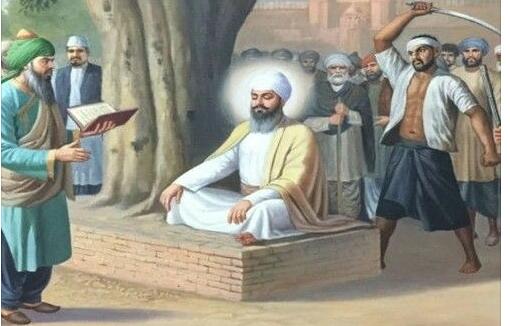
Between a church and a masjid in the heart of New Delhi stands the historic Gurdwara Rakab Ganj Sahib a place that quietly holds one of the most profound stories of sacrifice in Indian history. It was here, nearly 300 years ago, that the cremation of the dismembered body of Guru Tegh Bahadur, the ninth Sikh Guru, took place after his execution under Mughal rule. His martyrdom on 24 November 1675 remains a defining moment for Sikhism and for the defence of religious liberty in India. For many, especially within the Sikh community, Guru Tegh Bahadur’s death represents a brave stand against tyranny, forced conversion, and the denial of basic human rights.
Guru Tegh Bahadur is remembered not only as a spiritual leader but also as an unwavering defender of human dignity. Members of the Delhi Sikh Gurdwara Management Committee (DSGMC) describe him as “the greatest humanitarian the world has ever seen,” highlighting that he sacrificed his life not for his own community, but for Hindus who faced persecution. His teachings promoted universal love, equality, and justice values that lay at the heart of Sikh philosophy.
Throughout his life, Guru Tegh Bahadur travelled extensively across India, spreading messages of compassion, peaceful coexistence, and service to the oppressed. His sermons emphasised inner strength, moral living, and resilience against injustice. The Guru’s calm but firm approach to spirituality and social responsibility made him a guiding light for people beyond the Sikh fold.
The backdrop of Guru Tegh Bahadur’s martyrdom lies in the policies of Mughal emperor Aurangzeb, who enforced Sharia law across his empire and reintroduced the jizya tax on non-Muslims. Many historical accounts mention episodes of forced conversions, especially in regions like Kashmir, where Hindu communities felt vulnerable under imperial pressure.
According to Sikh tradition, a group of Kashmiri Pandits sought refuge and protection from Guru Tegh Bahadur as they faced coercion to convert. It was on the advice of his young son the future Guru Gobind Singh that he took up their cause and decided to challenge Aurangzeb directly. Accounts differ on the exact events that followed: some say Aurangzeb demanded that he perform a miracle, which the Guru refused; others narrate that the emperor asked Hindus to produce someone willing to die for their faith, and Guru Tegh Bahadur volunteered. Regardless of the version, all agree that his stand was extraordinary and selfless.
Guru Tegh Bahadur was arrested on 11 November 1675 and transported to Delhi, where he faced brutal torture and public humiliation. Despite offers to save his life through conversion to Islam, he remained steadfast in his commitment. Seventeen days later, on 24 November, he was publicly beheaded at Chandni Chowk. Today, Gurdwara Sis Ganj Sahib marks the spot of his execution.
Historian accounts, including those by Haroon Khalid, note that Aurangzeb forbade anyone from touching or removing the Guru’s severed head. Yet, in defiance of imperial orders, two devoted followers acted with remarkable courage. Bhai Jaita Ji carried the head to Anandpur Sahib, while Bhai Lakhi Shah Vanjara secretly transported the body to his home in Rakab Ganj, where he set the house ablaze to cremate the Guru without arousing suspicion. This heroic episode gave rise to the present-day Gurdwara Rakab Ganj Sahib.
Guru Tegh Bahadur’s sacrifice is remembered as a watershed moment not just for Sikh history, but for India’s collective conscience. His willingness to lay down his life for another community earned him the title “Hind ki Chadar,” meaning the Shield of India. His martyrdom underscored the belief that defending another’s faith is as vital as defending one’s own. As sources like Khalsa Vox note, his teachings remain deeply relevant, stressing equality, human rights, and social harmony.
Guru Tegh Bahadur’s life and death stand as enduring reminders of the power of moral courage in the face of tyranny. His sacrifice was not confined to the boundaries of religion; it was an assertion of the right to believe, worship, and live freely. In a world still grappling with intolerance and division, his message of universal love, justice, and protection of the oppressed continues to shine bright. Guru Tegh Bahadur remains a timeless symbol of bravery and humanity a guardian of freedom whose legacy transcends generations.