















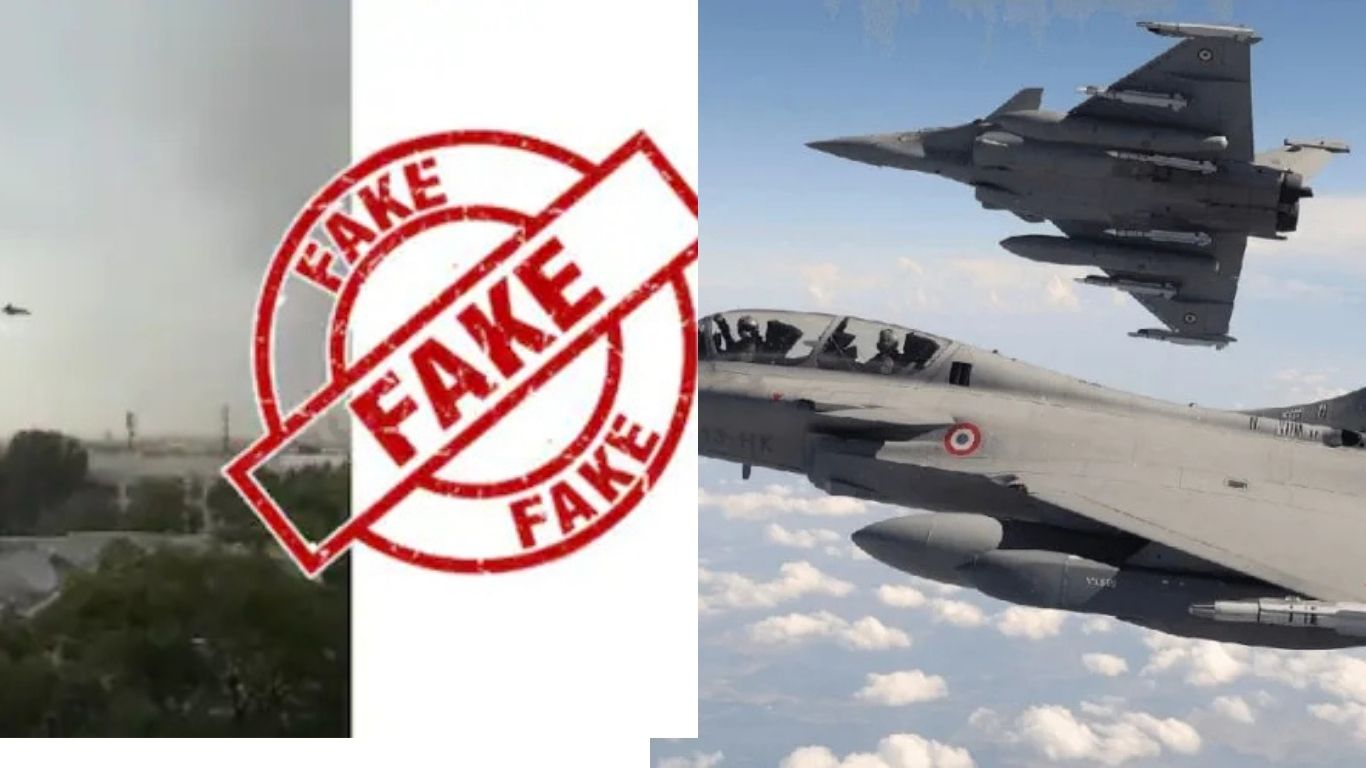
The latest attempt by Pakistan to manufacture a victory narrative after its defeat in Operation Sindoor has collapsed spectacularly after the French Navy issued a strong, point-by-point rebuttal against Pakistani media reports. Outlets such as Geo News, Dunya News, Samaa TV, Pakistan Today, and Times of Islamabad claimed that a French naval officer had confirmed Pakistan’s shooting down of multiple Indian Rafale jets during the May 2025 India–Pakistan conflict. But in an official statement posted on X (formerly Twitter) on November 22, the Marine Nationale labelled these reports as fake news and clarified that the officer in question Captain Yvan Launay never made any such assertions. This explosive clarification has not only exposed Pakistan’s ongoing disinformation campaign but also reaffirmed that its media ecosystem has no qualms about fabricating foreign endorsements to hide military embarrassment.
How Pakistani Media Invented a Fictional Rafale “Debacle”
The controversy began when Pakistani publications attributed false statements to Captain Launay, claiming he had spoken at a conference about alleged Indian Air Force failures during Operation Sindoor. Geo News even misreported his name as “Captain Jacques Launay,” fabricating quotes that suggested the Indian Rafale losses occurred not because of Pakistan’s Chinese-origin J-10C jets, but because of “Indian pilot errors.” According to their fictional narrative, Launay supposedly said that more than 140 fighter jets took part in the engagement, making it “very easy to hit an aircraft” and that Pakistan “handled the situation better.”
These statements never existed but Pakistani media repeated them aggressively. Dunya News reproduced the same fabricated quotes, adding that Launay allegedly praised Pakistan’s air defence systems. Times of Islamabad pushed the propaganda further, asserting that the Pakistan Air Force used “superior tactics” to destroy the Indian Rafales, based on conclusions they attributed to the French officer. Multiple other outlets, including Pakistan Today and Samaa TV, joined the chorus, each amplifying the fiction with dramatic headlines claiming that a French commander had “confirmed” Pakistan’s battlefield victory.
The French Navy, which normally refrains from responding to foreign media speculation, finally stepped in with a rare, sharp rebuttal. In their official statement, they made it abundantly clear that Captain Yvan Launay never consented to any publication, never spoke about Operation Sindoor, and never made any comment regarding Indian Rafales or Pakistani fighter jets. The Navy clarified that Launay is a commander at a French naval air station hosting Rafale Marine aircraft a completely different variant from the Indian Air Force’s Rafale fighters used in the Indo-Pak conflict.
The French statement noted that during a routine presentation at an Indo-Pacific conference, Launay discussed only his base’s operational assets, Rafale Marine missions, and the French carrier strike group’s deployment patterns. When questioned informally about Operation Sindoor, he declined to comment entirely. The Navy also emphasised that he never mentioned the Chinese J-10 or any alleged radar jamming of Indian Rafales claims that were central to the Pakistani media narrative.
The only technical remarks Launay made were about universal pilot challenges, such as cognitive overload from excessive cockpit data during high-pressure aerial engagements. These were generic observations relating to fighter aviation worldwide not to India, Pakistan, Rafales, or J-10s. Yet Pakistani outlets weaponised these remarks to construct a fiction of Pakistani military superiority.
France, calling out “extensive misinformation and disinformation,” made it clear that Launay’s comments had been twisted beyond recognition and inserted into a fabricated propaganda narrative.
Pakistan’s eagerness to push fake stories stems from the heavy losses it suffered during Operation Sindoor. Satellite images, independent analysts, and multiple global defence observers have documented significant damage across several Pakistani Air Force bases following Indian strikes. Cratered runways left bases inoperable for months, hardened shelters were destroyed, and hangars containing fighter jets and AWACS platforms took direct hits from Indian precision weapons.
These losses created a domestic political crisis for Pakistan, forcing its government and military to rely on disinformation campaigns to maintain the illusion of parity with India. The fabricated Rafale “shootdowns” serve this purpose offering Pakistan’s public a fake sense of victory despite the overwhelming evidence of military setbacks.
Crucially, Pakistan has produced no proof whatsoever to back its claim of shooting down multiple Indian jets. There is no wreckage, no satellite evidence, no pilot testimony, and no third-party confirmation. India, meanwhile, has categorically denied losing multiple aircraft and has indicated that at most one jet may have been lost, with no confirmation linking it to Pakistani action.
The French Navy’s intervention has decisively shattered Pakistan’s narrative, proving that the claims circulating in its media space were not merely exaggerated but entirely fabricated. By inventing quotes, misusing a foreign officer’s identity, and twisting basic aviation remarks into strategic military conclusions, Pakistan exposed the extent of its desperation following its defeat in Operation Sindoor. India’s position remains backed by evidence, transparency, and international credibility while Pakistan stands discredited by its own disinformation machinery. In the end, facts have prevailed, and the world has seen through yet another attempt to manipulate the truth.