
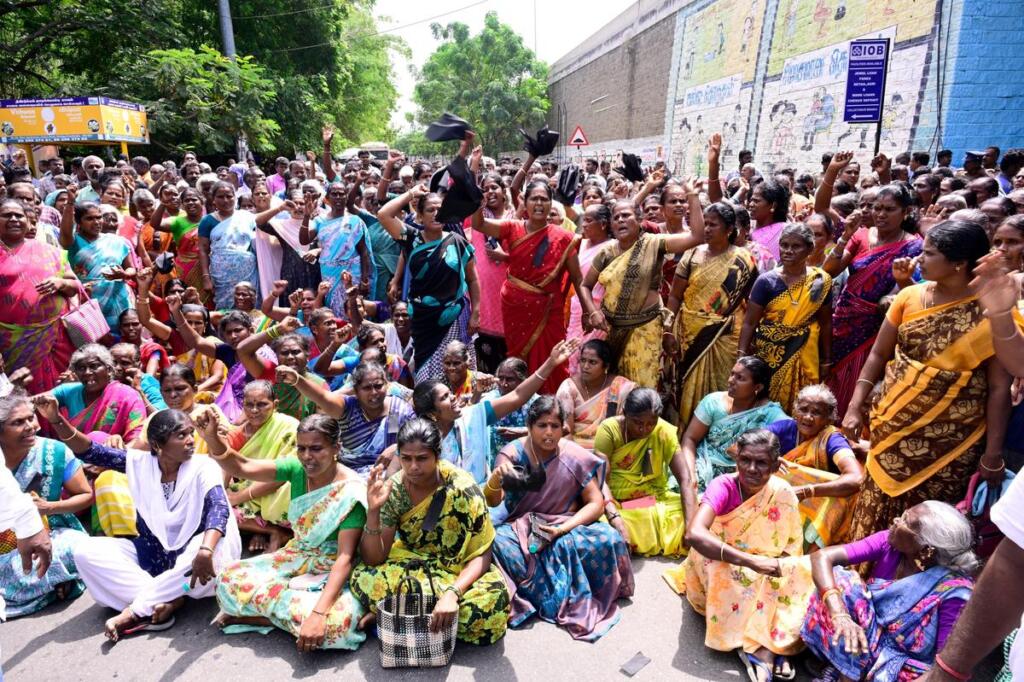
In a remarkable turn of events in Dindigul, Tamil Nadu, a legal dispute involving religious tensions has revealed the challenges Hindus face in practicing their religion freely in a country with a Hindu-majority population. On November 4, 2025, the Madras High Court issued a landmark ruling allowing a Hindu community to conduct a traditional “annadhanam” (free food distribution) on a piece of public land. However, this permission sparked outrage and protests from the local Christian community, raising important questions about religious rights, public space, and the role of the state in ensuring freedom of religion for all citizens.
The Dispute: A Hindu Feast on Public Land
The controversy began with the local Hindu community in Panchampatti village, Dindigul, seeking to hold a feast as part of a Hindu temple’s Kumbabishekam (a consecration ceremony). This event was to take place on a piece of government-owned land, known as “gramamatham,” which is typically designated as vacant land for public use. When the Hindu community requested permission from the local authorities, they were initially denied. The officials cited concerns over potential law and order issues, fearing that allowing the religious event so close to a local church could trigger unrest.
However, a member of the Hindu community decided to challenge the rejection in court. The case eventually reached the Madurai Bench of the Madras High Court, where the arguments focused on the ownership of the land and the constitutional right to religious freedom. The authorities had argued that granting permission for the feast could disturb communal harmony, but the court ruled in favor of the Hindu community, asserting that public land should be available for use by all citizens, regardless of their religion.
Madras High Court’s Ruling
The pivotal ruling was delivered by Justice G.R. Swaminathan. The court examined whether a government-owned land could be reserved for one religion and excluded others. Justice Swaminathan observed that the land in question was government property and should be made available to all citizens, irrespective of their religious background. In his judgment, he emphasized that “a public ground should be available for the use of all communities or none.” He also pointed out that excluding a religious group from using public land solely based on their religion would violate Article 15 of the Indian Constitution, which prohibits discrimination on the grounds of religion.
Justice Swaminathan further clarified that the right to hold the feast fell under the ambit of Article 25 of the Constitution, which guarantees every citizen the right to freely practice, profess, and propagate their religion. Thus, the court’s judgment not only reaffirmed the right of Hindus to celebrate their religious traditions but also set an important precedent for how public spaces should be managed in a secular country.
Christian Protest and Tensions Escalate
Despite the court’s ruling, the decision did not sit well with the local Christian community. On November 4, a massive protest involving over 500 Christian villagers from Panchampatti in Dindigul took place, with the protesters blocking roads and staging a demonstration against the court’s order. The protestors, including women, gathered near the Dindigul collector’s office and condemned the decision, claiming that it would disrupt the social fabric of the community. Some protestors even announced their intent to submit their government-issued identity cards, such as Aadhaar and voter IDs, as a symbolic act of defiance.
The situation escalated to the point where more than 100 police officers were deployed to maintain law and order. Negotiations between the protesters, district officials, and law enforcement led to the eventual withdrawal of the blockade, though a case was registered against 100 individuals for staging a protest near the event site the previous night.
The Legal and Religious Landscape
This incident highlights a growing concern about the challenges faced by religious minorities, particularly Hindus, in exercising their religious freedoms within a predominantly Hindu nation. While India is constitutionally a secular republic, religious tensions often manifest in local disputes over issues such as the use of public spaces, religious gatherings, and freedom to practice one’s faith.
In many cases, Hindu communities have found themselves needing legal interventions to ensure their right to celebrate religious events, even on public land. One striking example of this is the increasing trend of court orders granting Hindus permission to conduct religious activities in spaces that are seen as neutral or communal. This issue becomes more pronounced in areas with religious pluralism, where one community’s religious practices may be perceived as threatening by another.
Furthermore, the legal intervention in this case underscores a critical point about the governance of public spaces in India. The ruling of the Madras High Court affirms that government land should be considered a resource for all citizens and should not be restricted by religious boundaries. The notion that such spaces are neutral and open to all is central to India’s secular ethos, but the reality on the ground often proves otherwise.
Conclusion: A Symptom of Broader Challenges
The Dindigul incident is more than just a local dispute—it represents a broader trend in India where Hindus, despite being the majority, face obstacles in practicing their religious customs. Whether it is obtaining permission for public religious events or navigating the complex dynamics between different religious communities, Hindus often find themselves caught in legal battles that challenge their basic constitutional rights.
As India continues to evolve as a pluralistic society, the tension between religious freedoms and public order remains a critical issue. The Dindigul case is a reminder that, in a secular democracy, public spaces must remain accessible to all, and the rights of individuals to practice their faith should not be hindered by communal divisions.