
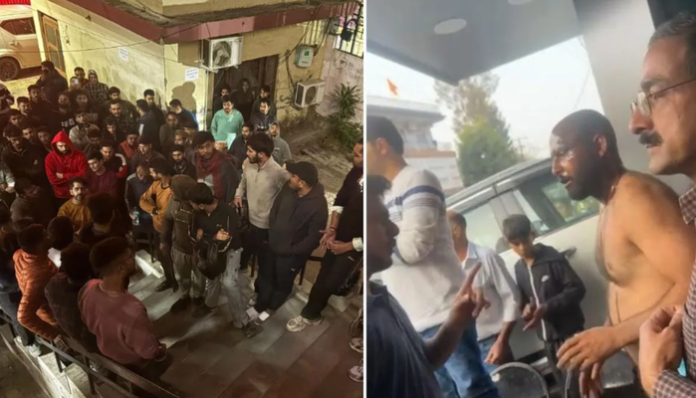
The small town of Sundarnagar in Himachal Pradesh’s Mandi district witnessed disturbing scenes of communal tension on November 5th after an alleged kidnapping attempt on a minor Hindu girl by a Muslim man named Abbas. The incident has not only shaken the local community but also reignited a larger debate over the safety of Hindu girls and women and the growing patterns of predatory targeting seen across different regions.
According to reports, the minor Hindu girl victim had told her family that Abbas, a married man with two wives, had been stalking her for several days. He frequently followed her to school and had even tried to grab her hand and pull her into a car the previous day. Fortunately, her cries for help drew attention, and he fled the scene. The family later reviewed nearby CCTV footage, identified the accused, and managed to capture him near their residence. Angry locals confronted Abbas, thrashed him, and blackened his face before handing him over to the police.
This incident sparked immediate communal outrage. When the Hindu girl victim’s family and the accused’s relatives came face-to-face outside the Sundarnagar police station, a heated confrontation ensued. The situation escalated rapidly but was brought under control after police intervention. DSP Bharat Bhushan confirmed that an FIR had been lodged against Abbas under the relevant provisions of the Bharatiya Nyaya Sanhita (BNS) and the Protection of Children from Sexual Offences (POCSO) Act. Some locals were also booked for creating a disturbance during the confrontation.
In a counter-action, the family of the accused filed a complaint, alleging that Abbas was unlawfully detained, assaulted, and publicly humiliated. Superintendent of Police Sakshi Verma stated that cross-FIRs had been registered and that both cases were being investigated impartially to avoid further escalation of communal tension.
While the law takes its course, the broader social concern persists: why are so many reports emerging of Hindu girl and women are being sexually harassed or targeted by men from different religious backgrounds? Many local activists argue that this reflects a disturbing pattern of exploitation where religious identity adds yet another layer to gender-based violence. The vulnerabilities of young Hindu women, particularly in smaller towns, make them easy targets for manipulation, stalking, and predatory behavior.
Sociologists and women’s rights advocates warn that such incidents deepen the mistrust between communities and polarize societies further. They emphasize the need to address the issue both as a criminal matter and as a social crisis. Protecting women including Hindu girls must be viewed beyond religious identity — as a collective moral responsibility upheld by law enforcement and civil society alike.
The Sundarnagar case stands as a grim reminder that safety for women cannot depend on chance, fate, or faith. It demands proactive vigilance, strict law enforcement, and an honest societal reckoning with how issues of gender and religion are exploited to harm the most vulnerable.