






















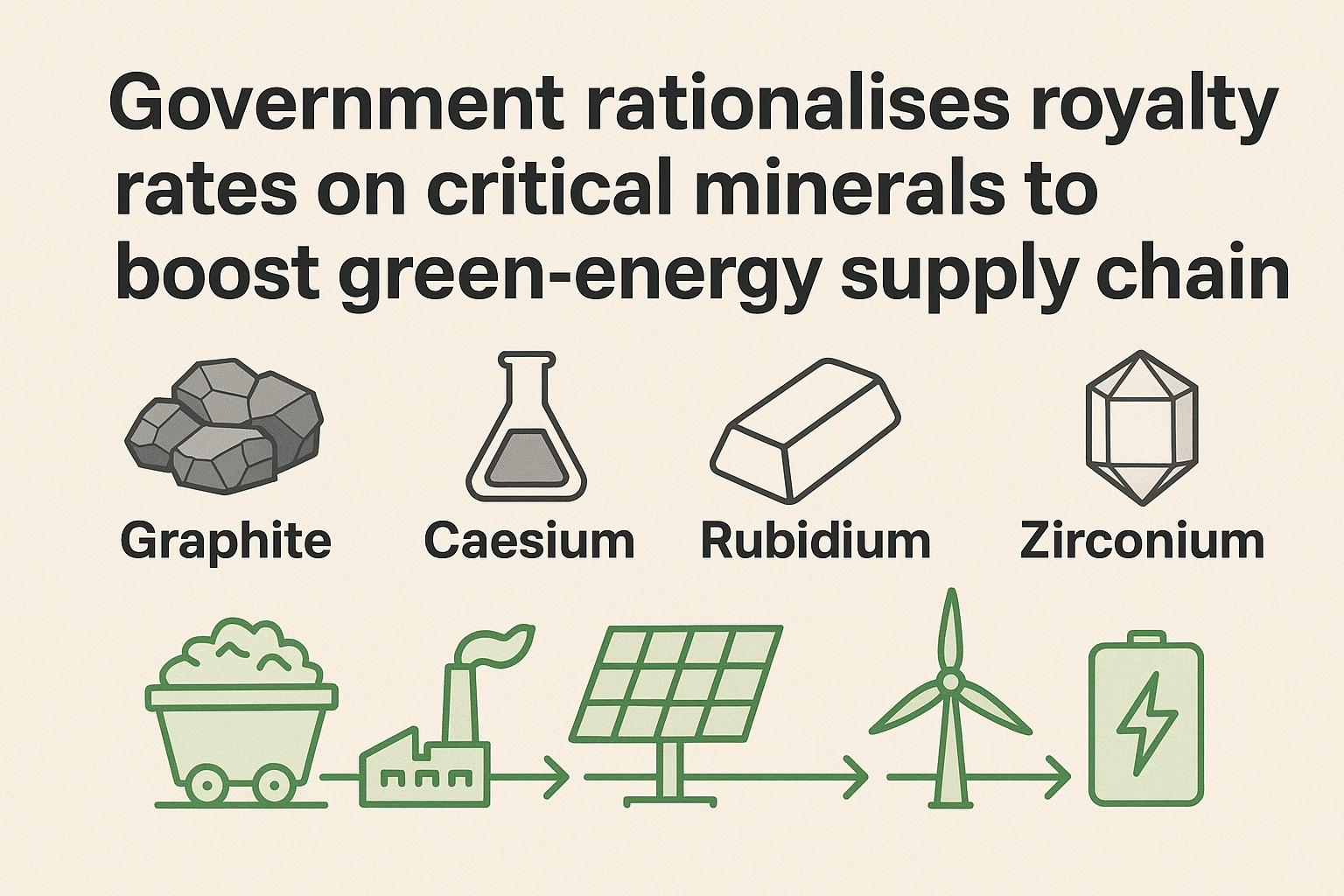
The Union Cabinet, chaired by Prime Minister Narendra Modi, has approved revised royalty rates for four minerals deemed critical to the green-energy transition and high-tech manufacturing: graphite, caesium, rubidium and zirconium.
Key changes to royalty rates
For caesium: the royalty is set at 2% of the Average Sale Price (ASP) of caesium metal chargeable on the metal contained in the ore produced.
For graphite: differentiated by grade—if fixed carbon content is 80 % or more, the royalty is 2% of ASP on an ad-valorem basis; if below 80 % fixed carbon, the royalty is 4% of ASP on an ad-valorem basis.
For rubidium: royalty at 2% of ASP of rubidium metal contained in the ore produced.
For zirconium: royalty at 1% of ASP of zirconium metal contained in the ore produced.
Why this matters
These minerals — graphite, caesium, rubidium and zirconium — are integral to the global energy transition and technological manufacturing ecosystem. Graphite is the anode material in electric-vehicle batteries and an essential component for high-capacity charge cycles; the country currently imports around 60 % of its graphite requirement. Zirconium finds use in sectors like nuclear energy, aerospace, healthcare and manufacturing thanks to its corrosion resistance and high-temperature stability. Caesium is used in precision instruments like atomic clocks, satellite navigation systems (GPS), and medical equipment including cancer-therapy devices. Rubidium is used in making speciality glasses used in fibre optics, telecommunications, and night-vision devices.
By specifying royalty in relation to ASP (and, in graphite’s case, moving to an ad-valorem basis) the government is aligning royalty rates with market dynamics and quality differentials. For graphite especially, the shift from a per-tonne royalty (in place since September 2014) to a price-based ad-valorem basis means that royalty revenue will more closely reflect variations in grade and global prices.
Strategic objectives and expected outcomes
The decision supports multiple strategic objectives:
Encouraging the auctioning of mineral blocks containing these critical minerals, thereby unlocking new deposits and associated minerals (such as lithium, tungsten, rare-earth-elements (REEs), niobium) that may be co-located.
Boosting indigenous production to reduce dependence on imports and thereby mitigate supply-chain vulnerabilities.
Generating employment opportunities in the mining and processing sectors.
At present, India has nine operating graphite mines and has already auctioned 27 blocks; additionally, around 20 blocks have been handed over by the Geological Survey of India (GSI) and the Mineral Exploration Corporation Limited (MECL) for future auction, with another 26 under exploration.
Further, a Notice Inviting Tender (NIT) issued on 16 September 2025 announces the sixth tranche of critical-mineral auctions: five graphite blocks, two rubidium blocks, and one block each of caesium and zirconium. The revised royalty rates scheme is intended to give bidders clarity and certainty before they submit their financial bids.
Wider implications
By rationalising royalty rates and linking them to market prices and quality (as in the case of graphite), the government’s move is a recognition of the rapidly evolving demand environment for critical minerals in the context of green-energy technologies and advanced manufacturing. As countries race to secure upstream mineral supply for batteries, electronics and strategic infrastructure, India’s policy shift can help position the country as a stronger player in mineral extraction and value-chain development.
Moreover, the move could spur investment in mining, processing and value-added manufacturing of battery materials, high-end electronics and aerospace components — areas identified for growth in national strategic plans. In the backdrop of global competition for critical-mineral supply chains, increasing domestic production also helps reduce dependence on imports, which can be a strategic vulnerability.
Conclusion
In summary, the Cabinet’s decision to revise the royalty rates for graphite, caesium, rubidium and zirconium reflects a clear policy to align royalty structures with market realities and to stimulate domestic extraction and processing of high-tech minerals. With the auctions and exploration underway, the next phase will test whether these policy changes translate into accelerated production, greater self-reliance and downstream manufacturing capability for India’s green-energy and technology ambitions.





