









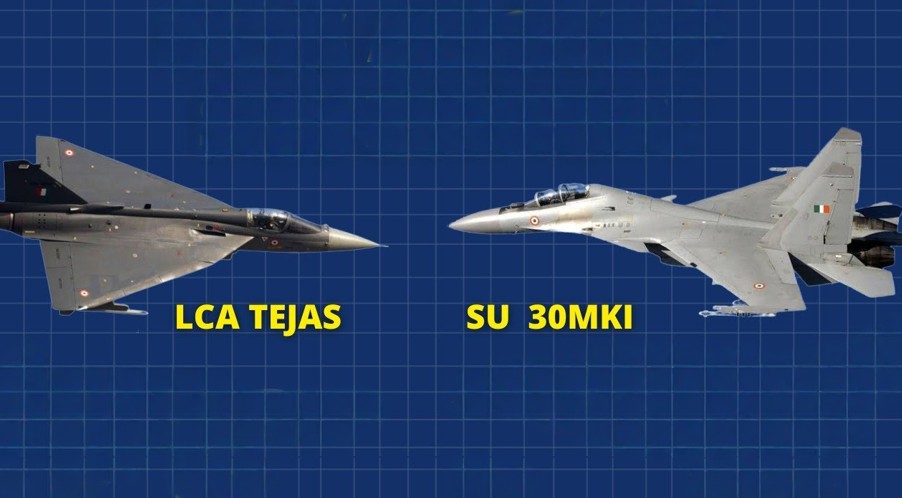
In the wake of the tragic Indian Airforce fighter jet Tejas crash at the Dubai Airshow, a wave of misinformation quickly spread online, claiming that Armenia had canceled a $1.2 billion deal for India’s indigenous fighter jet.
The story, propagated by Turkish-linked accounts, suggested that the accident had derailed India’s first potential Tejas export. The truth, however, is starkly different since Armenia has never negotiated for the Tejas LCA.
The nation’s defence talks with India have always focused exclusively on the heavy, multirole Su-30MKI fighter, a platform that aligns with Yerevan’s strategic airpower needs and long-term procurement plans.
No Tejas Deal Ever Existed
There was no such deal, the deal was that of Su-30 not LCA. Yet after the tragic crash of an Indian Air Force Tejas at the Dubai Airshow, a Turkish-linked account, ‘Clash Report,’ claimed that Armenia had “suspended negotiations” for 12 Indian-made Tejas jets worth $1.2 billion.
The post implied that the accident had derailed India’s first potential Tejas export. Eurasian Times and Indian defence analysts quickly debunked the claim stating that Armenia has never negotiated for the Tejas, and the story is a fabricated attempt to exploit a tragedy for disinformation purposes.
Armenia’s Real Interest Lies In Su-30MKI
In reality, Armenia has been negotiating with India for nearly a dozen Su-30MKI fighters since late 2024. Manufactured under license by HAL, the Su-30MKI is a heavy, multirole platform that perfectly aligns with Armenia’s strategic airpower requirements.
Sam Lichtenstein, Director of Analysis at risk intelligence firm RANE, highlighted that Su-30MKIs are also a far more cost-effective option than Western alternatives like the Rafale. “Yerevan is likely to focus on acquiring India-built Su-30MKIs, which provide the best combination of performance and affordability,” he said.
Dubai Crash: Tragic, But Not a Dealbreaker
The Tejas Mk1 crash at Dubai Airshow, which claimed the life of Wing Commander Namansh Syal, was a tragic reminder of the risks of aerobatic displays. The single-engine, 4.5-generation LCA lost control during a high-G vertical loop and crashed approximately 1.6 kilometers from the showground.
While shocking, the crash has no bearing on Armenia’s defense procurement. Defense experts point out that history shows isolated accidents rarely affect major fighter deals.
Walter Ladwig of the Royal United Services Institute cited the 1999 Paris Airshow Su-30 crash in France, which did not derail ongoing deals, emphasising that fighter sales are driven by strategic requirements, not media sensationalism.
Disinformation at Work
The Clash Report post illustrates how propaganda can weaponise tragedy. By linking the crash to a fictitious Tejas deal, it aimed to generate doubt about India’s defense exports and create geopolitical noise.
“Armenia has suspended negotiations to buy 12 Indian-made Tejas fighter jets, valued at 1.2 billion after a Tejas crashed during an aerobatic display at the Dubai airshow. The halted deal would have been the aircraft’s first export sale. The cause of the crash remains unclear,” posted Clash Report.
Indian observers were quick to respond. A user on X remarked bluntly, “Turkish fake news handle @ClashReport peddling crap as usual. Armenia is negotiating to buy 12 HAL-built Su-30MKI fighters from India, not Tejas.”
Eurasian Times further confirmed with sources in India and Armenia that ongoing discussions involve only the Su-30MKI platform. The Tejas program remains on course, with no export deals canceled or disrupted.
Reality vs Rumor
The Dubai Airshow crash was a tragic loss for India and the aviation community, but it did not affect Armenia’s procurement strategy. Armenia’s focus remains on acquiring the Su-30MKI, while India continues its push to export the Tejas.
The so-called “Armenia–Tejas deal” is entirely fabricated, a reminder of how disinformation can distort facts and manipulate public perception.
The IAF’s LCA Tejas Mk1 crashed during an aerial manoeuvre at the Dubai Airshow on November 21. The incident occurred on the final day of the biennial event at Al Maktoum International Airport.
Earlier, a day before the crash took place, the Press Information Bureau (PIB) fact-check unit had debunked social media claims of an “oil leakage” from a Tejas aircraft at the airshow.
On November 20, the PIB addressed circulating videos alleging technical issues with the LCA Tejas Mk1, stating, “Several propaganda accounts are circulating videos claiming that at the Dubai Airshow 2025, the Indian LCA Tejas Mk1 suffered oil leakage. These claims are fake”.
The “propaganda videos” claimed that “oil was leaking” from one of the fighter jets. The government’s fact-check unit clarified that the footage showed “routine, intentional draining of condensed water from the aircraft’s Environmental Control System (ECS) and On-Board Oxygen Generating System (OBOGS)”, a standard procedure in humid conditions like Dubai’s.
The PIB described the narrative as “deliberately pushed” to undermine the jet’s reliability and urged verification before sharing information.