
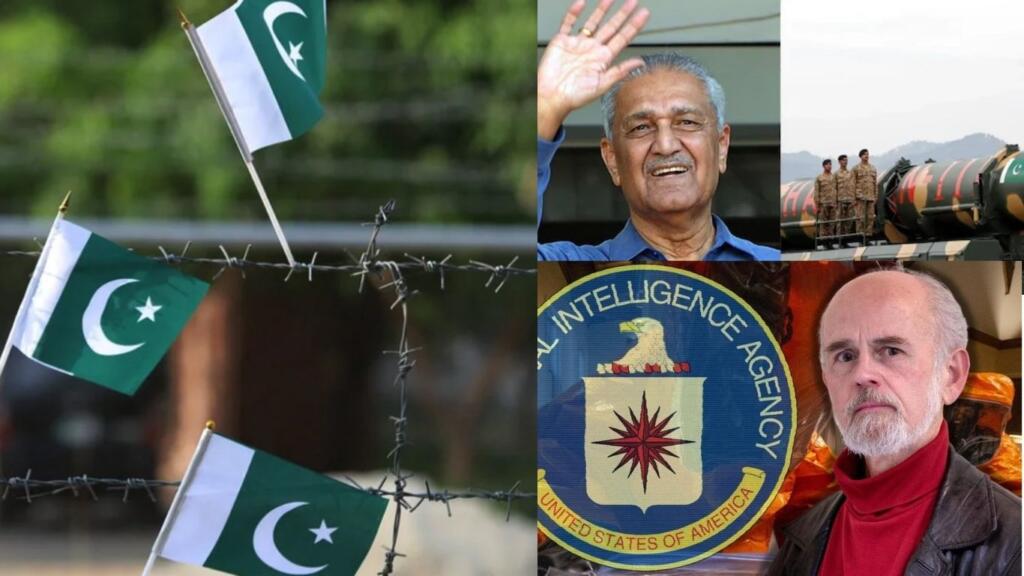
This is the story that exposes why Pakistan should never have been allowed to possess nuclear weapons, and why its nuclear arsenal remains one of the greatest dangers to global security. Former CIA counter-proliferation chief James Lawler has now openly revealed that A.Q. Khan the man Pakistan celebrates as a national hero and who was actually running a global nuclear smuggling empire, had powerful Pakistani generals on his payroll. This is not just an expose of one so called scientist. It is a reminder that Pakistan’s nuclear weapons are not controlled by an elected civilian government but by a set of scientists and a military establishment that will do anything to hold on to power.
James Lawler, Former CIA officer the man widely credited for breaking the infamous A.Q. Khan nuclear smuggling network, has revealed explosive details about Pakistan’s nuclear programme and the generals who protected it. In a recent interview, Lawler described how his intelligence career led him into the heart of global nuclear trafficking networks, and why he eventually nicknamed A.Q. Khan the “Merchant of Death.” According to Lawler, the CIA initially believed Khan’s activities were confined to supplying Pakistan’s own nuclear programme. But they soon realised that Khan had transformed himself into a full-scale proliferator, moving nuclear design secrets, components, and technologies to multiple foreign programmes, including Iran, Libya, and North Korea. Lawler openly stated that A.Q. Khan had Pakistani generals and senior leaders on his payroll. This statement alone destroys Pakistan’s long-standing claim that its nuclear programme has always been under responsible, secure, state-controlled supervision. Instead, Lawler’s testimony confirms what the world has quietly known for decades that Pakistan is not run by its elected government but by an opaque and unaccountable military establishment that has repeatedly misused its power. And when a nuclear programme is controlled by a military clique instead of a stable civilian leadership, the risks multiply beyond measure.
Lawler explained that the CIA had monitored A.Q. Khan for years but initially underestimated the scale of his operation. What began as procurement for Pakistan’s own nuclear development soon expanded into a massive global trafficking network. Khan’s network eventually supplied nuclear components, centrifuge designs, ballistic missile technology, and even a Chinese atomic bomb blueprint to other countries. Lawler noted that Iran’s nuclear programme used designs originally stolen from URENCO and passed through Khan’s network, relying on the same P1 and P2 centrifuge models. This deepened the global concerns about a “nuclear pandemic,” where one country acquiring a bomb could trigger multiple others to seek their own deterrents, sharply increasing the risk of conflict.
Lawler’s counter-proliferation career began in a European country known for advanced technologies sought by states pursuing nuclear weapons. After returning to the CIA headquarters in 1994, he was picked to lead the counter-proliferation office in the European division. He later moved on to infiltration and sabotage operations targeting nuclear programmes, including Iran’s. He said he drew inspiration from Felix Dzerzhinsky’s “Trust” operation, creating covert overseas entities that pretended to supply nuclear-related equipment. The CIA would then provide compromised or defective components designed to disrupt illegal nuclear efforts. Lawler described this strategy saying “We took the reverse of the Hippocratic oath. We always did harm.”
This method proved critical in exposing and dismantling A.Q. Khan’s operations. Over the decades, the CIA built contacts, infiltrated Khan’s network across jurisdictions, and used sting operations to uncover trafficking routes. Despite the vast global implications of the case, no more than ten officers at CIA headquarters were assigned exclusively to the operation, with support from personnel overseas. The intensity increased after 9/11, when concerns grew about the possibility of Pakistan’s nuclear assets falling into extremist hands. CIA Director George Tenet ensured that the agency closely monitored whether Khan had ever provided nuclear material to al-Qaeda. Tenet personally confronted Pakistan’s ruler Pervez Musharraf with evidence of Khan’s proliferation activities.
One of the biggest turning points came during the interception of the BBC China merchant vessel. Lawler explained that the ship carried “hundreds of thousands of nuclear components,” supplying Libya’s nuclear programme. When US officials confronted Libya with the seized material, the leadership struck silent. Libya later abandoned its programme, and Lawler described celebrating beside the seized containers, convinced that the CIA’s actions had prevented a greater catastrophe. His account also revealed that Iran’s programme and its ambitions for nuclear weapons were a direct extension of designs obtained through Khan’s network. This is why Lawler repeatedly warned that an Iranian bomb would create a “nuclear pandemic” in the Middle East.
Lawler rejected the idea that US inaction during Pakistan’s initial nuclear development was due to Saudi pressure. Instead, he said the United States turned a “blind eye” because Pakistan was useful during the Soviet-Afghan war. Those decisions, he admitted, had long-term consequences, including enabling A.Q. Khan to evolve into a global supplier of nuclear technology. He further explained how the CIA sabotaged illicit nuclear programmes by ensuring that centrifuge facilities were filled with flawed components, causing constant breakdowns. Reflecting on his work, Lawler said he had no regrets and believed his efforts prevented multiple countries from acquiring nuclear weapons.
The core message in Lawler’s revelations is clear. Pakistan’s nuclear programme was never a responsible, state-controlled effort. It was built, expanded, and trafficked under the influence of military generals who were willing to sell nuclear secrets to maintain their own power. A.Q. Khan was not a hero he was running a global nuclear black market. And this is exactly why Pakistan, a country governed by its military rather than its people, poses a continuous nuclear danger to the world.