







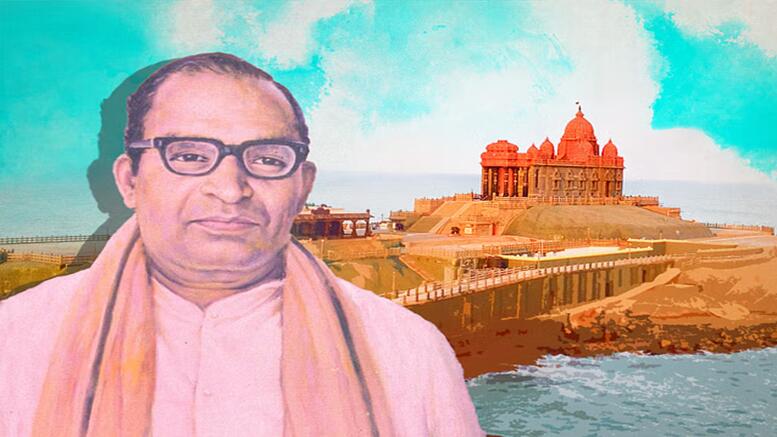
The Vivekananda Rock Memorial at Kanyakumari is today one of India’s most revered spiritual landmarks, visited by millions every year. Yet behind its majestic presence lies a story that most Indians remain unaware of a story of relentless struggle, political resistance, religious friction, administrative stonewalling and a distorted idea of “secularism” that stood like a barricade at every step. What finally transformed an impossible dream into a national monument was not government enthusiasm, but the iron resolve of one man: Eknath Ranade, the visionary RSS Pracharak who refused to let the legacy of Swami Vivekananda be reduced to a footnote.
The rock on which Vivekananda meditated in December 1892, contemplating the future of Bharat, carries for Hindus the sacred footprints of Goddess Kanyakumari. Yet when a memorial was proposed in 1962, immediate opposition came from certain Christian groups who declared it “St. Xavier’s Rock” and even erected a huge cross on it. This triggered public outrage, court interventions, police barricades and ultimately Section 144 in the area. Even after the government removed the cross and officially declared it “Vivekananda Rock,” the hostility persisted. The Madras state government refused permission for any structure on the rock, insisting that only a small stone tablet could be placed there a tablet that was later vandalised and thrown into the sea.
The script was familiar. Just as President Rajendra Prasad had once been discouraged from inaugurating the Somnath Temple in the name of “secularism,” the same doctrine was now being invoked to obstruct a memorial for Vivekananda. It was clear that the project required someone with exceptional organisational skill, persuasive power and unwavering commitment. It found that leader in Eknath Ranade.
Ranade joined the Vivekananda Rock Memorial Committee in August 1963 at a time when the project was virtually paralysed. A disciplined RSS Pracharak since 1938, a philosopher, an administrator, and later General Secretary of the organisation, Ranade understood Vivekananda not merely as a saint but as the architect of India’s national awakening. He approached every challenge with military precision. When the Chief Minister of Madras, M. Bhaktavatsalam, kept blocking the proposal arguing that the memorial would “spoil the natural beauty” of the place, Ranade countered each objection with reason and strategy. But he also understood that logic alone would not work; national pressure was essential.
On advice from Lal Bahadur Shastri, Ranade executed one of his most brilliant moves. In an unprecedented show of mobilisation, he collected the signatures of 323 Members of Parliament in just three days, cutting across political lines. This extraordinary unity forced Jawaharlal Nehru to support the project, compelling the state government to relent. When the Chief Minister still attempted to limit the memorial to a tiny structure, Ranade tactfully approached the Shankaracharya of Kanchipuram, whose approval Bhaktavatsalam respected deeply. The seer suggested a grand design, and the state had no choice but to approve it.
Yet acquiring permission was only half the battle. The memorial needed funds ₹1.35 crore, an enormous amount in the 1960s. For most people, this would have been a dead end. For Ranade, it became an opportunity to build a national movement. He printed lakhs of one-rupee and two-rupee donation folders, ensuring that ordinary citizens became stakeholders in the memorial. Money poured in from every corner of the country students, farmers, industrialists, jawans, NGOs, MPs, and even distant state governments with no direct connection to Vivekananda. ₹85 lakh came from small contributions alone. The Vivekananda Rock Memorial became a monument truly built by the people of India.
Construction began under Ranade’s fastidious supervision, overcoming storms, logistical hurdles, and technical challenges. On 2 September 1970, President V. V. Giri inaugurated the magnificent structure. Even Prime Minister Indira Gandhi, despite her political differences with the RSS, could not hide her admiration and called it “a moving experience” and a testament to the faith of thousands in Vivekananda’s message.
But Ranade’s vision did not end with the memorial. In 1972, he founded Vivekananda Kendra to carry forward the mission of nation-building through character-building. Today, with more than 1,332 centres across 26 states, the Kendra works among youth, women and marginalised communities, focusing on education, rural development and cultural empowerment turning Vivekananda’s ideals into lived reality.
Ranade believed that a nation is not defined by geography or population but by a common mission. His entire life, from refugee relief after Partition to his work in the Northeast, from organisational leadership in the RSS to the creation of the Rock Memorial and Vivekananda Kendra, embodied this philosophy. When he passed away on 22 August 1982 at Chennai, he was cremated at Vivekanandapuram, close to the institution he built and the memorial he made possible.
The Vivekananda Rock Memorial stands today not merely as a monument of stone but as a monument of conviction. It tells the story of how political resistance, religious hostility and bureaucratic cynicism nearly erased a sacred chapter of India’s heritage. And it tells the story of how one man armed only with discipline, devotion and national resolve turned the impossible into reality. It did not rise because the path was smooth. It rose because Eknath Ranade had the courage to make it happen.