
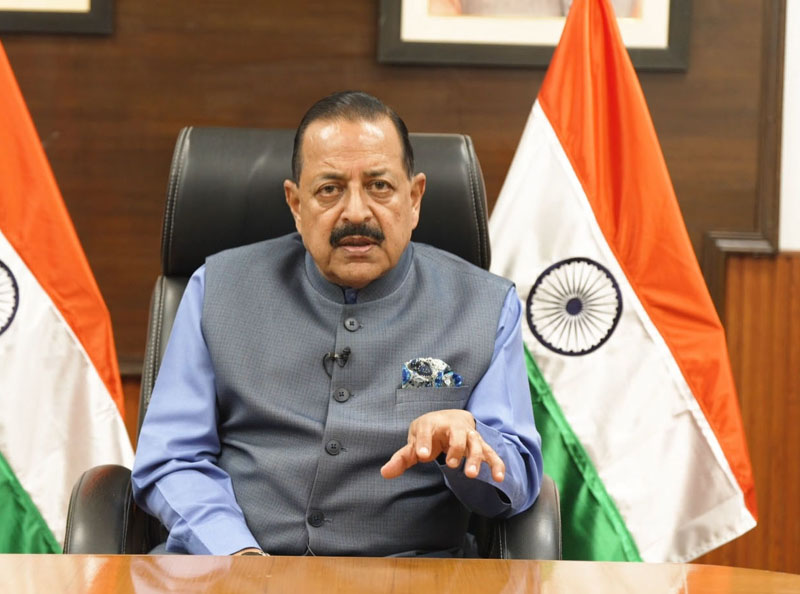
Union Minister Dr Jitendra Singh has formally announced a landmark countrywide innovation challenge, underlining the government’s bold vision to harness India’s scientific talent at all levels and unlock grassroots ingenuity. With this initiative, he aims to empower not just established researchers or startups, but ordinary citizens — students, farmers, creators, and community innovators — to contribute meaningfully to national development through science and technology.
A Call to Innovate: Science for Everyone
In his video address, Dr Singh described India as an emerging “deep-tech powerhouse,” highlighting phenomenal growth across fields like biotechnology, quantum computing, space, and AI. Over the past decade, he noted, India has dramatically scaled up research capacity while fostering an ecosystem that allows pointed ideas to drive real-world impact.
The innovation challenge is open to all—students, researchers, entrepreneurs, and even farmers. The broad eligibility reflects the minister’s conviction that good ideas are not limited to elite labs or urban centers.
Entries can range from raw concepts and prototypes to pilot projects — the only essential criteria being clarity of goal, scalability, and a direct social impact. Specifically, ideas must have the potential to positively affect the lives of at least 1,000 people, ensuring that the call for innovation is not abstract, but rooted in real-world transformation.
Deep-Tech Focus with Social Intent
Dr Singh’s innovation challenge highlights a few thematic priorities: AI, quantum technology, biotechnology, space science, climate tech, healthcare, agriculture, and education. OpIndia These are not arbitrary — they reflect the government’s larger strategy to drive innovation in sectors that align with India’s long-term development goals and societal needs.
The minister also pledged mentorship for the top ideas, and promised structured support through agencies such as the Department of Science & Technology (DST), Department of Biotechnology (DBT), CSIR, and BIRAC. Winning innovators may be felicitated at the upcoming India International Science Festival (IISF) 2025.
Democratizing Innovation — Not Just for Cities
A distinguishing aspect of Dr Singh’s push is his emphasis on inclusivity. The innovation challenge is not just for urban techies — rural innovators, community labs, classroom projects and even farm-based experiments are explicitly encouraged. OpIndia+2The Hans India+2
At the silver jubilee of the National Innovation Foundation (NIF), Dr Singh reaffirmed his commitment to scaling up innovation in India’s hinterlands. He asserted that remote, rural ideas deserve the same support and visibility as those coming from metropolitan labs. The Hans India+1
This roots the initiative firmly in equity: it’s not only about breakthroughs, but about ensuring innovation becomes a tool for leveling the playing field across India’s regions.
Driving Forward India’s Global Innovation Profile
Dr Singh’s innovation challenge is more than just a domestic effort — it is a strategic push toward raising India’s international innovation status. In recent years, the Minister has pointed to India’s rise in the Global Innovation Index, its growing number of deep-tech startups, and its investments in quantum and mission-mode science projects. Department of Science & Technology+1
He has repeatedly stressed the need for “industry-determined innovation research” — that is, innovation that is deeply linked to market reality, not just academic inquiry. Department of Science & Technology This ensures that good ideas don’t languish in labs, but translate into products, services, and scalable solutions for people.
Why This Innovation Challenge Matters:
-
Boosts Democratization of Science
By inviting citizens from all walks of life, the challenge breaks down the myth that innovation only happens in elite institutions. This could unleash tremendous latent potential. -
Aligns Innovation with Social Impact
The requirement that ideas serve at least 1,000 people ensures the challenge remains socially meaningful, not just technically ambitious. -
Strengthens India’s Deep-Tech Ecosystem
With a focus on cutting-edge fields like quantum, AI, biotech, and climate tech, the challenge dovetails with national priorities for technological self-reliance and leadership. -
Bridges Academia, Industry, and Government
Structured support from DST, DBT, CSIR, BIRAC — combined with mentorship from Dr Singh — creates a holistic support pipeline from ideation to real-world scaling. -
Respects Regional Innovation
By giving rural and grassroots innovators a seat at the table, India stands to benefit from context-specific, locally relevant solutions, not just urban-centric technology.
Challenges and Considerations
Of course, successfully executing such a challenge is not without risks. Here are a few potential issues:
-
Resource Bottlenecks: Scaling up so many ideas would require substantial mentorship bandwidth, funding, and administrative support.
-
Idea to Impact Gap: Many early-stage ideas fail to convert into sustainable projects. Ensuring follow-through would be critical.
-
Equity in Selection: While the call is open to everyone, selection criteria and evaluation mechanisms must be transparent and fair to truly democratize innovation.
Seeds of India’s Innovation Future
Dr Jitendra Singh’s Nationwide Innovation Challenge is more than a government program — it’s a symbolic and practical commitment to science as a people’s movement. By opening innovation to all, especially those in marginalized and remote communities, Dr Singh is effectively planting the seeds of India’s technological and social future.
The challenge extends beyond profit-driven startups — it is a clarion call to the nation’s imagination, asking citizens to reimagine what is possible when creativity, science, and social purpose intersect. If executed well, this initiative could not only surface breakthrough technologies but also strengthen India’s identity as a democratic, inclusive, and forward-looking innovation powerhouse.
As Dr Singh so aptly said, “India is shaping the future. And the next breakthrough can come from you.”