





















In a surprising turn of events, Turkey has allegedly obstructed the delivery of India’s second and final batch of AH-64E Apache attack helicopters, deepening the ongoing diplomatic rift between New Delhi and Ankara. The six advanced helicopters, ordered in 2020 for the Indian Army, were en route to India when the transport aircraft was abruptly turned back mid-journey, delaying a crucial defense delivery.
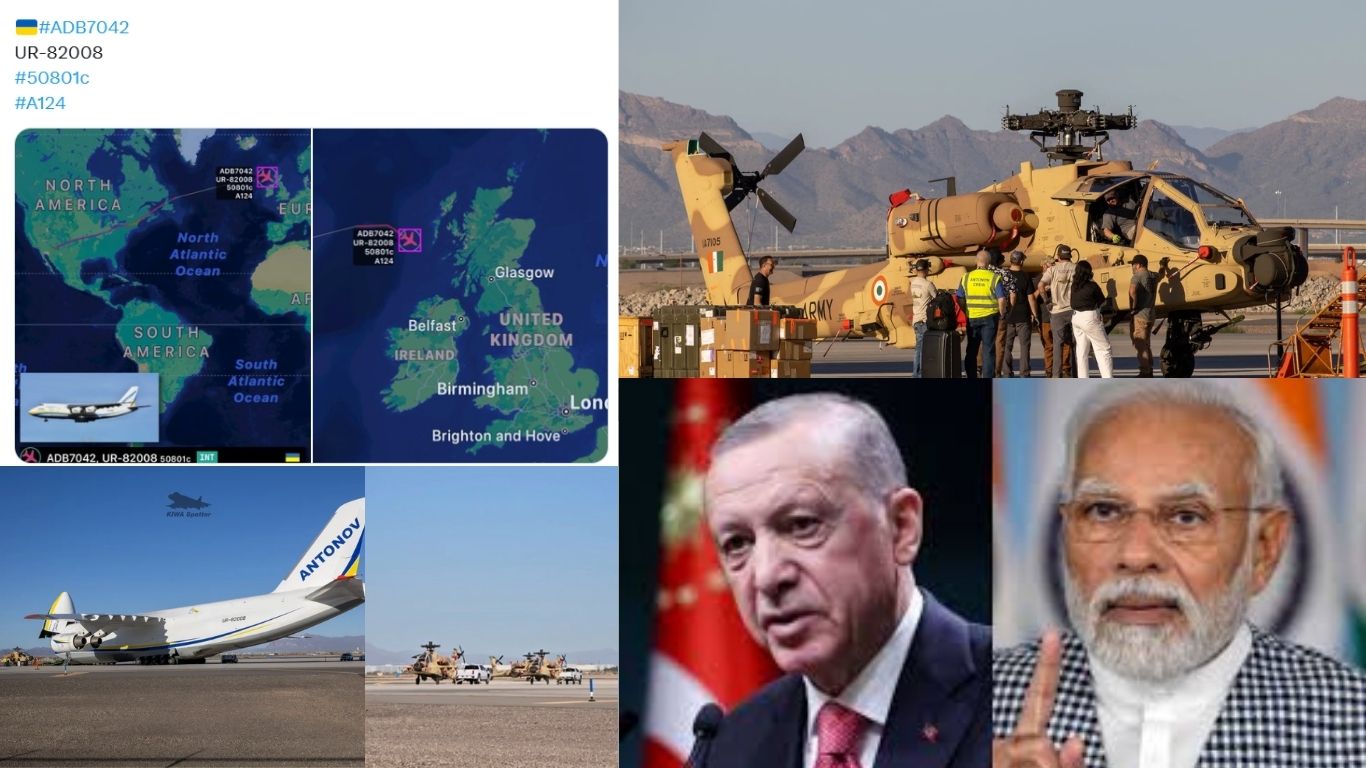
On October 30, an Antonov An-124 cargo aircraft, registered UR-82008, departed from Leipzig, Germany, to Mesa Gateway Airport in Arizona the manufacturing base for Apache helicopters. Plane spotters confirmed that three helicopters, painted in Indian Army colors, were loaded onto the aircraft. The An-124 subsequently took off for England, landing at East Midlands Airport on November 1, where it remained grounded for eight days. However, instead of heading toward India, the plane unexpectedly returned to Mesa, Arizona, on November 8 as per reports cited by TWZ. Upon arrival, the Apaches were offloaded and towed away, sparking intense speculation over the cause of the reversal.
While Boeing later cited “logistical issues” as the reason behind the detour, sources cited by The EurAsian Times familiar with the development revealed that Turkey’s refusal to grant airspace clearance was the real cause.
According to a reliable insider quoted by EurAsian Times, the aircraft was stranded in England because Ankara denied the transit request, citing the “current state of relations” between India and Turkey.
Worsening India-Turkey Relations After the May 2025 Conflict
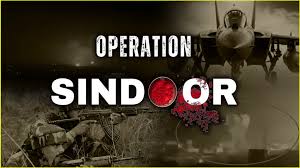
The denial of airspace access appears to be another manifestation of deteriorating diplomatic relations between the two nations. Tensions hit a new low after Turkey openly sided with Pakistan during the brief four-day war in May 2025. Ankara not only condemned India’s Operation Sindoor launched to avenge the Pahalgam terror attack but also supplied Islamabad with critical military support, including reconnaissance drones and battlefield intelligence.
Turkey’s overt interference infuriated New Delhi. India retaliated by blocking social media handles of several Turkish media outlets accused of spreading anti-India propaganda and revoked the security clearance of Celebi Airport Services, a Turkish firm operating in India’s aviation sector. Though some of these measures were later reversed, the damage to diplomatic trust was irreversible.
Following these developments, several Indian trade associations and business leaders called for a complete boycott of Turkish goods, tourism, and cultural exchanges. Consequently, the number of Indian visitors to Turkey fell sharply in 2025, signaling the economic cost of Ankara’s pro-Pakistan posture.
Turkey’s President Recep Tayyip Erdoğan has also been repeatedly critical of India’s internal policies, especially on Kashmir. Since 2019, he has used global platforms like the UN General Assembly to internationalize the Kashmir issue, describing it as a “threat to regional peace.” For New Delhi, such remarks amount to blatant interference in domestic matters.
As a countermeasure, India has been deepening ties with Turkey’s regional rivals Greece, Cyprus, and Armenia expanding defense cooperation and diplomatic engagement in the Mediterranean region. India’s absence from the Turkish National Day celebrations in New Delhi in late October 2025 further underscored the continuing diplomatic freeze.
The Indian Army’s Apache acquisition was a strategic move to boost its aerial strike capabilities, especially in high-altitude border regions. The Indian Air Force already operates 22 Apache AH-64E helicopters, inducted in two phases between 2019 and 2021 at Pathankot and Jorhat bases. The Army’s separate order, worth $600 million, was signed in 2020 for six advanced variants optimized for mountainous warfare.
🇺🇦#ADB7042
UR-82008#50801c#A124 pic.twitter.com/VL6CRZ0NSD— 🏴MilScot (@mil_scot) October 31, 2025
Initially scheduled for delivery in mid-2024, the project faced multiple delays due to pandemic-related disruptions and production bottlenecks. The first batch finally arrived in July 2025, and the second batch was expected by November 2025 until the recent setback triggered by Turkey’s alleged airspace blockade.
At the induction of the first batch, Defence Minister Rajnath Singh hailed the Apache helicopters as a transformative asset for Army Aviation. “These helicopters will significantly enhance operational effectiveness in challenging terrains, ensuring India’s dominance across multiple combat scenarios,” he said.
Boeing describes the AH-64E Apache as the most advanced multi-role combat helicopter in service today, featuring increased thrust, advanced avionics, and superior survivability. It is capable of executing precision strikes in all-weather conditions, day or night, and can engage multiple targets simultaneously through its Longbow radar and advanced missile systems.
The Apache AH-64E is often referred to as a “flying tank,” designed for dominance in modern high-intensity warfare. Its powerful engines and composite rotor system enable operations in high-altitude regions like Ladakh and Arunachal Pradesh, areas critical to India’s defense against both Pakistan and China.
Equipped with the AN/APG-78 Longbow millimeter-wave radar, the Apache can detect, classify, and prioritize up to 128 targets in less than a minute and engage up to 16 simultaneously. The helicopter’s Hellfire missiles, coupled with its Hydra-70 rockets and 30mm M230 chain gun, provide unmatched firepower against armored vehicles, bunkers, and enemy fortifications.
The aircraft’s avionics suite includes Lockheed Martin’s Arrowhead Forward-Looking Infrared (FLIR) system, providing superior night vision and target acquisition capabilities. Its digital connectivity allows seamless coordination with ground troops and unmanned aerial vehicles (UAVs) through Manned-Unmanned Teaming (MUM-T) technology a critical advantage in modern network-centric warfare.
With tensions simmering along both the western border with Pakistan and the eastern frontier with China, the Apache’s deployment holds immense tactical value. Its ability to perform deep strike missions, conduct close air support, and engage armored threats makes it a cornerstone of India’s evolving combat aviation strategy.
New photos from KIWA show all 3 apache’s being towed away by 3 F250s@Adhyayan_S @KiwaSpotter pic.twitter.com/oKtECxP8Hd
— TSW1 (@TheShipWatch_1) November 10, 2025
The latest Apache delivery setback, triggered by Turkey’s alleged airspace denial, marks a new chapter in the worsening India-Turkey relationship. What began as diplomatic disagreement over Kashmir has now spilled into the realm of defense logistics, reflecting the depth of mistrust.
For India, the incident reinforces the need to diversify logistical routes and reduce dependency on hostile nations’ airspace for critical defense deliveries. New Delhi’s growing partnerships with Greece, Armenia, and other Mediterranean nations indicate a recalibration of its strategic outreach to counter Turkey’s pro-Pakistan axis.
As the world’s largest democracy continues modernizing its military under the Atmanirbhar Bharat vision, the Apache delay may be temporary but it highlights a crucial reality, in an era of geopolitical polarization, even the skies are no longer neutral.





