
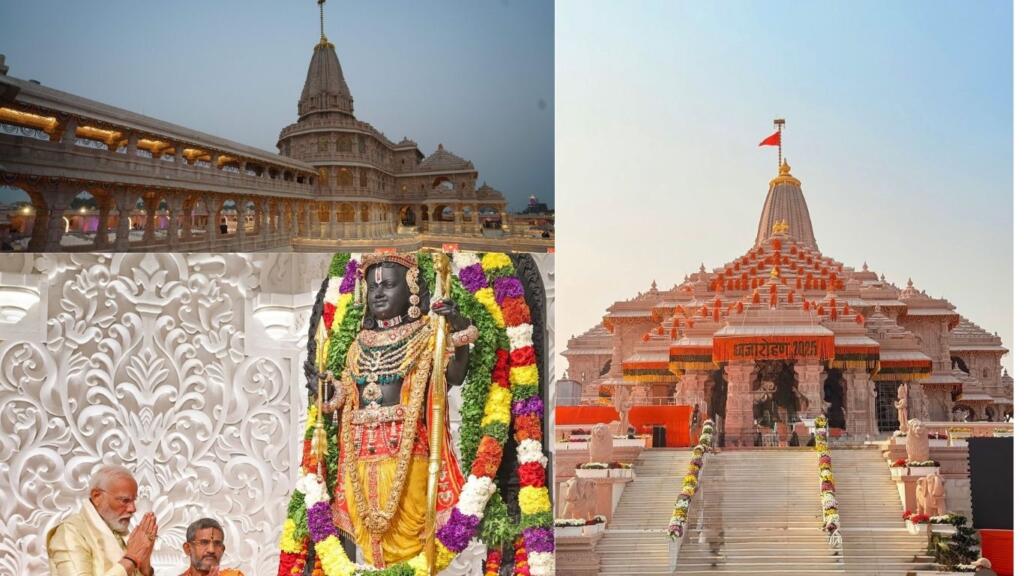
Ayodhya stands at the heart of India’s spiritual consciousness, and on Vivah Panchami one of Hindu tradition’s most sacred days the city enters a historic chapter that blends devotion, culture, and civilisational pride. Prime Minister Narendra Modi will today ceremonially hoist a monumental saffron flag atop the 191-foot shikhara of the Shri Ram Janmabhoomi Mandir, marking the symbolic completion of the temple’s construction. Hoisting the Dharma Dhwaj at precisely noon, during the auspicious Abhijit Muhurat associated with the divine union of Shri Ram and Mata Sita, is designed not merely as a ceremonial act but as a reaffirmation of India’s civilisational continuity.
Vivah Panchami, celebrated in the month of Margashirsha, is revered for its spiritual potency. In the Bhagavad Gita, Lord Krishna proclaims, “Among the months, I am Margashirsha,” underscoring its auspiciousness. In the Ramcharitmanas, Tulsidas calls the tithi the “root of all auspiciousness,” a time when the divine marriage of Sri Ram and Sri Sita sanctified the union of Ayodhya and Mithila. This year, the celebration takes on deeper meaning as the dhwaj symbolising Sanatan ideals rises skyward over the newly completed temple complex, speaking to centuries of devotion and the cultural revival that the moment represents.
Symbolism of the Sacred Dhwaj: Om, the Sun, and the Kovidar Tree
The saffron flag to be hoisted today is not merely an emblem it is a repository of sacred symbolism deeply intertwined with India’s spiritual traditions. Measuring ten feet in height and twenty feet in length, the dhwaj carries three profound symbols: Om, the Sun, and the Kovidara tree. Each of these motifs is rooted in the foundations of Sanatan culture.
The Om, placed at the centre of the flag, represents the primordial sound from which creation is believed to have emerged. It symbolises eternal consciousness, spiritual awakening, and the cosmic vibration that connects all beings. The Sun motif—central to the Suryavansh lineage into which Bhagwan Shri Ram was born symbolises radiance, valour, leadership, and righteous governance. Its presence on the dhwaj reflects the brilliance and tejas of Shri Ram, who is revered not just as a deity but as a model king embodying Dharma.
The Kovidara tree, historically associated with King Dashrath’s kingdom, adds yet another layer of cultural depth. According to tradition, the tree is a hybrid of the Mandar and Parijat species, created by Rishi Kashyap an early example of ancient plant hybridisation in India’s knowledge systems. Featured in the narratives of the Valmiki Ramayan, the Kovidara tree symbolises continuity between the epic era and the present, echoing the recognition of royal lineage when Lakshman identified Bharat’s chariot through its emblem.
Together, these three symbols present a unified message of dignity, unity, and cultural continuity values central to the concept of Ram Rajya and to the civilisational memory of the Indian subcontinent.
Prime Minister’s Pilgrimage Through Ayodhya’s Sacred Circuit
The Prime Minister’s visit today begins with an extensive spiritual itinerary, reflecting the sanctity of Ayodhya’s ancient sites and the saintly figures who shaped India’s spiritual foundations. At around 10 a.m., PM Modi will visit the Saptmandir, a cluster of temples dedicated to Maharshi Vashishtha, Maharshi Vishwamitra, Maharshi Agastya, Maharshi Valmiki, Devi Ahilya, Nishadraj Guha, and Mata Shabari personalities deeply woven into the Ramayana’s narrative tapestry.
This is followed by darshan at the Sheshavtar Mandir, after which he will proceed to the Mata Annapurna Mandir at around 11 a.m. The sequence of visits mirrors the traditional pilgrim route connecting the realms of sages, devotees, and divine figures associated with Shri Ram’s life.
The Prime Minister will then perform darshan and pooja at the Ram Darbar Garbh Grah, followed by darshan at the Ram Lalla Garbha Grah, the sanctum that now houses the deity in his rightful abode. Senior temple officials have noted that this moment symbolically marks the culmination of centuries of devotion, sacrifice, struggle, and cultural resilience that sustained the dream of rebuilding the Ram Mandir. As Nripendra Mishra, Chairman of the Temple Construction Committee, emphasised, the flag hoisting is “an announcement to devotees across the world that the temple is complete.”
At noon, the Dharma Dhwaj will be raised atop the magnificent shikhara constructed in the traditional Nagara architectural style. Standing 191 feet tall, the shikhara will now officially bear the emblem of Dharma, marking the sacred site’s completion. Surrounding the shrine is the 800-metre Parkota, built in South Indian temple tradition, showcasing the architectural diversity and unity of India’s sacred design philosophies.
A City Immersed in Devotion: Army-Assisted Hoisting and Cultural Atmosphere
In an unprecedented technical feat, the Indian Army will execute the ceremonial hoisting from ground level a first-of-its-kind operation in India for a flag of such scale and height. This complex task underscores not only the engineering prowess involved but also the shared sense of collective pride associated with the temple.
Across Ayodhya, the atmosphere is vibrant with bhajans, kirtans, and the continuous reverberation of Ramdhun playing through public address systems. Locals, devotees, and visitors alike are immersed in devotional fervour. Mayor Girish Pati Tripathi stated that the city is striving to embody the ideals of purity, divinity, and grandeur as it welcomes this historic occasion.
The temple complex itself is an architectural and cultural marvel. The outer walls depict 87 intricately carved stone episodes from the Valmiki Ramayana, while 79 bronze-cast episodes from Indian culture line the enclosure walls. Through these depictions, visitors journey through the life of Shri Ram and the broader sweep of India’s civilisational history transforming the temple into a living museum of cultural memory.
Senior RSS leader Ram Madhav called the ceremony the symbolic completion of “Mission Ram Temple,” a culmination of centuries of struggle and devotion. He noted that the Dhwajarohan traditionally marks the final stage of temple construction in Hindu ritual practice, making today’s event especially significant.
The day also holds multi-layered spiritual relevance. It coincides with the martyrdom day of Guru Tegh Bahadur, the ninth Sikh Guru, who meditated in Ayodhya for 48 hours in the 17th century. Later in the day, the Prime Minister will travel to Kurukshetra to inaugurate the ‘Panchjanya’ project dedicated to Lord Krishna’s sacred conch and visit the Mahabharata Anubhav Kendra further connecting the celebrations to India’s broader sacred geography.
Ram Rajya’s Symbolic Rise Over Ayodhya
As the saffron flag ascends the 191-foot shikhara of the Ram Janmabhoomi Mandir, India witnesses a defining moment of cultural resurgence and spiritual reaffirmation. The Dhwajarohan on Vivah Panchami is more than a ceremonial act it is a reminder of timeless values, unity, and the unbroken thread of civilisation that continues to guide the nation.
In the union of sacred symbolism the Om, the Sun, and the Kovidara tree in the architectural splendour of the temple, and in the collective devotion of millions, Ayodhya today stands as a testament to India’s enduring cultural soul. The hoisting of the Dharma Dhwaj signals not just the completion of a temple, but the renewal of a legacy, an affirmation of dharma, and the rise of a new cultural dawn over the sacred city of Shri Ram.